
Most engineering teams deploy Copilot and expect a 10x frontend boost, only to watch cycle times balloon due to context bloat and dependency locks. The trick isn't prompting better—it's restructuring your frontend boundary lines so AI agents can execute without destroying system integrity.
The Context Trap Walloping Enterprise Frontends
Engineering leaders are flooding their teams with generative tools, assuming faster code generation automatically translates to faster shipping. Yet, when developers feed thousands of lines of monolithic React state and legacy CSS into LLMs, the models struggle with context rot. Hallucinated props, conflicting dependency versions, and non-deterministic UI state changes follow instantly.
Without explicit architectural boundaries, generative AI creates technical debt faster than developers can review it. In fact, a controlled SDLC experiment revealed that AI-assisted code quality measured 21% lower when manual reviews and strong architectural controls were omitted (Source: Softensity, 2024). The real bottleneck isn't model intelligence—it's forcing AI to work inside coupled, unconstrained frontend monoliths that overwhelm context windows.
The C.O.R.E. Framework for Agentic Frontend Execution
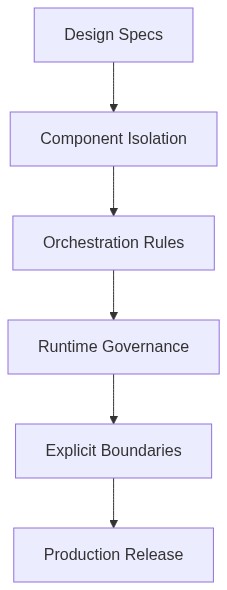
To prevent code collapse, enterprise frontends must adopt the C.O.R.E. Framework—a four-layer system designed specifically for AI-driven SDLC pipelines:
- Component Isolation: Enforce decoupled UI boundaries so AI agents generate localized features without touching global state.
- Orchestration Rules: Define strict schema contracts (TypeScript/GraphQL) that LLMs must validate against before submitting PRs.
- Runtime Governance: Deploy automated linting, compilation, and visual regression checks directly into the agentic loop.
- Explicit Boundaries: Isolate experimental AI features into independent build units to protect core platform availability.
When implemented effectively, explicit architectural governance allows teams to achieve incredible speed. A SaaS financial analytics platform using a hybrid human-AI SDLC cut its development cycle from 60 days to 30 days (a 50% efficiency improvement) while maintaining 99.9% availability and an average latency of 1.2 seconds (Source: Edumatic, 2024).
Micro-Frontends Are the Real Context Boundary
Think of a monolithic frontend as a giant city power grid: one bad wiring job by an AI agent blackouts the entire town. A Micro-Frontend (MFE) architecture operates like microgrids with automated circuit breakers, confining local AI edits to individual, safely isolated zones.
By decoupling heavy AI features—like conversational bots or dynamic prediction engines—into distinct micro-frontend units, organizations unlock massive performance and velocity gains. Experimental studies comparing MFE-AI setups to traditional monoliths showed a 60–90% reduction in build & deploy time, 22% faster NLP chatbot responses, and 30% faster AI dashboard predictions (Source: IJIRT, 2023). Furthermore, MFE architecture achieved ~40% more throughput under load and a ~20% improvement in reported UX (Source: IJIRT, 2023). Modular boundaries allow AI agents to parse smaller context windows, yielding cleaner, compile-ready code.
Autonomous Orchestration and Design-to-Code Pipelines
Modern frontend SDLCs expand far beyond simple code completion—they automate the pipeline from design mockups to micro-frontend orchestration. Consider the DAIMA orchestration engine, which uses reinforcement learning to manage micro-frontend bundles. It delivered a 30% improvement in page load times and a 40% reduction in dependency-related conflicts (Source: ESPJETA, 2023).
Simultaneously, autonomous design-to-code pipelines like AI4UI enable direct conversion from Figma to production-ready frontends, achieving an 87.1% compilation success rate, a 78.0% feature implementation rate, and a 73.5% code-review quality score (Source: arXiv, 2025).
Cross-functional impact is equally striking across the full development lifecycle. Softensity’s controlled experiment demonstrated that AI-driven requirement clarity accelerated product owner tasks by 76%, UX design by 45%, QA tasks by 41%, and frontend development speed by 13% (Source: Softensity, 2024). This resulted in a 62% reduction in defect density, a 38% faster lead time, and an estimated $10,374 in monthly savings per team (Source: Softensity, 2024).
Architectural Oversight Unlocks $48k in Hours
Eliminating engineering waste requires embedding architectural oversight directly into the AI toolchain. When AI agents evaluate codebases against structural best practices, they catch redundant abstractions before a single line hits production.
In a 21-day pilot across 5 core teams documenting 49 AI-enhanced SDLC use cases, HealthEdge logged 680+ hours of time saved across 53 active contributors (Source: HealthEdge, 2024). Crucially, a single AI architecture use case identified and eliminated $48,000 in direct business value by optimizing UI and database design in a matter of hours rather than weeks (Source: HealthEdge, 2024).
Tactics without architectural governance simply generate tech debt faster. By coupling micro-frontend isolation with agentic workflows, software organizations transform AI from a risky code generator into a disciplined, scalable execution engine.
Sources: HealthEdge blog, 'Building an AI-First SDLC: Lessons From Our Claude Pilot Program' (2024) | Softensity case study, 'Enhancing Quality and Efficiency in SDLC with AI Tools' (2024) | Edumatic: Jurnal Pendidikan Informatika, 'Hybrid Human AI SDLC for SaaS-based Financial Analytics Platform' (2024) | IJIRT paper, 'Micro-Frontend Architectures Enabling AI-Powered Web Applications' (2023) | ESPJETA journal, 'Implementing AI-Driven Micro-Frontend Architectures Using Reinforcement Learning and Graph Neural Networks' (2023) | arXiv preprint, 'Autonomous, Enterprise-Grade Frontend Development Systems' (2025)
No comments:
Post a Comment