
Most engineering teams test conversational AI like traditional software: they validate single-turn prompts, watch unit tests pass, and assume production will hold. In reality, isolated prompt evaluations conceal catastrophic context collapse, leaving systems unprepared for real human dialogue.
The Illusion of the Flawless Single Prompt
Engineering leaders routinely ship conversational agents after running static benchmarks that look pristine. The error lies in treating conversations as independent transactions. When evaluated in isolation, large language models generate fluent, logically sound answers. But conversational systems are not single-shot calculators; they operate as stateful feedback loops. Research spanning over 200,000 simulated conversations revealed that leading LLMs suffer an average 39% decline in task performance when transitioning from single prompts to multi-turn interactions (Source: Chatbot Evaluation: 3 Methods and 8 Metrics in 2026). When users pivot, contradict earlier constraints, or introduce ambiguity, the model's internal attention distribution degrades, resulting in hallucination and context drift.
The Real Problem Is Context Entropy
Your bottleneck is not model intelligence; it is context entropy. Think of a conversation as a game of telephone played with a single actor: with every turn, previous context is compressed, re-interpreted, and diluted. When real users interact with an assistant, they do not provide clean inputs. They change their minds, refer back to statements made four turns ago using ambiguous pronouns, and append extraneous constraints. In a typical failure mode, a user negotiating an account upgrade shifts to a billing issue; the bot attempts to merge both objectives, triggering logic failures. If your evaluation suite only feeds isolated prompts to an API, you are testing a showroom engine that has never experienced actual road friction.
The TRACE Verification Engine
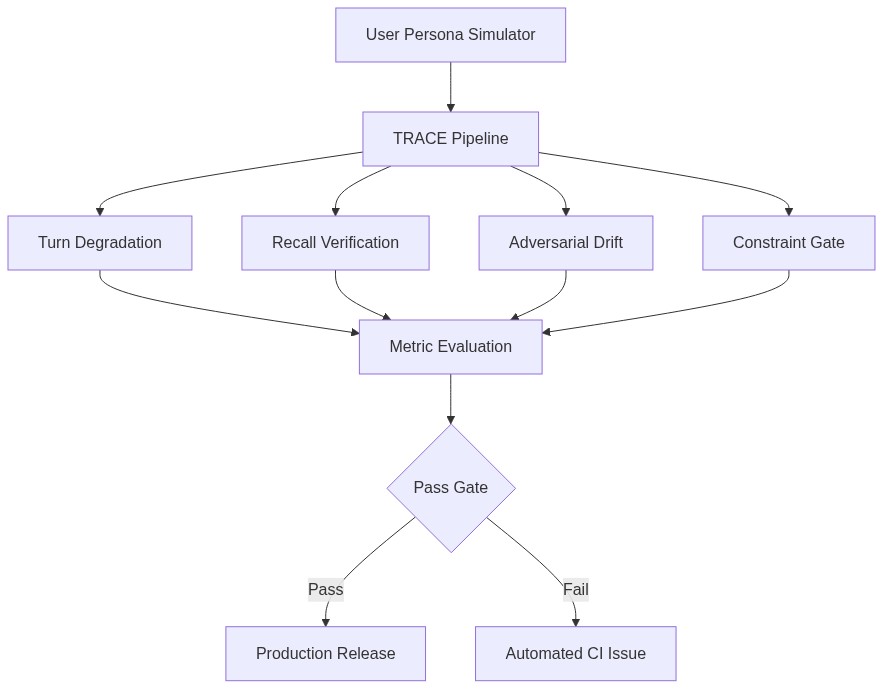
To prevent multi-turn breakdown, teams require a deterministic protocol rather than ad-hoc spot checks. The TRACE Framework systematizes chat testing across four non-negotiable vectors: Turn Degradation tracking, Recall Verification, Adversarial Drift testing, and Constraint Enforcement. Instead of subjective grading, TRACE simulates state progression across extended dialog trees. High-performing deployments validate resilience by scaling automated coverage: an enterprise pipeline utilizing automated test generation expanded endpoint coverage from 35% to 89% and slashed test authoring duration from 2 days to 2 hours, preventing breaking changes from reaching production for 6 months (Source: AI Testing Case Studies Collection). Of those generated suites, 72% proved immediately usable without manual intervention (Source: AI Testing Case Studies Collection).
Building the Autonomous Evaluation Pipeline
Implementing conversational testing requires separating synthesis from evaluation. First, deploy a synthetic user persona configured with varying frustration and ambiguity levels to drive multi-turn sessions. Second, funnel interaction logs into an evaluation layer that scores conversational coherence against golden datasets. Comprehensive benchmarking demands rigorous dimensionality: in a large-scale evaluation of an enterprise conversational assistant, applying 170 distinct evaluation metrics yielded a 98% pass rate across 167 verified criteria (Source: Beyond chat demos: evaluating LLM systems at scale with ...). Automated CI pipelines can simultaneously monitor diagnostics: targeted failure analysis on approximately 180 daily failed builds reduced mean diagnosis time from 23 minutes to 4 minutes while classifying 81% of failures correctly on the first attempt (Source: AI Testing Case Studies Collection).
From Flaky Demos to Mission-Critical Reliability
Building reliable conversational agents requires moving past aesthetic satisfaction toward verifiable boundary enforcement. A chat demo that dazzles stakeholders in a five-minute scripted trial is liabilities disguised as innovation if it fails under conversational strain. Rigorous multi-turn testing transforms AI from an unpredictable toy into mission-critical infrastructure. When you systematically stress-test conversational boundaries across hundreds of turns, you build software that earns human trust in the moments that matter most.
Sources: AI Testing Case Studies Collection | Beyond chat demos: evaluating LLM systems at scale with ... | Chatbot Evaluation: 3 Methods and 8 Metrics in 2026
No comments:
Post a Comment