
Most engineering teams deploy frontier models based on pristine headline benchmarks, only to discover their production bills balloon while actual reliability collapses. If you evaluate AI models using public scorecards instead of harness-aware telemetry, you are optimizing for a vanity metric that actively masks real-world failure.
The 80% Headline That Masks a 29% Reality
Engineering leadership loves a clean leaderboard metric. But headline numbers systematically obfuscate domain variance. Consider evaluations surfacing for Claude Fable: headlines tout a stellar 80.3% on SWE-Bench Pro, leading teams to assume near-human execution across all code challenges (Source: Actively seek out critical takes, documented failures, and skeptical ...). Yet when evaluated against FrontierCode Diamond, that performance plummets to just 29.3% (Source: Actively seek out critical takes, documented failures, and skeptical ...). Think of a modern model like a high-performance sports car tested strictly on a banked velodrome; the moment you steer it onto unpaved gravel, the performance breaks down. It is not that frontier models lack raw compute; rather, synthetic benchmarks reward hyper-specialized token paths that evaporate under novel environments.
The $11,000 Invoice for Unfinished Tasks
The real problem is not raw reasoning capability; it is behavioral friction and refusal cascading. During community trials on the WolfBenchAI benchmark, an evaluation run racked up $11,081.12 in API spend and still failed to secure top leaderboard status (Source: Claude Fable Review: The Most Capable AI Model Yet). The cause was not syntax errors or hallucinated APIs, but repeated refusals that aborted tasks mid-flight, forcing costly retries (Source: Claude Fable Review: The Most Capable AI Model Yet). When an autonomous agent hits a false-positive safety trigger, you do not just lose the output—you burn thousands of tokens in multi-turn overhead without closing the ticket. If your evaluation metrics ignore task-abort rates, your unit economics will collapse in production.
The 200-Task Harness Flaw
We often assume an evaluation evaluates the weights. In truth, an evaluation evaluates the harness. When the Agent Security League executed a 200-task re-evaluation switching to the Cursor harness, it produced a radically different result compared to baseline benchmarks on the exact same model (Source: Claude Fable 5.1: Features, Benchmarks, and Pricing - DataCamp). Isolating execution environments reveals how fragile synthetic scores really are. On Terminal-Bench-Science 0.1, the model logged a score of 52.6%, failing nearly half of the operational terminal interactions (Source: Claude Fable 5 & Claude Mythos 5 Benchmarks Explained - Vellum). Furthermore, anecdotal safety tests surfaced empty responses or forced fallbacks in over 70% of safety-related test cases (Source: Claude Fable 5: The Ultimate Guide for PMs v3). The container, the tool definitions, and safety guards dictate production outcomes far more than base parameters.
The SIFT Audit Framework
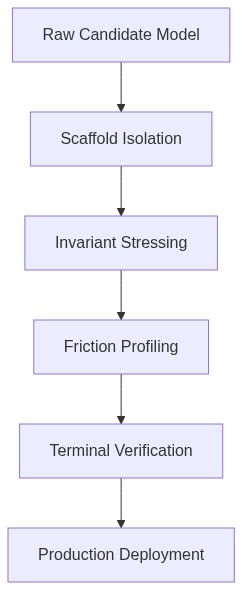
To decouple true agent utility from marketing benchmarks, stop running open-ended model bake-offs. Implement the SIFT Framework: a four-stage harness audit that stress-tests operational viability before signing an enterprise contract.
- Scaffold Isolation: Benchmark the model inside your custom agent harness, never the provider's native testbed (Source: Claude Fable 5.1: Features, Benchmarks, and Pricing - DataCamp).
- Invariant Stressing: Run specialized domain suites like FrontierCode Diamond to expose edge-case drop-offs below baseline (Source: Actively seek out critical takes, documented failures, and skeptical ...).
- Friction Profiling: Track safety refusal aborts and empty fallbacks across non-adversarial prompts to measure wasted compute (Source: Claude Fable Review: The Most Capable AI Model Yet, Claude Fable 5: The Ultimate Guide for PMs v3).
- Terminal Verification: Score against strict execution environments like terminal runners where task completion must exceed 50% (Source: Claude Fable 5 & Claude Mythos 5 Benchmarks Explained - Vellum).
Building Production Realism Over Benchmark Vanity
Deploying frontier AI is no longer about blindly trusting marketing scorecards or chasing paper gains. It demands treating model evaluations like high-stakes infrastructure testing. The teams shipping sustainable autonomous software do not care about curated launch-day figures. They evaluate runtime economics, harness resilience, and defensive guardrails under real workloads. True technical leverage comes not from adopting the most celebrated model of the week, but from mastering the harness architecture that keeps your systems reliable, cost-controlled, and resilient.
Sources: Claude Fable Review: The Most Capable AI Model Yet | Actively seek out critical takes, documented failures, and skeptical ... | Claude Fable 5 & Claude Mythos 5 Benchmarks Explained - Vellum | Claude Fable 5: The Ultimate Guide for PMs v3 | Claude Fable 5.1: Features, Benchmarks, and Pricing - DataCamp
No comments:
Post a Comment