Most engineers build AI agents like they hire interns: they grant broad permissions and hope the 'prompt' holds the line. But your bottleneck isn't the model's intelligence—it's the catastrophic failure of guidance. While 68% of organizations are racing to track skills, they are ignoring the fact that even the safest configurations execute unsafe actions 17% of the time (Source: Survey report insights: Global Skills Technology and Adoption, LLMSecurity/awesome-agent-skills-security). You don't need a smarter agent; you need the Skills and Guardrails Pattern.
The Prompt Is Not a Firewall
We have reached the limits of 'guidance.' In a massive study of 679 agent rule files, researchers found that positive instructions are far less effective than negative constraints. The reality is that prompts leak and models hallucinate when given too much creative freedom over system-level actions. Specifically, curated negative rules—like 'do not refactor unrelated code'—produced a 13.8 percentage-point gain in performance across 5,000 trials (Source: Guardrails Beat Guidance: A Large-Scale Study of Rules, ...). The root cause of agent failure isn't a lack of knowledge; it's the absence of a hard 'No.' Without explicit guardrails, you are essentially giving a high-speed engine to a vehicle with no brakes.
The 74% Inter-Skill Handoff Failure
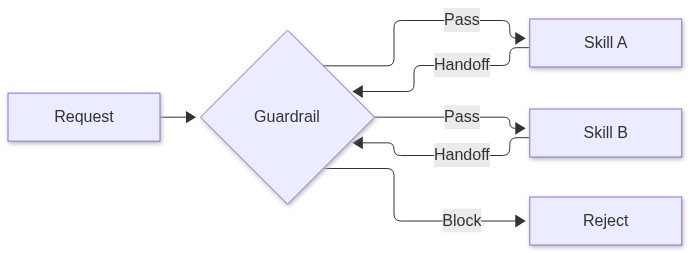
You might think isolating individual skills keeps you safe. It doesn't. Research into cross-skill attack vectors shows that malicious chains succeed 74.2% of the time when jumping between different actions (Source: LLMSecurity/awesome-agent-skills-security). However, when those actions are merged into a single, monitored skill unit, that success rate plummets to 17.4% (Source: LLMSecurity/awesome-agent-skills-security). This is the S.A.F.E. Framework (Segmented Action Functional Execution). Think of it like a submarine: individual bulkheads (skills) must be pressurized independently, or a single breach in a 'safe' third-party skill floods the entire system. Your agent’s vulnerability lies in the 'seams' between its capabilities.
The Weaponization of Third-Party Skills
Integrating externally sourced skills is the standard, but it introduces 'taint-style' vulnerabilities. In an assessment of 11 open-source agents, 104 such vulnerabilities were found, with 25.1% of trials leading to vulnerable execution paths (Source: LLMSecurity/awesome-agent-skills-security). Of these, 15 were fully weaponized through payload injection (Source: LLMSecurity/awesome-agent-skills-security). To implement the Skills and Guardrails pattern, you must treat every skill as 'untrusted' by default. This involves a three-step hardening process: 1. Capability Scoping, 2. Directional Security Mapping, and 3. Regression Testing. By exploring over 72,000 security directions, developers have achieved an 87% remediation rate for these exact risks (Source: faberlens/hardened-skills: 200 AI agent ...).
Architecture of the S.A.F.E. Pattern
The recommended approach is to decouple 'The Skill' (the ability to do work) from 'The Guardrail' (the authority to execute). This isn't just best practice; it's a structural necessity. Currently, 40% of organizations fail to link skills to concrete rewards or recognition, mirroring how technical teams fail to link agent skills to concrete execution limits (Source: Survey report insights: Global Skills Technology and Adoption). An effective implementation uses a 'Guardrail Proxy' that intercepts every skill call. Imagine a bank teller (the Skill) who can count money but requires a manager’s key (the Guardrail) to open the vault. If the manager isn't present, the teller's skill is inert.
Escaping the Sandbox of Mediocrity
Building with the Skills and Guardrails pattern isn't about restriction; it's about velocity. When you know your 'Hardened Skills' have a high remediation rate—specifically 87% against known regressions (Source: faberlens/hardened-skills: 200 AI agent ...)—you can deploy more agents into higher-stakes environments. The goal is to move beyond simple chatbots into agents that actually manipulate infrastructure. By shifting from 'vague guidance' to 'hard constraints,' you bridge the gap between experimental toys and enterprise-grade autonomous systems. Your purpose isn't to build a 'safe' AI; it's to build a 'useful' AI that is structurally incapable of being dangerous.
Sources: Guardrails Beat Guidance: A Large-Scale Study of Rules, ... | Survey report insights: Global Skills Technology and Adoption | LLMSecurity/awesome-agent-skills-security | faberlens/hardened-skills: 200 AI agent ...
No comments:
Post a Comment