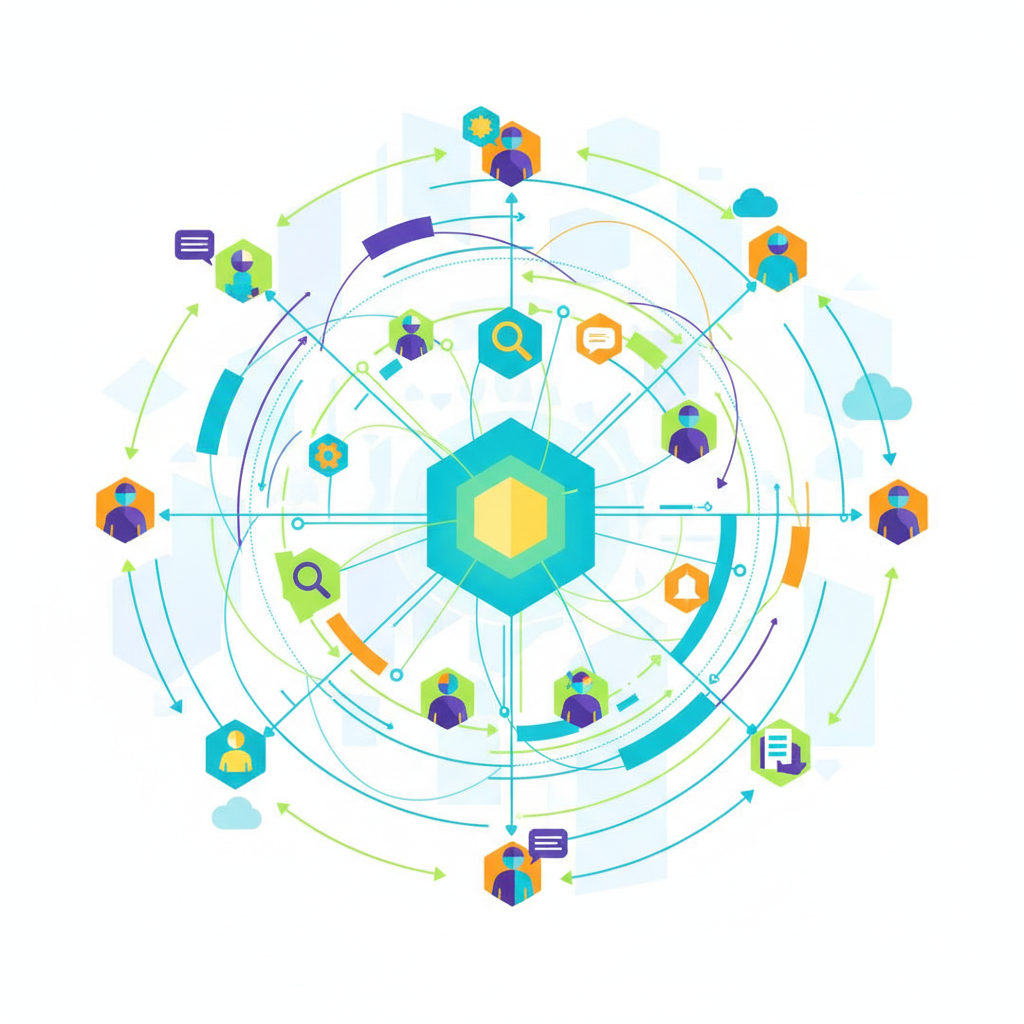
AI agent orchestration has evolved into a critical enterprise capability that coordinates multiple specialized AI agents to solve complex tasks more efficiently than single-agent systems. The field has undergone significant transformations, driven by advances in fine-tuning techniques, standardized communication protocols, and increasingly sophisticated orchestration patterns that enable organizations to scale AI deployments across their operations.
What Is AI Agent Orchestration?
AI agent orchestration is the process of coordinating multiple specialized AI agents within a unified system to efficiently achieve shared objectives.[5] Rather than relying on a single AI model, organizations deploy multiple agents—each with distinct capabilities—and use an orchestrator to manage their interactions.[5] This approach functions like a digital symphony, where each agent plays a unique role and a central coordinator ensures the right agent activates at the right time for each task.[5]
Multi-agent systems (MAS) emerge when multiple AI agents collaborate in either structured or decentralized ways to solve complex tasks.[5] The orchestrator helps synchronize these agents, optimize workflows, minimize errors, and enhance interoperability by dynamically allocating resources and responding to changing conditions in real time.[5]
Key Components of Modern Orchestration Systems
The Orchestrator Agent
The orchestrator agent serves as the central coordinator in multi-agent systems.[4] It receives incoming requests, analyzes what needs to be done, and decides which specialized agents should handle each part of the task.[4] When conflicts arise between agents, the orchestrator makes final decisions and keeps workflows moving smoothly.[4]
Agent Selection and Task Distribution
The orchestration platform identifies which agents possess the right capabilities for each component by evaluating agent availability, current workload, and performance history.[4] Work then gets divided among selected agents with clear instructions and priorities, with each agent receiving the specific information it needs along with context about how its work fits into the larger workflow.[4]
Real-Time Coordination
Agents maintain communication with each other and the orchestrator while working on assigned tasks.[4] They share progress updates, intermediate results, and any issues that arise during processing through communication protocols that maintain data consistency across the system.[4] This prevents conflicts and ensures smooth workflow execution.[4]
Orchestration Framework Architectures
Organizations can implement orchestration through three primary models:[1]
Centralized Orchestration places a single coordinator in control, assigning tasks, monitoring performance, and enforcing business rules.[1] This approach suits processes requiring tight control and clear visibility, such as compliance or finance operations.[1]
Decentralized (Distributed) Orchestration allows AI agents to operate more autonomously, communicating directly with each other and dynamically negotiating tasks and responsibilities.[1] This model proves highly adaptable and resilient for fast-moving environments such as logistics or supply chain management.[1]
Hybrid Models combine centralized oversight with decentralized agent communication, giving organizations the flexibility to scale while maintaining control where it matters most.[1]
Orchestration Patterns in Practice
Modern multi-agent solutions employ several orchestration patterns, often in combination, to address enterprise needs:[3]
- Sequential orchestration: Agents refine outputs step by step (e.g., document refinement workflows)
- Concurrent orchestration: Agents run in parallel and merge results, allowing independent analysis from multiple perspectives for tasks like risk assessment or quality assurance[3]
- Group chat/maker-checker: Agents debate and validate outputs together
- Dynamic handoff: Real-time triage or routing of tasks to appropriate agents
- Managerial orchestration: A manager agent coordinates all subtasks until completion[3]
Advanced Fine-Tuning Techniques
Recent advancements in fine-tuning have dramatically improved agent reasoning and decision-making capabilities.[2] As agent-based applications gained prominence, organizations increasingly demanded customization of reasoning models to encode domain-specific constraints, safety guidelines, and reasoning patterns aligned with intended agent functions.[2]
Key techniques include:
- Grouped-based Reinforcement Learning from Policy Optimization (GRPO): Enhances reasoning capabilities and became particularly notable in implementations like DeepSeek-V1[2]
- Direct Advantage Policy Optimization (DAPO): Enables more efficient and sophisticated agent reasoning while maintaining computational efficiency[2]
- Group Sequence Policy Optimization (GSPO): Supports scenarios requiring long text outputs in Mixture-of-Experts (MoE) model training by shifting optimization from token-level to sequence level[2]
These methods improve agents' performance in maintaining coherent plans, avoiding logical contradictions, and making appropriate decisions for domain-specific use cases.[2]
Standardized Communication Protocols
To ease agent orchestration in enterprises, open protocols are being developed to standardize AI agent interactions.[1] These include:
- MCP (Model Context Protocol)
- ACP (Agent Communication Protocol)
- A2A (Agent-to-Agent Protocol)
- ANP (Agent Network Protocol)
- AG-UI (Agent-User Interaction Protocol)
These protocols allow disparate tools and models to interoperate efficiently, avoiding vendor lock-in and simplifying future integrations.[1]
Enterprise Benefits
Organizations adopting AI agent orchestration report substantial improvements:
Efficiency and Automation: Orchestrated multimodal AI agents streamline entire business processes by coordinating across functions—for example, a telecom organization can synchronize agents across billing, fraud detection, customer support, and network management.[1] Automated decision-making cuts response times, eliminates data entry errors, and allows employees to focus on strategic tasks.[1]
Operational Speed: IBM reports that organizations using AI agent orchestration see 30% faster resolution times compared to single-agent approaches or manual processes.[4]
Customer Experience: By synchronizing agents across various functions and platforms, organizations deliver tailored responses, consistent omnichannel support, and real-time insights that boost satisfaction and productivity.[1]
Predictive Capability: Gartner predicts that by 2028, agentic AI will enable 15% of day-to-day work decisions to be made autonomously, and by 2029, agentic AI will autonomously resolve 80% of common customer service issues.[1]
Industry Applications
Organizations across sectors are leveraging agent orchestration:
- Finance: Automating transactions, enhancing fraud detection, and improving regulatory compliance
- Insurance: Automating claims processing, enhancing underwriting, and personalizing customer engagement
- Telecom: Coordinating billing, fraud detection, customer support, and network management
- Supply Chain: Optimizing logistics and responding to dynamic conditions in real time
Enterprise Platforms
Leading platforms enabling agent orchestration include IBM watsonx Orchestrate, which provides enterprise-grade security and compliance features, pre-built industry-specific agent templates, and seamless integration with IBM ecosystem and third-party systems.[4]
Future Outlook
The field of agent orchestration continues advancing rapidly. Organizations are embracing multi-agent orchestration to effectively align processes, tasks, and teams, boost productivity, reduce operational friction, and enable faster, smarter decisions at scale.[1] By deploying multiple agents across various functions, organizations improve flexibility, problem-solving capabilities, and overall resilience, making multi-agent orchestration an essential building block of enterprise AI.[1]

No comments:
Post a Comment