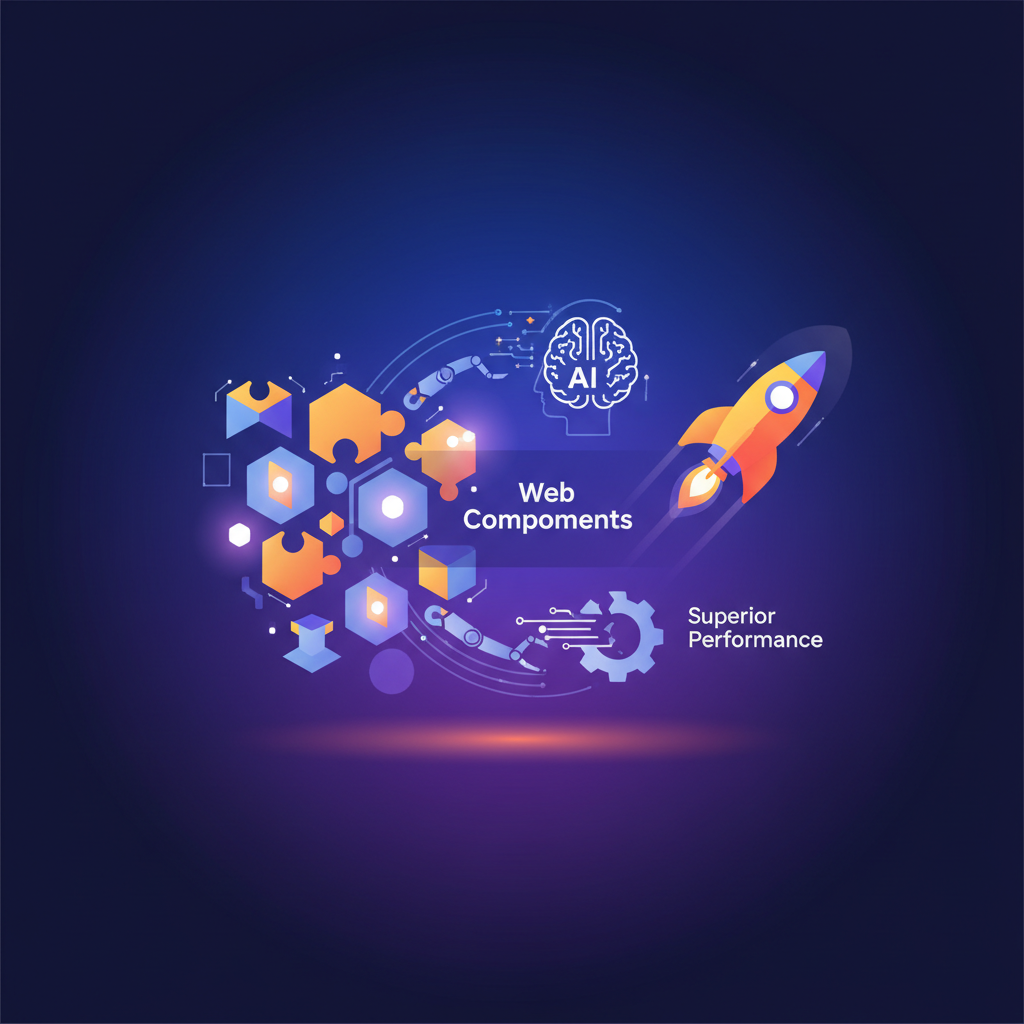
Web development without traditional build tools relies on Web Components—native browser standards for reusable, encapsulated UI elements—combined with AI to generate efficient, vanilla HTML, CSS, and JavaScript code that eliminates bundling overhead and boosts performance.[1][4]
The Shift Away from Build-Heavy Frameworks
Modern web frameworks like React, Vue, and Angular introduced build steps to manage complexity, but these create dependencies, bloat bundles, and technical debt as frameworks evolve or fade.[1] AI changes this by generating lean, standards-based code directly, bypassing builds entirely. Developers report building full SaaS apps in hours using pure web standards prompted via AI, resulting in faster loads, zero dependencies, and future-proof code that runs unchanged for decades.[1]
Web Components enable this "no-build" paradigm natively. They use Custom Elements, Shadow DOM, and HTML Templates to create self-contained components that work across frameworks or vanilla sites without tooling.[4] No transpilation, no bundlers—just ship HTML files to any server.
Core Advantages of No-Build Web Development with Web Components
- Lightning Performance: Avoids framework runtime overhead (e.g., React's virtual DOM reconciliation). Vanilla JS with Web Components hydrates minimally, leveraging browser optimizations for smaller payloads and instant interactivity.[1][4]
- No Dependencies or Lock-In: Code relies solely on web standards, immune to npm vulnerabilities or ecosystem shifts. AI handles state, routing, and DOM updates via simple patterns like Custom Events.[1]
- Simplified Deployment: Static hosting suffices—no Node servers for builds. Components are portable, embeddable anywhere without integration concerns.[4]
- Maintainability: Readable, framework-agnostic code reduces onboarding time. AI regenerates or refactors on demand, minimizing technical debt.[1]
Challenges exist: Web Components add minor Shadow DOM overhead in server-side rendering (SSR), requiring wrappers for hydration, though this is lighter than framework alternatives.[4]
AI's Role in Accelerating No-Build Workflows
AI bridges the "complexity gap" frameworks once filled by instantly producing:
- Responsive HTML structures and CSS grids.
- Vanilla JS for modals, tabs, state management, and API fetches.
- Custom Web Components for reusable UI (e.g.,
<my-nav-menu>).[1]
Prompt AI with specifics like "Generate a responsive dashboard Web Component using Shadow DOM and vanilla JS," yielding production-ready code. This "pair programming" with AI emphasizes clear communication over framework mastery.[1] In 2026 tools, AI generates entire layouts from text, editable visually without code.[2]
Visual platforms like WeWeb blend this: AI drafts Web Component-like UIs, with pro-code import for custom elements, decoupling frontend from backends for scalable apps.[2]
Performance Benchmarks and Real-World Gains
No-build apps load faster due to tree-shaking by default (no dead code) and native browser parsing. AI-generated code prioritizes critical rendering paths, outperforming bundled SPAs in Core Web Vitals.[1][2] For example:
| Metric | Framework SPA (e.g., Next.js) | No-Build Web Components + AI |
|---|---|---|
| Bundle Size | 100-500KB+ | <50KB |
| Time to Interactive | 2-5s | <1s |
| Dependency Count | 100+ | 0 |
| SSR Overhead | High (hydration) | Minimal (native) |
Enterprises favor this for micro-frontends, sharing components at runtime without redeploys.[2]
The Future: AI-Driven Performance Evolution
By 2026, AI makes no-build Web Components the default for high-performance web apps. Generative AI becomes standard for UI, logic, and optimization, targeting "pro no-coders" who mix visuals with custom code.[2] Expect:
- AI auto-optimizing components for edge computing and PWAs.
- Native browser AI enhancements (e.g., declarative Web Components with built-in inference).
- Hybrid tools evolving no-code into AI-assisted standards, with backend freedom.[2][3]
Developers thriving will master web fundamentals and AI prompting, building complex apps sans frameworks. Web Components aren't "the future" alone but excel when AI eliminates authoring friction, ensuring evergreen performance.[1][4] This returns web dev to its roots: simple, fast, universal.

No comments:
Post a Comment