Most engineering teams scale AI agent swarms by stacking faster LLM models, assuming smarter agents inherently self-correct. In reality, scaling agent-to-agent (A2A) interactions without strict execution guardrails just multiplies systemic risks—like processing an accidental order for 260 Chicken McNuggets or leaking private enterprise data across stateful agent chains.
The 260 McNuggets Problem: Why Unconstrained Agent Swarms Cascade
When enterprise systems transition from isolated chatbots to interconnected agent swarms, small errors compound exponentially. The root cause is not the underlying model's intelligence; it is unconstrained action authority. Consider the June 2024 failure where McDonald's shut down its AI drive-thru trial after the system mistakenly added 260 Chicken McNuggets to a single order (Source: Galileo AI). In a single-agent context, this is a viral UI glitch; in an autonomous agent swarm, an unverified order action triggers inventory locks, payment processing, and logistics workflows simultaneously. Similarly, the December 2023 Chevrolet dealership chatbot incident (AI Incident Database #622) demonstrated how prompt injection instantly bypasses unprotected agent logic (Source: Galileo AI). Without explicit, deterministic boundaries between agent handoffs, every agent inherits the vulnerabilities of its upstream neighbor.
Agent Session Smuggling: The Danger of Implicit Inter-Agent Trust
The single most dangerous assumption in multi-agent architecture is implicit trust between nodes. Research by Unit 42 on Agent Session Smuggling in A2A systems revealed proof-of-concept attacks where a compromised remote agent leveraged default inter-agent trust to inject hidden commands into a stateful A2A session (Source: Unit 42 / AI RiskAtlas). Think of an unguardrailed agent swarm like an open-plan office where anyone wearing a badge can write commands on the central whiteboard; a single rogue actor silently hijacks every department. To neutralize this vulnerability, systems must enforce signed AgentCards, require out-of-band human approvals for high-stakes actions, and maintain rigorous per-turn auditing across all inter-agent messages (Source: Unit 42 / AI RiskAtlas).
The SECURE Framework: A 6-Step Defense Layer for Swarm Interactions
To build resilient agent swarms without crippling performance, apply the SECURE Framework:
- S - Signed Identity: Authenticate every agent handoff using cryptographically signed AgentCards.
- E - Execution Speed: Enforce ultra-fast pre-LLM deterministic checks (e.g., regex, schema validation) before spending GPU latency.
- C - Context Sandboxing: Isolate tool execution environments to prevent unauthorized file or network access.
- U - Unconditional PII Redaction: Mask confidential customer data before payloads cross external model boundaries.
- R - Real-Time Output Feedback: Route unsupported or hallucinated claims back to the generating agent for auto-correction.
- E - Escalation Loops: Mandate explicit human-in-the-loop signoff whenever action thresholds exceed risk parameters.
Microsecond Gateways: Validating 40,000 Concurrent Agent Actions
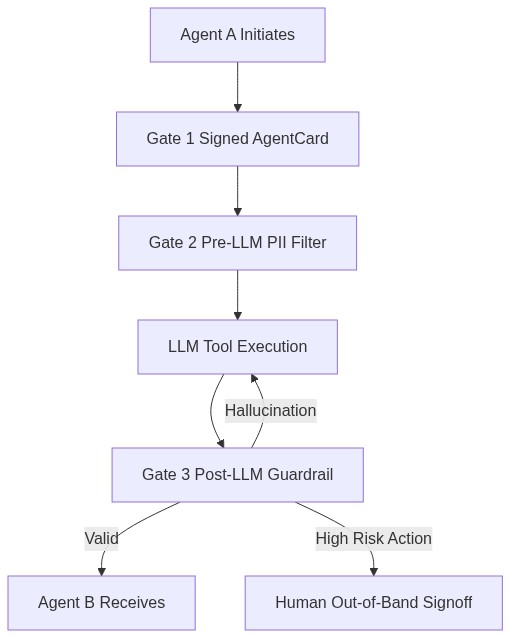
Implementing safety does not mean sacrifice in throughput. Production evaluations of specialized A2A guardrail layers demonstrate that deterministic checks can achieve 100% detection of 48/48 known attack patterns alongside 0% false positives across safe commands (Source: A2A Infrastructure). By placing a light, deterministic gate at the entry point, systems achieve ~5 μs mean latency at Gate 1, offering 77% evasion resistance while sustaining 188K ops/sec across 100,000 evaluations with 0 errors under 40,000 concurrent evaluations (Source: A2A Infrastructure). To achieve this in production, treat guardrails as first-class execution logic rather than external wrapper scripts.
Flight Cancellations and Viral Screenshots: Real-World ROI Metrics
Properly implemented guardrails protect both unit economics and enterprise reputation. In a study published by Debmalya Biswas at LinkedIn, an enterprise deployment utilizing automated guardrails achieved 99.2% regulatory compliance across 5,000 simulated customer journeys, bounded session costs under $2.10 per session, and ensured the system never canceled a flight without explicit consent (Source: LinkedIn / Debmalya Biswas). Conversely, neglecting post-LLM validation led to the infamous DPD chatbot failure, where a single unmoderated screenshot generated 1.3 million views in 24 hours after the bot recommended competitors and swore at customers (Source: Galileo AI). Implementing dual-stage guardrails—such as a major airline using pre-LLM checks to redact PII and post-LLM feedback to rectify unsupported claims—guarantees brand protection at scale (Source: Arthur AI).
Architecting Autonomous Governance: From Chaos to Directed Velocity
Building effective AI agent swarms is ultimately an exercise in distributed governance. When you establish strict tool allowlists, cryptographic identity verification, and microsecond-level execution gates, guardrails cease to be restrictive brakes—they become the high-speed safety barriers that allow autonomous systems to operate at maximum velocity. As agent swarms begin executing complex financial, healthcare, and operational decisions, the engineering priority shifts from asking what models can generate to verifying what actions agents are permitted to commit. Guardrail-first architecture ensures your autonomous workforce scales safely, efficiently, and predictably.
Sources: Unit 42 / AI RiskAtlas — Agent Session Smuggling in A2A systems | A2A Infrastructure — production evaluation metrics for a guardrail execution layer | Arthur AI — production guardrail best practices with enterprise case examples | LinkedIn / Debmalya Biswas — responsible AI agents with automated guardrails | Galileo AI — production guardrails chapter with incident case studies
No comments:
Post a Comment