
Most engineering teams building embedded UI widgets default to standard global state, only to find their widgets cross-contaminating data, polluting window namespaces, and leaking memory when unmounted. The real fix isn't sprawling Redux boilerplates or heavy Context wrappers—it's isolation-first state architecture using Zustand.
The $40k Micro-Frontend Trap: Why Global Stores Leak
When you embed multiple instances of a dashboard widget or ship a standalone UI module, the default impulse is to reach for a global Zustand store. It is fast, lightweight, and familiar. But global singletons carry a hidden cost: state bleeding. If a user mounts three identical analytical cards on a single page, a standard global store forces them to share the exact same state, causing user inputs in Card A to mutate Card B.
Developers attempt to fix this by adding complex instance-indexing logic (state.widgets[id].data), turning clean state trees into messy, deeply nested dictionaries. When the widget unmounts, stale keys remain in memory. The root cause is not React or Zustand—it is a fundamental mismatch between global store lifecycles and instance-based component lifecycles. To build truly resilient, standalone widgets, state lifecycle must strictly match element DOM lifecycle.
Stop Fighting Context: The SCOPE Framework for Isolated State
To build resilient widgets without state leakage, we use the SCOPE Framework, a 5-step blueprint for instantiating micro-stores on demand:
- Separate Concerns: Split server caching from transient UI state.
- Create Factory: Instantiate store instances via a factory function rather than a global singleton.
- Own the Subtree: Bind the factory instance to a React Context provider dedicated strictly to that widget subtree.
- Provide Selectors: Expose custom React hooks that consume the scoped context safely.
- Exit Cleanly: Ensure store destruction automatically triggers on component unmount to prevent memory leaks.
By leveraging this pattern, every mounted widget owns an isolated slice of memory that initializes on mount and completely disappears on unmount (Source: Alexey79, Dev.to, 2025).
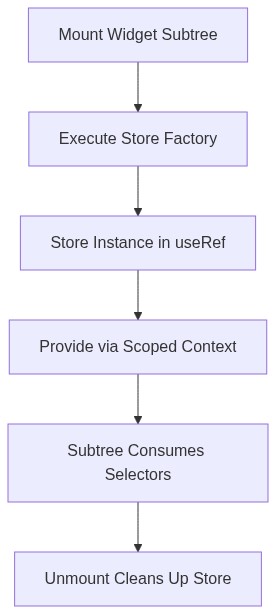
Under the Hood: React Context Meets Vanillajs Store Factories
Think of a traditional global store like a central community water tower. Every house tapping into it gets water from the exact same source; if one house dyes the water blue, everyone drinks blue water. A scoped store factory is like installing an on-demand filtration pump inside every individual house. Each house gets its own pure, independent supply generated the moment the front door opens.
To implement this, you pass a store creator function into a React Context. Instead of exporting useStore = create(...), you export createWidgetStore = () => createStore(...). The widget root component calls useRef to initialize this store once during mount, then passes the store instance into a local Vanilla Zustand Provider. Child components subscribe via custom hooks, bypassing global window pollution entirely while maintaining lightning-fast atomic selectors.
Real-World Proof: From Offline Mobile Apps to Live Dashboards
This isolation-first approach is already proven in production environments across various complex domains:
- Offline-First Mobile Apps: AddJam integrated Zustand for local UI state alongside React Query for server caching in a React Native app. By scoping local stores per feature screen, they minimized network requests while keeping offline UI controls fully responsive across independently mounted screens (Source: AddJam blog, March 20, 2026).
- Dynamic Dashboards: IGNEK engineered a weather dashboard coordinating search inputs, metric cards, and last-updated indicators. Metrics like temperature, wind speed, and direction are fetched via REST APIs into Zustand, allowing independent UI cards to render seamlessly (Source: IGNEK blog, 2025).
- Modular Enterprise Apps: Globant implemented a modular 'Library Store' architecture, decoupling auth, book catalog, and transaction widgets into small, focused stores that scale without Redux-level overhead (Source: Globant Medium, 2024).
Step-by-Step: Blueprinting a Self-Contained Shopping Widget
Let us walk through building an isolated, embedded shopping cart widget based on standard isolated UI patterns (Source: Zustand official site / Ricardo Gesteves, 2024):
Step 1: Define the Store Factory Create a function returning a vanilla Zustand store (createStore) containing items, item count, and toggle state.
Step 2: Create the Scoped React Context Establish a React context that holds the store instance reference, guarding it with a fallback error check.
Step 3: Wrap the Root Component Inside ShoppingCartWidget, use useRef(() => createCartStore()).current to guarantee stable reference instantiation across renders.
Step 4: Consume via Selectors Sub-components like CartSummary or ItemCount call useCartStore(state => state.items). When instance A updates, instance B remains untouched, preserving absolute UI boundaries.
Architecting for Scale: Scoped Widgets vs Global State
Choosing between global state, standard React Context, and scoped Zustand stores dictates your app's long-term maintainability. While standard Context causes unnecessary re-renders across subtrees, global stores risk name collisions and state pollution.
Scoped Zustand stores combine the best of both worlds: zero-boilerplate Context distribution with atomic selector subscriptions. The decision matrix is simple: if a component can appear multiple times on screen simultaneously, or if its state must die the moment it unmounts from the DOM, scope the store. Reserve global stores strictly for application-wide session settings, user auth, or global theme preferences.
The Strategic Imperative: Clean Boundaries Build Resilient Systems
State management is not merely about tracking variables—it is about defining clear architectural boundaries. As frontend architectures lean heavily toward micro-frontends, embedded widgets, and modular dashboards, the capability to encapsulate state becomes a core engineering superpower.
By adopting store scoping patterns, you eliminate entire classes of bug reports: ghost state on re-navigation, memory leaks in long-lived single-page apps, and accidental cross-talk between UI instances. You empower your team to ship composable, self-contained UI modules that can be dropped into any environment with total confidence. Clean isolation today means effortless scalability tomorrow.
Sources: Alexey79, 'Stop Fighting Zustand & Context: Practical Store Scoping Patterns for React', Dev.to, 2025 | AddJam blog, 'React Native Offline Data with React Query and Zustand', March 20, 2026 | IGNEK blog, 'Creating a Dynamic Dashboard with React, Zustand', 2025 | Globant Medium article, 'React State Management — using Zustand', 2024 | Zustand official site 'Examples' / Ricardo Gesteves, 'Zustand: When, How, and Why', Dev.to, 2024
No comments:
Post a Comment