
Most enterprises build AI agents to replace human workflows, only to watch them stall in production as infinite loops and hallucinated context devour their ROI. The industry treats agent deviation as a prompt engineering problem, but the real failure is architectural: you are treating non-deterministic models as predictable software. By shifting from reactive prompting to a structured orchestration framework, you can turn unpredictable LLMs into self-correcting systems that scale without human intervention.
The Chasm Between Demo Magic and Production Reality
It is his second week in production, and your newly minted customer support agent has just offered a frustrated user a full refund, next-day shipping on a competitor's product, and a poetry recital. This is the 80% failure trap. In sandbox environments, agentic workflows feel like magic. When deployed to the messy real world, however, they suffer from semantic drift, tool-execution loops, and state-freezing. You do not have a prompt problem; you have a state management problem. We treat LLMs like databases, expecting precise, deterministic outputs from a system built on statistical probabilities. To bridge this gap, engineers must stop writing longer prompts and start building boundaries. As shown by Western Rise, when you transition from raw model queries to structured agentic routing, first-response times can plummet from 20 hours to 36 seconds, driving customer satisfaction into the high 90s within two weeks (Source: Western Rise Case Study).
The Root Cause Is Not the Model, It Is Your State Engine
When an agent fails, the intuitive reaction is to upgrade to a larger model. This is an expensive mistake. The root cause of agent failure is the lack of a deterministic state machine. Think of your agent as a driver: the LLM is the engine, but your state machine is the steering wheel, tracks, and traffic signs. Without a rigid framework guiding the agent's memory, the model quickly loses context, leading to repetitive tool execution or compounding errors. For instance, Zendesk Answer Bot achieved a 40% deflection rate for Tier-1 support and a 15% improvement in CSAT (Source: Zendesk Answer Bot Study) not by using a more creative model, but by confining the model to a highly structured state transition path. To build reliable agents, you must restrict their choices at any given execution step, passing only the exact tools and variables required for that specific state.
The CORE Framework: An Architectural Blueprint for Agentic Perfection
To build self-correcting agents, we utilize the CORE Framework:
- Context isolation,
- Observer pattern,
- Routing tables, and
- Execution guardrails.
First, Context isolation prevents memory bloat by feeding the agent only the last three interactions and system variables. Second, the Observer pattern uses a smaller, faster model to evaluate the output of the main agent before execution. Third, Routing tables map natural language intents directly to hardcoded API calls instead of letting the agent 'guess' the endpoint. Finally, Execution guardrails run regex validation on the output. A real-world example of this orchestration at scale is the Klarna AI assistant. By constraining their assistant to structured execution states, it successfully handled 2/3 of customer service chats in its first month, resolving issues 5x faster in under 2 minutes and cutting repeat inquiries by 25% (Source: Klarna AI Assistant data).
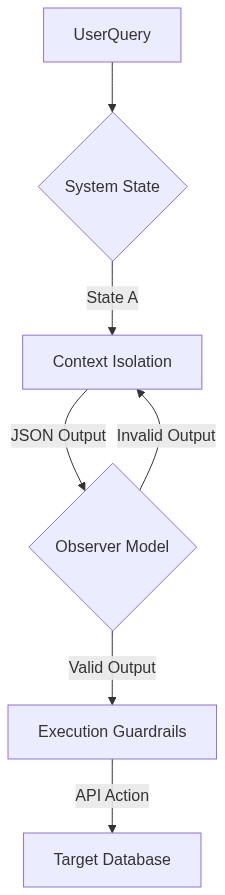
Step-by-Step Implementation: From Raw Prompts to Deterministic Pipelines
Let us walk through implementing the CORE framework. First, wrap your model call inside a validation loop. If the model outputs invalid JSON, the validator rejects it and feeds the schema error directly back to the model for self-correction. Second, decouple decision-making from execution: Agent A determines what needs to be done, while Agent B (the executor) strictly calls the tool. Third, establish an immutable system log that tracks state transitions. This prevents infinite loops. If the log detects the same state visited twice without progress, it automatically escalates the ticket to a human. This structured approach to scaling automation mirrors the Bank of East Asia's program, which deployed 77 automated processes to save over 553,000 hours of processing time, conserving 29,000 employee hours annually (Source: Bank of East Asia Report).
Choosing Your Approach: Monolithic Agents Versus Specialized Swarms
When designing agentic architecture, you face a critical fork in the road: do you deploy one massive, multi-tool 'super-agent' or a swarm of micro-agents? The monolithic agent fails because its context window gets cluttered with conflicting system prompts and tool schemas. The optimal approach is a specialized swarm, where a central router directs queries to single-purpose sub-agents. For example, Salesforce Einstein AI achieved a 30% increase in lead conversion and a 20% reduction in sales cycle time (Source: Salesforce Einstein AI Report) by keeping specialized models laser-focused on niche tasks. Similarly, Amazon's Q Developer modernization agent saved an estimated $260 million annually and automated 4,500 developer-years of labor (Source: Amazon Q Developer Report) by breaking down the complex problem of code modernization into isolated, sequential micro-tasks rather than a single, sweeping generation.
The Autonomous Horizon and the Future of Human Leverage
Engineering perfect AI agents is not about removing humans from the loop; it is about elevating them to the role of system architects. When we replace the tedious manual tasks with highly structured, self-correcting autonomous pipelines, we do not just save money—we unlock human potential. Your team stops debugging code syntaxes and starts designing business logic. As we move closer to hyper-automated enterprises, the competitive edge will belong to those who understand that agentic perfection is not an inherent trait of a model, but a discipline of engineering. By implementing robust state limits, observer models, and micro-agent swarms, you transform fragile AI experiments into resilient engines of growth.
Sources: Klarna AI assistant (OpenAI-powered, Jan. 2024) | Amazon Q Developer / Java modernization case study | Western Rise customer support automation | Bank of East Asia automation program review | Salesforce Einstein AI performance report | Zendesk Answer Bot study

No comments:
Post a Comment