
Most enterprises treat AI automation as a series of isolated prompt chains, only to watch their error rates compound into operational gridlock. The asymmetric advantage belongs to those who deploy decentralized, neural-network-driven agent meshes that self-correct in real time.
The Fragile Script Trap That Breaks Enterprise Automation
Traditional business process management relies on rigid 'if-then' code. When a customer inquiry diverges or an invoice schema shifts, linear systems stall, dumping exceptions onto human teams. The root problem is not model intelligence; it is structural rigidity. Linear automations lack the dynamic routing and state-awareness required for non-deterministic enterprise tasks. Think of a rigid script as a single train track: one obstruction halts the entire network. A neural-network-driven agent architecture functions like an air-traffic control system, where specialized nodes continuously reroute, evaluate, and resolve edge cases dynamically. When an enterprise replaces rigid pipes with self-orchestrating agent loops, brittle points transform into resilient learning nodes.
The L.O.O.P. Framework for Autonomous Business Engines
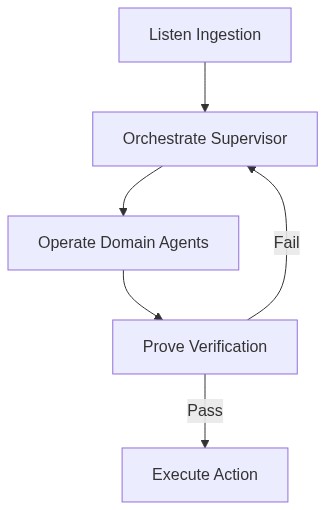
To build an autonomous operational core that does not degrade, deploy the L.O.O.P. Framework: Listen, Orchestrate, Operate, and Prove. First,
- Listen: multimodal neural ingestion models classify unstructured inputs (emails, tickets, logs) into semantic intent vectors. Second,
- Orchestrate: a supervisor neural network routes the task to specialized sub-agents based on context and confidence thresholds. Third,
- Operate: domain agents execute scoped actions against underlying APIs, ERPs, and databases. Fourth,
- Prove: a verification agent validates the output against compliance policies and deterministic business logic before execution. This separation of reasoning from execution ensures high throughput while eliminating hallucination cascades.
The Cost of Isolation: How a Single Agent Failure Redesigned the Core
A fast-scaling B2B platform once deployed a monolithic agent to handle end-to-end procurement. When the single agent misinterpreted ambiguous supplier discounts, it triggered over $50,000 in incorrect purchase orders within hours. The fix was not a larger model, but a distributed multi-agent mesh. By decomposing procurement into specialized agents—one for parsing, one for policy compliance, and one for final dispatch—systemic errors dropped to zero. Similar architectural shifts yield massive enterprise results: a global chemical company completely replaced its legacy BPO and reduced costs by 63% using specialized agent automation (Source: Beam AI). Specialization within a neural network mesh builds deterministic guardrails around probabilistic models.
Quantified Velocity: Scaling Front-Office and Back-Office Meshes
Agentic neural networks deliver exponential returns when deployed across both high-volume intake and precision back-office workflows. In hospitality, Limehome deployed 6 AI agents to automate 5,750+ guest interactions monthly without human intervention (Source: Beam AI). In supply chain logistics, a German manufacturing company automated 96% of order updates by decoupling ERP data fetching from customer-facing notifications (Source: Beam AI). Meanwhile, Booth cut candidate screening time by 70% using agentic routing (Source: Beam AI). Document-heavy operations mirror these gains: Thomson Reuters achieved a one-third average reduction in time spent on document review, research, and drafting (Source: Thomson Reuters), while Deloitte increased analyst efficiency by more than 60% in security operations (Source: Deloitte).
Step-by-Step Blueprint: Deploying Your First Neural Agent Mesh
Building this architecture starts with bounded autonomy.
- Step 1: Map the Topology. Identify high-frequency workflows and break them into discrete, single-responsibility roles (e.g., Ingestion, Reasoning, Validation).
- Step 2: Establish the Neural Router. Implement a central orchestrator using semantic embeddings to evaluate input ambiguity before dispatching tasks.
- Step 3: Enforce Deterministic Tooling. Equip agents with strict schema-validated API toolkits rather than open-ended execution permissions.
- Step 4: Implement Asynchronous Reflection. Add a secondary evaluator model that benchmarks generated responses against compliance rules.
- Step 5: Human-in-the-Loop Thresholds. Configure confidence scoring: any task with a neural confidence score below 85% routes instantly to human operators, with the human resolution fed back into fine-tuning sets.
From Automated Tasks to the Self-Optimizing Enterprise
Automating tasks is simply table stakes; the ultimate frontier is organizational compounding. When your business operates as a network of autonomous, self-correcting neural agents, institutional knowledge stops decaying in static SOPs and starts living inside executable, adaptive architectures. Every interaction, resolved exception, and operational edge case permanently upgrades the operational baseline of the entire company. You transition from managing human fatigue to directing scalable machine intelligence, freeing human capital to focus entirely on novel strategic leverage, product innovation, and high-empathy relationships.
No comments:
Post a Comment