
Most teams spend months fine-tuning prompts and adding retrieval tools, only to watch their agents hit a hard performance ceiling in production. The mistake is treating agents as static software artifacts rather than self-evolving species. By implementing a continuous feedback-evolutionary engine, you turn every production error into permanent system-level fitness.
The Production Ceiling Is Not a Prompting Flaw
When an agent fails in production, the standard reaction is rewriting the prompt or adding more context. This creates brittle, bloated prompts that fail unpredictably on edge cases. The real root cause is not model capability; it is the absence of a closed runtime selection pressure. Biological systems do not survive by hardcoding responses to every predator; they maintain genetic memory and iterate against environmental feedback. If your agent treats every run as an isolated transaction, it cannot compound intelligence. Real-world benchmarks expose this gap: on the live Prophet Arena benchmark over a 10-week horizon, a static agent decays, whereas an online evolutionary loop for memory updates improved the Brier score by 20.8% and lifted market returns by 12.9% (Source: Live-Evo). Without evolution, your agent suffers architectural entropy.
The Four Levels of Runtime Agent Adaptation
To understand how agents evolve, compare them to self-correcting code in an operating system. Level 1 is simple execution without memory. Level 2 uses episodic verbal feedback, seen in systems like Reflexion, which logs verbal critiques after failed tasks, and Self-Refine, which critiques and revises within a single inference run (Source: Self-Refine / Reflexion family). Level 3 moves from output patches to plan updates. Consider CuGEdit, which operates as a feedback-conditioned decision interface, translating critiques directly into rewritten downstream plans rather than localized edits (Source: CuGEdit). Level 4 is population-level evolution, seen in architectures like AlphaEvolve, LLaMEA, and Absolute Zero, where automated evaluators screen candidate agent variants across continuous generations (Source: AlphaEvolve / population-loop systems).
The EVOLVE Blueprint for Autonomous Fitness
Building an evolutionary system requires a disciplined pipeline. We use the EVOLVE framework: Execute baseline workflows, Verify outputs via automated oracles, Optimize memory using failure reflections, Leverage mutation operators to generate candidate plans, Validate in sandboxed population tournaments, and Embed winning traits into long-term skill libraries. Consider a concrete failure: an agent attempting automated scientific data analysis repeatedly fails due to unhandled sensor anomalies. Instead of human debugging, the system triggers the loop: the failure log is converted into an episodic critique, mutated into a defensive parsing skill, evaluated against regression suites, and published to global memory.
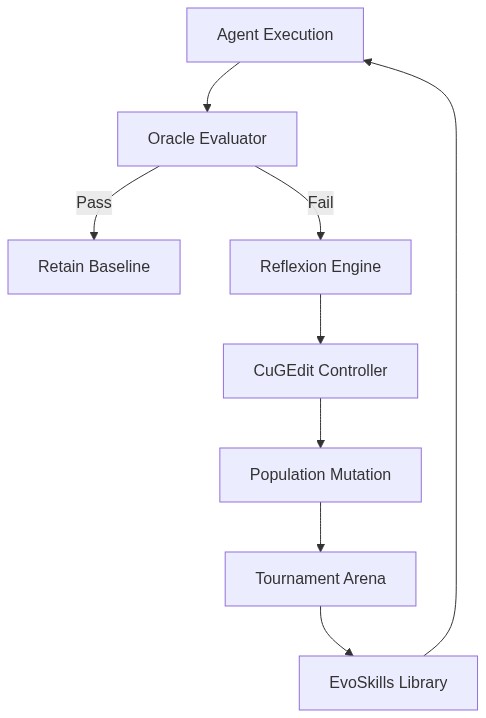
How Dynamic Skill Trees Reach Flawless Oracle Coverage
The true test of an evolutionary loop is whether improvements transfer across diverse models. Consider EvoSkills: in an Exoplanet Transit Period Detection case study, an agent evolved its skill bank across iterations from Version 1 to Version 4, ultimately hitting 100% ground-truth oracle coverage (Source: EvoSkills). Furthermore, EvoSkills secured the highest pass rate among five baselines on SkillsBench across Claude Code and Codex, while successfully generalizing its evolved capabilities to six additional LLMs (Source: EvoSkills). When you evolve modular skills rather than rigid prompts, you create model-agnostic capabilities that survive underlying infrastructure migrations.
Architecting the Closed-Loop Discovery Engine
This architecture mirrors the modern scientific method. In systematic agentic science frameworks like The AI Scientist and AlphaProof, progress is driven by a continuous tri-part engine: hypothesis generation, automated experiment execution, and feedback-driven refinement (Source: Agentic science / closed-loop experimentation). When selecting your evolutionary strategy, avoid single-agent self-critique for mission-critical paths because single models harbor blind spots. The recommended approach is an automated population-loop evaluator paired with a feedback-to-plan controller. This separates the generation of strategies from objective fitness scoring, preventing degenerate feedback loops.
The Shift from Prompt Engineering to Cognitive Ecology
We are moving past the era of hand-crafted prompts into an era of cognitive ecologies. When you deploy agents equipped with feedback-evolutionary architectures, you stop managing fragile scripts and start curating fitness landscapes. Your role shifts from writing rigid rules to defining rigorous objective functions, verifiers, and environmental constraints. By building agents that learn from their own failures, refine their own code, and compound their own memory, you construct autonomous systems capable of continuous self-directed discovery.
Sources: Live-Evo: Online Evolutionary Memory Retrieval on Prophet Arena | EvoSkills: Continuous Skill Evolution for LLM Agents on SkillsBench | Self-Refine & Reflexion Survey on Agentic Memory and Output Editing | CuGEdit: Feedback-Conditioned Decision Interface for Self-Evolving Agents | AlphaEvolve & Population Loop Benchmarks: LLaMEA, DGM, SPIN, Absolute Zero | Systematic Survey on Agentic Science: The AI Scientist & AlphaProof
No comments:
Post a Comment