
Most professionals assume high-stakes execution requires relational peace, waiting for domestic calm before pursuing ambitious goals. In reality, letting your life's work stall during emotional turmoil creates a compounded failure mode where both your purpose and your partnerships collapse simultaneously.
The Dangerous Myth of Emotional Preconditions
When interpersonal conflict erupts, human instinct triggers a freeze response around long-term ambition. We tell ourselves we cannot build wealth (Artha) or master our craft (Dharma) while our domestic foundation is shaking. But waiting for total relational serenity is a mathematical trap.
Relational friction is frequently systemic rather than personal. A 2024 review in PMC notes that modern marriages face deep strains from horizontal imbalances in fairness and justice as well as vertical imbalances in emotional and material resources (Source: PMC 2024 Review). When external pressures disrupt stability, halting your core responsibilities does not heal the bond—it merely strips you of agency. The classical Indian philosophy of *Purushartha*—the four integrated aims of life: Dharma (duty), Artha (economic security), Kama (pleasure/relationships), and Moksha (inner freedom)—was designed specifically as an operating system for turbulent times, not a fair-weather luxury.
The Submarine Compartment: Why Decoupling Is Survival
Consider a naval submarine operating under hostile conditions. When a single hull compartment breaches and takes on water, the crew does not flood the remaining chambers in sympathy; they seal the bulkhead doors immediately to maintain propulsion and oxygen.
Your psyche requires the exact same structural boundary. Interpersonal trauma belongs to the realm of Kama, but allowing it to flood Artha (your financial production) and Dharma (your ethical duty) ensures total structural sinking. As teacher Sadhguru observes, relational suffering is an internal projection carried by the individual rather than an absolute property of the external conflict (Source: Sadhguru Talk). By diagnosing that your relational friction is an isolated chamber, you preserve the core energy needed to execute your daily disciplines regardless of domestic turmoil.
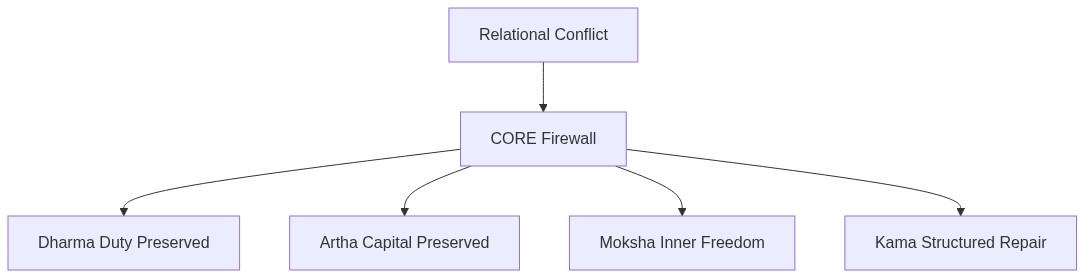
The 4-Vector Purushartha Firewall Framework
To prevent emotional chaos from eroding professional output, implement the CORE Isolation System—a systematic approach designed to run your four aims as decoupled, parallel processes rather than an interdependent chain.
- Compartmentalize Artha: Lock high-leverage work into non-negotiable morning blocks before addressing personal messaging or disputes.
- Obligate Dharma: Tie daily duties to absolute standards rather than transient emotional willingness.
- Restructure Kama: Treat relational friction through structured problem-solving rather than reactive emotional venting.
- Elevate Moksha: Maintain a baseline of inner detachment, understanding that external dynamics never define internal sovereignty.
This system ensures that emotional volatility in one vector never cross-contaminates your material stability or mental health.
The Dubai Migration Fracture: Anatomy of a Systemic Failure
Examine the documented Rahmaa case study of a newly married husband who migrated to Dubai for employment immediately following his wedding (Source: Rahmaa Case Study). The abrupt geographical and structural shift triggered immediate, severe relational strain between the newlyweds.
The critical failure occurred when the structural stress of economic migration (Artha) collided unmanaged with the marital bond (Kama). Without compartmentalization, the relational fracture began paralyzing the individual's focus on the very professional mission that caused the move.
Similarly, research on non-traditional live-in relationships in India reveals friction cascading across family, workplace, housing access, legal documentation, and sibling marriage prospects (Source: Practical Philosophy Analysis). The root cause is almost never a lack of commitment; it is the failure to insulate functional life domains from social and structural cross-pressures.
The 70% Recovery Metric: The Power of Structured Containment
Maintaining disciplined execution during conflict does not mean abandoning the relationship to deteriorate. Counterintuitively, sustaining your individual stability creates the grounded environment required for relational repair.
Data from Emotionally Focused Couple Therapy (EFCT) proves that severe relational strain is highly reversible when addressed through systematic structures rather than chaotic reactions. Research by Johnson and Talitman (1997) documented a 50% improvement in relationship quality immediately post-treatment and a 70% recovery rate at 3-month follow-up among participating couples (Source: Johnson and Talitman 1997 / 2022 Review).
When you stop demanding that your partner regulate your personal purpose, you de-escalate tension. You operate from a position of functional surplus rather than emotional bankruptcy.
Transcendence Through Relentless Duty
Ultimately, your life's purpose cannot be held hostage by interpersonal weather. Relational dynamics will fluctuate across seasons of alignment, tension, repair, and transformation. If your financial discipline and creative output are conditional on external harmony, you have surrendered your fundamental agency.
Purushartha is not a theoretical model for an idealized existence; it is an ancient, battle-tested technology for human sovereignty. By honoring your Dharma and Artha through the storm, you construct an unshakable foundation. You achieve the ultimate realization of *Moksha*—not by escaping the reality of human relationships, but by standing complete and purposeful in the midst of them.
Sources: Johnson and Talitman (1997) EFCT Study (2022 Review) | PMC Review on Couples Therapy and Fairness (2024) | Rahmaa Long-Distance Marriage Case Study | Practical Philosophy Analysis of Indian Relationship Dynamics | Sadhguru Discourse on Relationship Suffering

No comments:
Post a Comment