
Most engineering teams attempt to scale LLM automation by feeding larger context windows into a single, high-reasoning model—and then wonder why production tasks choke on latency, hallucinate, and drain budgets. The real bottleneck is not model capability; it is sequential execution overhead. By replacing single-agent loops with a phased, fan-out/fan-in sub-agent architecture, you unlock parallel execution speeds that outpace monolithic prompts by up to 90.2% on benchmark accuracy while slicing processing times from days to hours.
The Context Window Fallacy and the Latency Wall
When automated workflows stall, developers usually reach for larger context windows or costlier models. This is the context fallacy. In a monolithic run, an LLM handles planning, data retrieval, tool calling, and verification sequentially. A single logic mistake at minute four poisons all subsequent tokens.
Think of a monolithic agent like a lone general contractor who insists on pouring concrete, wiring circuits, hanging drywall, and inspecting the plumbing entirely alone. If the wiring fails, the drywall is ruined. Phased execution, by contrast, operates like a modern assembly line: specialized workers execute in parallel within strict quality gates.
Anthropic proved this architectural shift: pairing a lead agent with Claude Opus 4 alongside Claude Sonnet 4 sub-agents outperformed a solitary Claude Opus 4 agent by 90.2% on internal research evaluations (Source: Anthropic research evaluation [8]). Specialization beats sheer model scale.
The 3-Tier Fan-Out/Fan-In Architecture
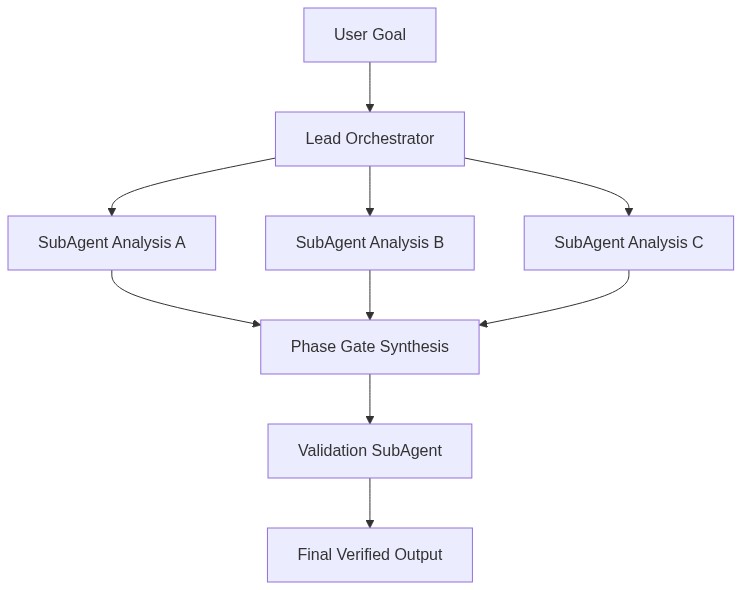
To build lightning-fast systems, you must decouple workflow stages into distinct execution barriers. We call this the PAR System (Partition, Actuate, Reconcile).
- Partition (Lead Orchestrator): A heavy reasoning model parses the objective, decomposes tasks into independent payloads, and provisions dedicated sub-agents.
- Actuate (Parallel Workers): Lightweight, focused sub-agents execute simultaneously without shared context interference. Fan-out removes sequential lag.
- Reconcile (Synthesis Gate): Outputs fan back into a validation layer that verifies schemas, resolves conflicts, and produces the unified deliverable.
Consider an AI Crossroads weekly bug-triage system: spawning 7 sub-agents in parallel—each taking 2–5 minutes—allowed the team to complete discovery in a wall-clock time of roughly 5 minutes. End-to-end triage dropped to 25–40 minutes instead of half a day (Source: AI Crossroads / Claude Code [10]). Parallel fan-out collapses wall-clock runtime to the duration of the slowest worker.
The 50,000-Line Codebase That Migrated in 8 Hours
Consider what happens when you apply structured, phased gating to massive software rewrites. A legacy 50,000-line Next.js codebase faced a full type-safety migration—a manual marathon estimated at 6 days of engineering labor (Source: Next.js migration case study [2]).
Instead of handing the repository to a single autonomous agent, the team deployed a 3-phase pipeline:
- Phase 1 (Analysis): 20 parallel agents scanned component trees, categorizing untyped surfaces.
- Phase 2 (Fixes): 10 parallel agents implemented strict TypeScript definitions across assigned modules.
- Phase 3 (Validation): 5 parallel agents executed unit tests and build validations.
The entire migration finished in 8 hours—an 18x speedup. It delivered an 82% reduction in any types with 0 new bugs introduced (Source: Next.js migration case study [2]). Phased boundaries eliminate hallucination cascade because bad code never crosses into the validation phase.
From Content Audits to Localization: The Operational ROI
Phased orchestration is not reserved exclusively for deep code migrations; it equally transforms operational workflows where human review normally stalls delivery.
In digital marketing operations, agency content audits historically required 8 hours. By orchestrating sub-agents across research, competitor gap analysis, and keyword mapping, the run dropped to 1.5 hours—an 81% time reduction saving $325 per audit at standard $50/hour billables. A parallel campaign-analysis workflow similarly shrank from 16 hours to 4 hours, recovering $600 per campaign in operational overhead (Source: Digital marketing sub-agent orchestration [18]).
Similarly, cross-market publishing across Japanese, English, Chinese, and Spanish collapsed from 2–4 hours down to 12 minutes—up to 20x faster—earning a 4.2/5.0 satisfaction score from native reviewers (Source: Multi-language documentation sync [2]). When sub-agents run independently, language-specific translation barriers execute concurrently without context cross-contamination.
The Anatomy of a Failed Agent Run
Before adopting the PAR System, teams often fall into the 'Chatty Sub-Agent Trap.' In an unphased architecture, sub-agents are allowed to query one another ad-hoc across a single global message bus. This causes exponential token bloat, race conditions, and deadlocks.
One enterprise migration attempt stalled because worker agents argued over linting configurations inside a continuous loop, exhausting rate limits within 40 minutes while producing zero commits. The root failure was unmanaged agent autonomy.
To prevent this, enforce Strict Phased Gating: sub-agents must never communicate peer-to-peer. They receive bounded context from the orchestrator, write strictly typed JSON to an isolated state branch, and terminate. The orchestrator alone evaluates the schema before initiating the next phase. This design transforms nondeterministic chaos into a clean, reproducible state machine.
Architecting Autonomous Systems for Deterministic Speed
The future of software automation is not larger prompts; it is precision orchestration. When you trade monolithic agent loops for phased sub-agent topologies, you solve the fundamental trilemma of enterprise AI: speed, cost, and correctness.
You stop treating generative models as creative conversationalists and start treating them as stateless compute functions executing inside a distributed pipeline. The gains—whether 18x speedups on deep system migrations or 90.2% gains in output quality—are structural advantages ready to be unlocked today.
Designing these systems forces you to clarify your exact operational standards. Once codified into deterministic phases, your agents don't just work faster—they run with a level of rigor and reliability that human teams alone could never sustain.
Sources: Anthropic multi-agent research system [8] | Next.js type-safety migration [2] | AI Crossroads / Claude Code subagents workflow [10] | Digital marketing sub-agent orchestration [18] | Multi-language documentation sync [2]
No comments:
Post a Comment