
Most professionals treat frontier AI models like ad-hoc search boxes, retyping baseline instructions dozens of times each day only to receive bloated, generic text. The asymmetric advantage belongs to those who deploy an immutable, structured default instruction across Claude, Gemini, and Perplexity—turning unpredictable chats into an automated, highly disciplined research and reasoning pipeline.
The Illusion of Model Superiority
When an answer fails to hit the mark, our reflex is to blame model capability and hop to another provider. But the root cause is rarely the neural network; it is structural drift. According to cross-platform prompting evaluations, the way you structure your ask matters as much as what you are asking (Source: Cross-Platform Prompting Guide). Treating enterprise LLMs like open chat windows causes variance, hallucinations, and stylistic fluff.
Think of frontier models like high-performance race cars: if you do not lock the steering rack and calibrate tire pressure before turning the key, horsepower simply drives you into the barrier faster. Without a universal default instruction enforcing constraints, context, and format, you force the model to guess your baseline expectations on every single turn.
The Cross-Platform Ecosystem Split
The biggest failure pattern is attempting to use a single monolithic assistant for every cognitive task. Industry benchmarks clearly define distinct model strengths: use Perplexity for sourced searches, Claude for deep reasoning, and Gemini to work across Google Workspace contexts (Source: 2026 AI Model Comparison). When you force Claude to discover raw web URLs or demand Gemini synthesize multi-agent web verification from scratch, quality collapses.
Practitioners frequently fail by tasking Claude with fresh real-time retrieval without citations, producing stale, confident assertions. Conversely, querying Perplexity for pure conceptual refactoring ignores its primary strength in real-time cross-referencing. Maximizing leverage requires matching your unified prompt architecture to the specific cognitive profile of each engine.
The ROCCO Universal Architecture
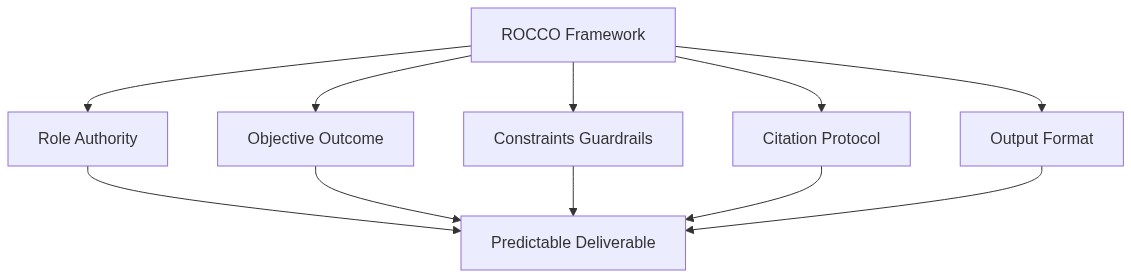
To build a robust default instruction that functions natively across disparate engines, apply the ROCCO framework. Instead of micromanaging execution steps, industry practitioners recommend defining outcomes and deliverables rather than policing the exact method (Source: Perplexity Computer Review). ROCCO organizes default prompts around five immutable pillars:
Role: Set clear authority and functional domain. Objective: Specify the exact required outcome without micromanagement. Constraints: Ban fluff, corporate buzzwords, and hand-waving. Citation Protocol: Define grounding requirements for claims. Output Formatting: Lock structural hierarchy and tone.
Deploying ROCCO transforms vague requests into predictable executions across reasoning, workspace retrieval, and real-time research tasks.
Calibrating ROCCO to Engine Archetypes
While ROCCO provides a universal backbone, each provider requires tailored emphasis. In Perplexity, the citation parameter must command direct link verification to leverage multi-agent workflows and source-page reading (Source: Perplexity Computer Review). For Claude, weight the framework toward deep analytical critique, demanding counterfactual exploration and logical pressure tests.
For Gemini, tie the framework to ecosystem synthesis across enterprise Google files and multi-modal documents. A concrete worked example for Gemini: Role: Enterprise Operations Lead; Objective: Reconcile project updates across Workspace drives; Constraints: No assumptions on missing data; Citations: Link active Drive documents; Output: Markdown discrepancy matrix. The core framework remains static, but the operational leverage aligns with model strengths.
Testing Default Instructions Against the Quad-Vector
Never deploy a system instruction permanently without verification. Evaluators validate prompt effectiveness by running a standardized control prompt and scoring responses across four empirical dimensions: depth, structure, creativity, and factual accuracy (Source: Cross-Platform Prompting Guide).
Run an ambiguous reference challenge—such as analyzing market entry risks—through your baseline configuration. If the output surfaces vague bullet points instead of quantified trade-offs and verified sourcing, your constraints are too weak. Tighten the constraint field, enforce explicit deliverable criteria, and run the benchmark again until responses remain uniform regardless of user query phrasing.
The Shift From Chatting to Cognitive Engineering
Standardizing your default instructions across tools is not an exercise in administrative formatting; it is a foundational upgrade in how you think alongside machines. When you anchor your cognitive tools with structured constraints, you eliminate the cognitive friction of repetitive prompting and elevate human focus to high-level strategy and decisive action.
As AI workflows increasingly shift toward autonomous task delegation, the professionals who succeed will not be those who type conversational messages. They will be the architects who establish rigorous operating protocols, leveraging each engine's distinct competitive edge to think, verify, and execute with absolute clarity.
Sources: Cross-Platform Prompting Guide | 2026 AI Model Comparison | Perplexity Computer Review

No comments:
Post a Comment