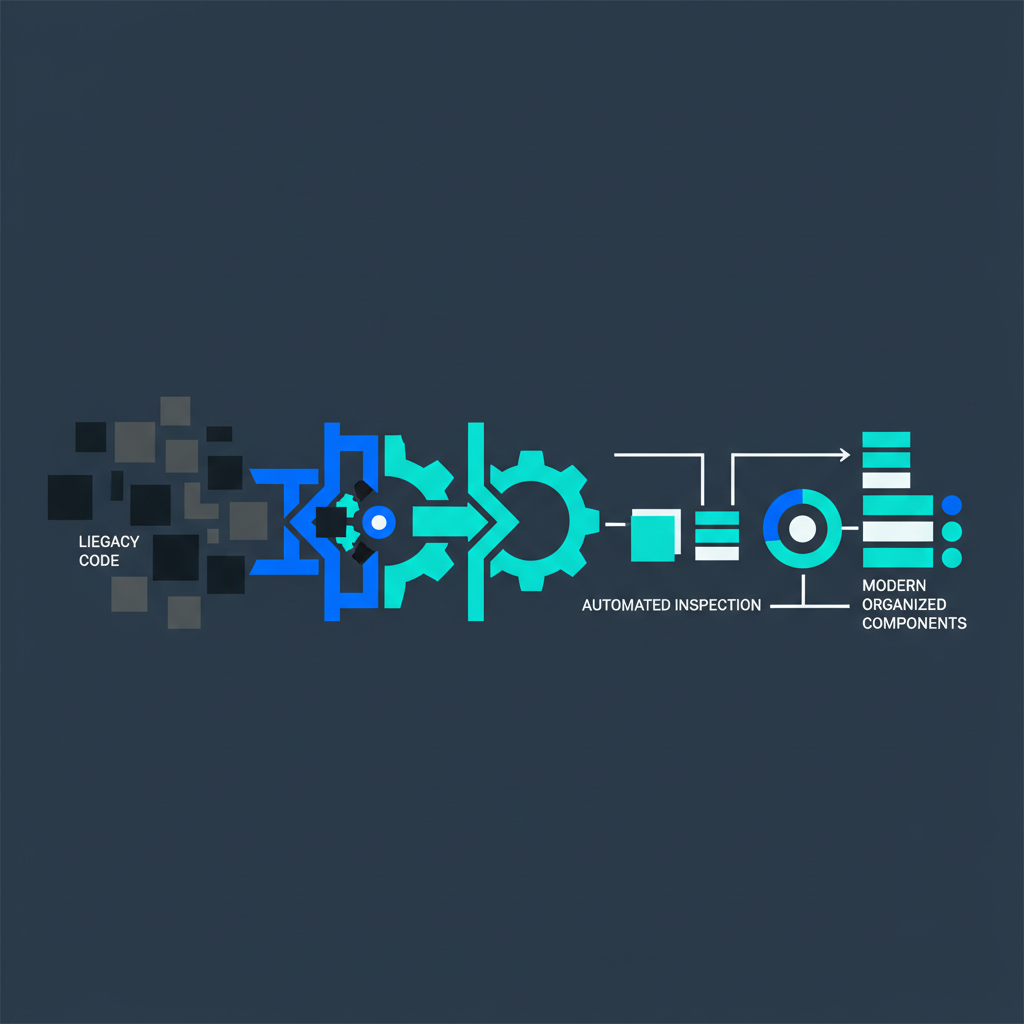
Most engineering teams hand an LLM their legacy codebase, paste a giant migration prompt, and pray for clean PRs—only to drown in silent regressions and uncompilable hallucinations. The real bottleneck is not the model's intelligence; it is the utter absence of an operational execution boundary.
The Illusion of the One-Shot Migration
Engineering leaders treat modern large language models like senior staff engineers who intuitively understand cross-module dependencies. They feed a 10,000-line monolithic service into a context window and expect a flawless rewrite. This one-shot mindset is why automated refactoring initiatives frequently stall: the model hallucinates external APIs, drops boundary assertions, and produces code that looks syntactically pristine while breaking under edge cases. It is like hiring a fast typist to rebuild a transmission without an assembly manual; speed without verification is simply accelerated technical debt. Root failure does not happen in generation—it happens when you ask the model to plan, code, and verify simultaneously without guardrails.
The Four-Stage PAVE Architecture
To de-risk legacy refactoring at scale, elite teams treat LLMs not as autonomous engineers, but as deterministic execution engines inside a strict harness. Enter the PAVE Framework:
- Pinpoint (inventory and leaf-node dependency mapping),
- Author (constrained, atomic AST-aware transformation),
- Verify (automated compilation and deterministic regression suites), and
- Execute (canary rollouts and telemetry auditing). By breaking the migration into discrete, verified chunks, you eliminate context drift. Every migration job must transition through explicit gates before hitting a human reviewer.

Mapping the Invisible Leaf Nodes
Before writing a single line of target code, you must construct an explicit dependency graph. Migrating top-down creates compounding errors: if your core abstractions change under the hood, every upstream AI-generated patch becomes obsolete. When Salesforce tackled their Apex-to-Java migration, they utilized a dependency-graph-driven, leaf-to-root AI refactoring approach. Instead of a monolithic shift, they migrated 275 Apex classes across 3,537 files, compressing a projected 2-year migration into just 4 months (Source: Salesforce Case Study). Identifying dependencies first ensures the AI transforms only self-contained leaf units, proving that architecture discovery must always precede automated code generation.
Transformation Under Tight Harnesses
Once dependencies are mapped, the transformation stage runs on narrow, bite-sized tasks rather than holistic file rewrites. During Google's JUnit3 to JUnit4 migration, engineers strictly bound the LLM to focused structural shifts, converting 5,359 files and 149,000+ lines in 3 months, achieving 87% of AI-generated code committed without modification (Source: Google Case Study). Across 39 internal migrations, Google documented that 74.45% of code changes and 69.46% of edits were LLM-generated, yielding an estimated 50% time reduction (Source: Google Case Study). When the AI handles only tightly constrained patterns, its accuracy scales massively.
The Arithmetic of Automated Verification
Human review cannot be your primary test harness. If an engineer must manually audit every generated method, review fatigue guarantees subtle bugs slip into production. During the Google Ads 32-bit to 64-bit ID migration, AI authored roughly 80% of the code modifications, yielding 50% end-to-end time savings because rigorous compilation and unit test loops caught breaking mutations immediately (Source: Google Case Study). Similarly, Google reported 89% estimated time savings on their Joda time migration by leveraging AI to pinpoint impacted code and enforce dependency validations prior to landing changes (Source: Google Case Study). Machine-speed coding demands automated gates.
Enterprise Modernization as a Competitive Moat
When institutionalized correctly, migration ceases to be a multi-year engineering tax and transforms into an agile operational capability. Amazon deployed this systematic modernization across 30,000 Java applications, saving approximately 4,500 developer-years and capturing $260M annualized gains, while collapsing average upgrade effort from 50 developer-days down to hours (Source: Amazon Case Study). Systematic AI migration frees high-leverage engineers from modernization drudgery, unlocking permanent speed and allowing teams to focus on core product innovation rather than historical preservation.
Sources: Google internal migrations case study (39 migrations) | Google Ads 32-bit to 64-bit ID migration report | Google JUnit3 to JUnit4 migration analysis | Google Joda time migration overview | Amazon Java modernization with Q Developer report | Salesforce Apex-to-Java enterprise migration summary
No comments:
Post a Comment