
Most people assume building an autonomous life-orchestrator requires a $200 monthly budget in proprietary API calls. The counterintuitive truth is that you can build an enterprise-grade personal routine agent for zero dollars—if you stop treating free models like toys and start architecting them like specialists.
The Context-Window Trap Costing You Hours
Most productivity agents collapse because of context rot. You hand a bot your messy calendar, 90-day task history, and evolving morning habits, only for its context buffer to truncate your operational state into hallucinations. You do not need a paid frontier model to fix this. OpenRouter maintains a catalog of 25 free models (Source: OpenRouter free-model filter snapshot, 2026), several of which carry massive enterprise-scale windows. For instance, Qwen3 Coder (free) and Nemotron 3 Ultra (free) each feature a 1M-token context window (Source: OpenRouter catalog review, 2026). When your agent can ingest 6 months of daily habit logs without dropping a single edge case, your bottleneck shifts entirely from token capacity to architectural discipline.
Your Failure Is Orchestration, Not Model Intelligence
When developers attempt a free routine agent, they usually hit a hard ceiling: an empty loop where the bot misinterprets a calendar event and silently halts. In an early implementation inspired by conversational assistant architectures, builders attempted to pipe unstructured morning check-ins directly into single-shot prompts, causing tool execution to trigger rate limit crashes (Source: Creating Free, Local AI Agents with OpenRouter, Ollama, and CrewAI). The root cause is never model capability; it is the absence of role separation. You cannot ask a single free endpoint to ingest telemetry, reason through trade-offs, and generate JSON actions simultaneously. High-throughput open-weight power exists—MiniMax M3 (free) handles 5.5T tokens/week, while Nemotron 3 Ultra (free) processes 3.9T tokens/week (Source: OpenRouter usage metrics, 2026). Reliability comes from chaining these specialized powerhouses.
The Tri-Model Switchboard: Treat LLMs Like Air Traffic Controllers
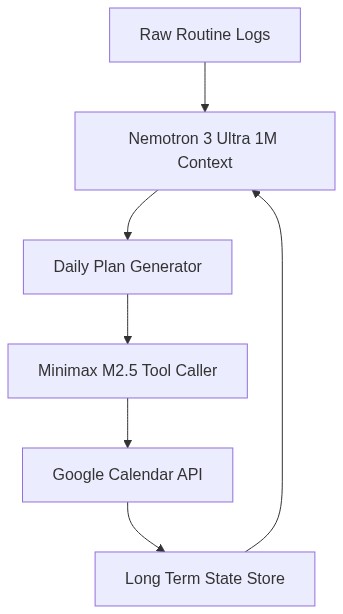
Think of a high-functioning routine agent not as an all-knowing oracle, but as an airport control tower. The control tower does not fly the aircraft, load baggage, and pour coffee. It routes telemetry to dedicated ground crews. In our architecture, the 1M-context model functions strictly as the air traffic controller, scanning the entire operational horizon. A specialized tool-caller acts as the runway manager, formatting strict API payloads. Finally, a lightning-fast conversational tier delivers the pilot briefing. OpenRouter’s empirical findings show that modern workflow reliability stems from agentic inference paired with targeted open weights (Source: OpenRouter State of AI 2025). By decoupling state synthesis from execution, free infrastructure matches premium reliability.
The S-P-A-R Framework for Autonomous Life Routines
To build an unbreakable agent, deploy the SPAR Framework: Synthesize, Plan, Act, and Reconcile.
- Synthesize: Feed your raw task logs and health metrics into a high-context orchestrator. Nemotron 3 Ultra (free) leverages its 1M context to spot schedule conflicts across weeks (Source: Teamday free-model guide, 2026).
- Plan: Generate a deterministic schedule prioritized by biological energy curves.
- Act: Hand the schedule to a functional agent model like Minimax M2.5:free or Owl Alpha to produce clean tool calls for your calendar API (Source: Lamjinlab guide, 2026).
- Reconcile: Log completion states back to long-term memory for tomorrow's synthesis loop.
Navigating the 20-RPM Barrier Without Breaking Code
Deploying free models requires respecting operational ceilings. OpenRouter enforces a rate limit of 20 requests per minute on free tiers, capped at 50 daily requests for accounts with under $10 in credits, though funding an account with at least $10 expands capacity to 1,000 daily requests (Source: OpenRouter limits review, 2026). For a routine agent executing morning briefings and evening debriefs, 50 requests per day is plenty if you batch calls. Pair CrewAI with Chainlit for interactive review (Source: Creating Free, Local AI Agents with OpenRouter, Ollama, and CrewAI). Implement exponential backoff wrappers around your API client, and set the system to fall back automatically across Laguna S 2.1 (free)—which logs 1.4T tokens weekly—if your primary tier experiences network congestion (Source: OpenRouter usage metrics, 2026).
From Reactive Task Checking to Cognitive Sovereignty
Building your own routine agent on sovereign, accessible infrastructure is not merely an exercise in saving subscription fees. When you outsource your executive function to commercial black-box applications, your daily attention is shaped by third-party engagement algorithms and opaque system prompts. Constructing an automated routine system with open endpoints returns intentionality to your schedule. Your agent enforces boundaries you consciously established, orchestrates tasks around your biological peaks, and preserves your privacy. The tools are completely free; the only barrier remaining is your willingness to architect them.
Sources: OpenRouter Free-Model Filter Snapshot (July 2026) | OpenRouter Usage Metrics Audit (2026) | OpenRouter API Limits & Access Review (2026) | Teamday Free-Model Guide (2026) | Lamjinlab Agent & Automation Model Guide (2026) | OpenRouter State of AI 2025 Study | Creating Free, Local AI Agents with OpenRouter, Ollama, and CrewAI

No comments:
Post a Comment