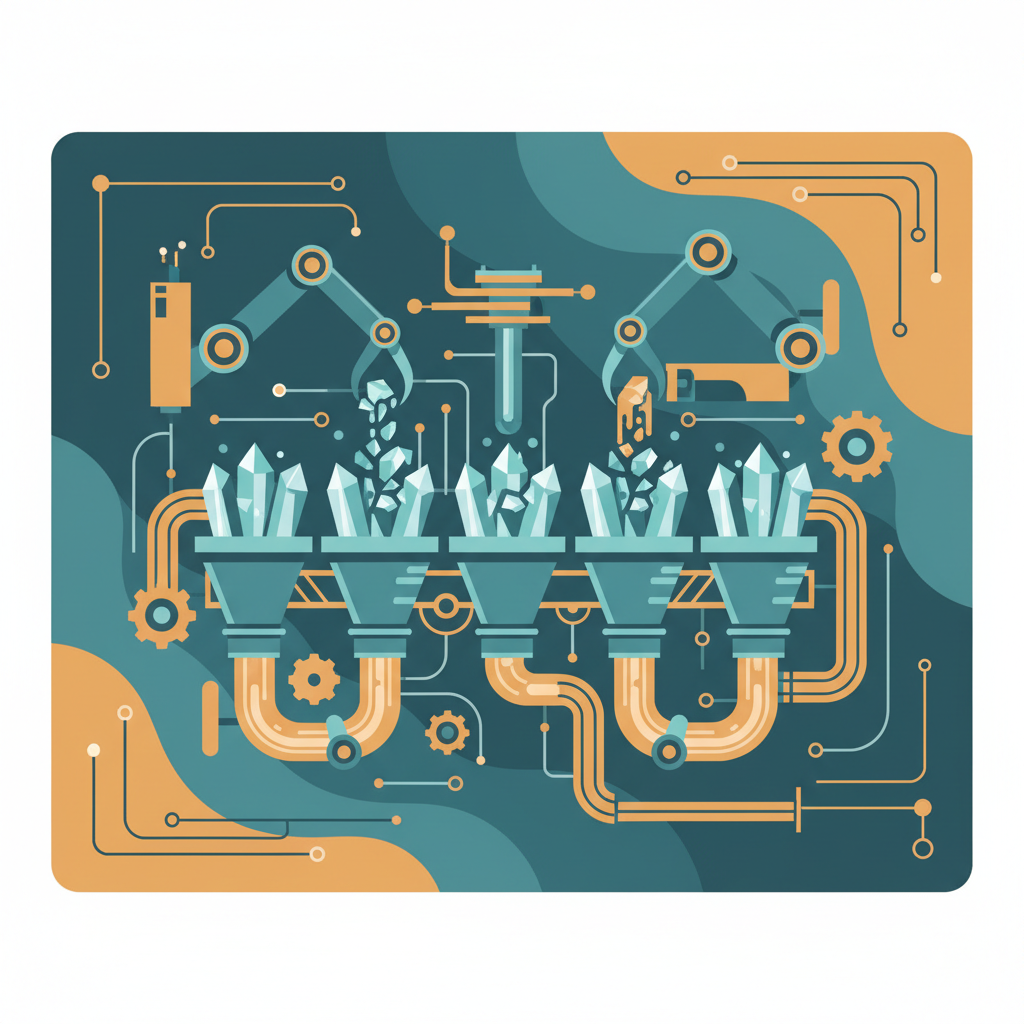
Most engineers believe scaling agentic workflows is an additive problem: add more agents, retain more context, and expand memory stores. This assumption triggers silent catastrophic decay, but treating multi-agent lifecycles like cellular biology reveals an asymmetric advantage: building self-clearing, autophagy-driven architectures that prune poisoned state before it breaks your production system.
The Context Bloat Trap Is Silently Breaking Your Pipeline
When multi-agent loops run continuously, teams assume that richer shared context yields sharper execution. In practice, the opposite occurs. Agents exchange synthetic intermediates, re-ingest past execution traces, and gradually dilute their task alignment. You do not have an orchestration deficit; you have a state purification failure. Just as biological cells accumulate misfolded proteins under oxidative stress, persistent multi-agent swarms accumulate synthetic artifacts, hallucinations, and stale telemetry. Left unmanaged, your system suffocates on its own operational waste.
The MAD Warning: Recursive Ingestion Destroys Coherence
This failure mode is not theoretical. Groundbreaking research on Model Autophagy Disorder (MAD) demonstrated how generative pipelines like DALL-E 3, Midjourney, and Stable Diffusion progressively degrade when recursively trained on self-generated synthetic outputs (Source: Self-Consuming Generative Models Go MAD). The mechanics hit text architectures just as severely. In recursive simulation workflows testing Llama2-7B, researchers observed that average linguistic entropy collapsed by approximately 7.5% at simulation step 10 on combined datasets, with individual dataset drops ranging between 4.7% to 8.7% (Source: Adaptive Mitigation of Model Collapse in Large Language Models). When agents ingest their own uncurated intermediate tokens, variance collapses, hallucinations amplify, and the network suffers functional cognitive starvation.
The Lysosome Engine: How Nature Solved Synthetic Poisoning
Consider a biological factory where thousands of sub-assemblies operate non-stop. If factory scrap is thrown back onto the raw material belt, the line jams within hours. Cellular biology prevents this catastrophe through autophagy: double-membrane vesicles encapsulate junk proteins, fuse with digestive lysosomes, break the waste into elemental amino acids, and recycle clean nutrients back to the cytoplasm. In an agentic stack, raw execution logs and synthetic reasoning chains are scrap. An autophagy-like supervisory layer identifies damaged context fragments, encapsulates them away from the active token pool, and recycles only high-salience structural constraints.
The REAP Protocol: Four Steps to Autonomous Memory Digestion
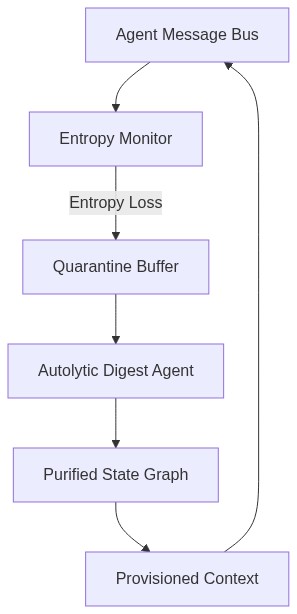
To implement continuous agentic rejuvenation, deploy the REAP Framework across your multi-agent message bus: Recognize, Encapsulate, Autolyze, and Provision.
First, Recognize degraded context using telemetry monitors. Much like the DeepPhagy deep-learning classifier evaluates autophagy phenotypes in Saccharomyces cerevisiae yeast cells (Source: DeepPhagy), your orchestrator must score agent outputs for repetitive entropy collapse.
Second, Encapsulate poisoned traces. Flagged context is fenced off into an isolated quarantine scratchpad, preventing downstream agents from conditioning on degraded synthetic traces.
Building the Autolytic Layer Inside Production Runtimes
The second half of REAP operates as your digital lysosome. In step three, Autolyze, a dedicated garbage-collection agent compresses flagged logs into low-dimensional semantic summaries. In biological multiomics research, models like LyMOI combine graph-based deep learning with LLMs to discover autophagy regulators like CTSL and FAM98A, proving that structured networks can isolate critical cellular survival mechanisms (Source: LyMOI). Similarly, your autolytic agent strips transient noise while preserving causal graphs.
Finally, step four, Provision, rehydrates the agent swarm with purified memory primitives, preserving system health without unbounded context window costs.
Precision Verification Beats Blind Agent Deletion
Teams often default to blunt timeouts or naive sliding-window context clearing. This is equivalent to apoptosis—killing the entire agent outright rather than recycling its resources. Advanced computer vision demonstrates the precision required: deep-learning pipelines analyzing 6,240 fluorescence microscopy images achieved an mAP50 of 0.80 with YOLOv8 object detection, an IoU of 0.82 via U-Net++ segmentation, and a classification accuracy of 0.86 using vision transformers to isolate autophagic activity (Source: Explainable AI to Unveil Cellular Autophagy Dynamics). Your agent runtime requires this exact granularity: targeting specific token sub-graphs for lysosomal digestion while keeping long-running orchestrators active.
Toward Self-Healing Cognitive Infrastructures
Just as machine learning workflows pinpoint mitophagy inducers that ameliorate Alzheimer's disease pathology in cross-species setups (Source: Amelioration of Alzheimer's disease pathology by mitophagy inducers identified via machine learning and a cross-species workflow), we must view self-consumption as a clinical requirement for artificial intelligence. Systems that cannot eliminate their internal scrap will collapse under the weight of their own synthetic exhaust. Designing an agent runtime around continuous, intentional autophagy transforms fragile, bloated swarms into resilient, indefinitely sustainable intelligence engines.
Sources: Self-Consuming Generative Models Go MAD | Adaptive Mitigation of Model Collapse in Large Language Models | Explainable AI to Unveil Cellular Autophagy Dynamics | LyMOI (AI-augmented discovery of autophagy regulators through mechanistic interpretation of multiomics data) | DeepPhagy | Amelioration of Alzheimer's disease pathology by mitophagy inducers identified via machine learning and a cross-species workflow
No comments:
Post a Comment