
Most engineering teams waste months tweaking system prompts to eliminate hallucinations, operating under the false belief that a model can reliably police its own output. The real leverage lies in treating the LLM as an unvetted proposal generator and offloading validation to deterministic, external execution hooks.
Your Prompt Is Not an Integrity Guarantee
When production LLM outputs fail, teams reflexively add warnings: 'Think step by step' or 'Check your calculations.' The root issue is not model capability; it is epistemic. Language models predict statistically probable text tokens, not mathematically ground truth. Entrusting a generative process to police itself invites failure. Think of an unverified LLM pipeline like an uninspected aircraft component: no amount of reassuring language during manufacturing replaces an automated ultrasonic scan on the assembly line. Relying solely on internal attention patterns creates an invisible technical liability that will silently pass invalid code and corrupted data directly to downstream microservices.
The Anatomy of a Verification Hook
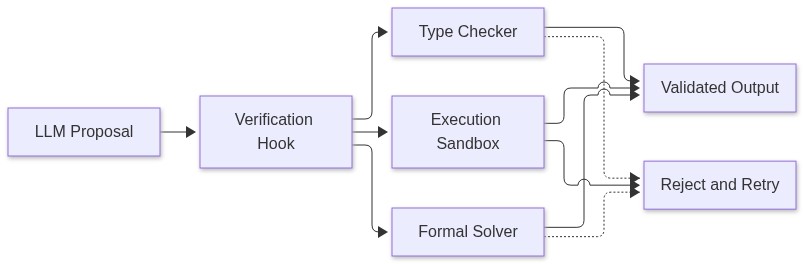
A verification hook is a deterministic interception layer sitting strictly between inference and ingestion. Instead of permitting an LLM output to update a database or execute a task immediately, the hook forces the generation through an isolated validator. If the generated output fails inspection, execution stops immediately, and the verification telemetry feeds back to the model for iterative correction or raises an exception. By separating the generative proposal engine from the deterministic evaluation engine, you decouple creativity from correctness, turning probabilistic text generation into a hardened software pipeline.
The Four Levels of Hook Architecture
Production-grade validation requires the T.E.S.T. framework: Type/Schema constraints, Executable unit sandboxes, Step-level formal checkers, and Traceable judges. Schema hooks reject malformed payloads before evaluation. Executable hooks run sandboxed tests against generated logic; benchmarked implementations demonstrate this pattern reaches 78.2% on SWE-Bench Verified and 86.5% on Terminal-Bench V2 (Source: LLM-as-a-Verifier: A General-Purpose Verification ..., LLM-as-a-Verifier is a general-purpose framework ...). Proof and formal tool hooks validate formal logic step-by-step; the FOVER system deployed formal solvers including Z3 and Isabelle to evaluate individual reasoning steps with mathematical certainty (Source: Trust but Verify! A Survey on Verification Design for Test-time Scaling).
Case Study: When Code Execution Replaces Guesswork
Consider an autonomous agent assigned to patch an open-source bug. Left alone, standard models draft syntactically plausible solutions that silently break internal state transitions. In contrast, DeepMind's FunSearch system restricted code acceptance exclusively to outputs that passed an executable task-specific evaluator, enabling novel mathematical discoveries (Source: A Survey of AI Scientists and the Verification Gap). When evaluating agents on complex, real-world repositories, wrapping LLM output in an execution verifier achieved 78.2% on SWE-Bench Verified (Source: LLM-as-a-Verifier: A General-Purpose Verification ...). Without an execution hook, the code looks correct to the user; with an execution hook, the runtime environment objectively proves whether it works before commit.
Why External Solvers Outperform Self-Reflection
Self-reflection loops often fail because the model shares the exact cognitive blind spots that generated the mistake in the first place. Sound verifiers require zero shared failure modes. Google DeepMind's AlphaProof demonstrates this principle: Lean serves as an external, deterministic proof checker that accepts only machine-valid proofs, establishing an unbreachable barrier against hallucinated logical steps (Source: A Survey of AI Scientists and the Verification Gap). Proof assistants like Lean, Coq, and Isabelle act as deterministic gatekeepers (Source: A Survey of AI Scientists and the Verification Gap). By forcing agent hypotheses through an uncompromising third-party solver like Z3 (Source: Trust but Verify! A Survey on Verification Design for Test-time Scaling), you eliminate the confirmation bias inherent in auto-regressive generation.
Engineering Trust at Test-Time Scale
Building reliable AI systems does not require waiting for a zero-error foundational model. Reliability comes from software architecture, not bigger parameter counts. When you implement rigorous verification hooks—combining runtime sandboxes, schema validation, and formal solvers—you stop pleading with a black-box model and start holding it accountable. The future of autonomous systems belongs to engineers who pair probabilistic discovery with deterministic enforcement.
Sources: Trust but Verify! A Survey on Verification Design for Test-time Scaling | A Survey of AI Scientists and the Verification Gap | LLM-as-a-Verifier: A General-Purpose Verification ... | LLM-as-a-Verifier is a general-purpose framework ...
No comments:
Post a Comment