
Most engineers waste hundreds of hours prompt engineering or migrating between foundation models to squeeze out marginal gains. Meanwhile, the actual leverage point isn't the model weight—it is the execution scaffolding you build around it.
The Model Is Frozen, Yet Success Jumps 20%
When developers face poor AI agent performance, their default instinct is model chasing. But the intelligence ceiling isn't dictated by parameter counts. Marmelab ran the identical model, identical tools, and 25 tasks through eight distinct scaffolding designs: task success spiked from 68% to 88% solely by switching the harness (Source: The State Of AI Harness Engineering 2026 - Marmelab).
An AI harness is not just an API wrapper; it is the runtime environment that dictates memory injection, error interception, and execution control. In 2026 alone, developers launched 21,500 agent-harness repositories on GitHub (Source: The State Of AI Harness Engineering 2026 - Marmelab). They realized that raw models are merely combustion engines; without a chassis, transmission, and steering column, you do not have a vehicle—you just have controlled explosions on an open workbench.
The Mechanism: Your Context Window Is Leaking Leverage
Consider a Formula 1 engine dropped into an uncalibrated frame: it either spins its wheels endlessly or burns out its fuel tank before completing a lap. LLMs operate under identical mechanical failure modes.
Without a structured harness, models suffer from context pollution. Every failed command re-enters the prompt unpruned, triggering context bloat and hallucination spirals. A recent study evaluating a six-step task across seven harnesses and five models discovered cost differences of up to 139× purely based on harness efficiency (Source: Agent Architecture & Harnesses). Notably, tool interfaces like MCP versus CLI showed no consistent cost effect (Source: Agent Architecture & Harnesses). The variance comes down entirely to how the harness prunes history, tracks loops, and validates intermediate terminal outputs.
The C-O-R-E Framework for Personal Scaffolding
To build an industrial-grade personal harness, discard unstructured conversational loops and implement the C-O-R-E Framework:
- Context Pruner: Intercept raw stdout/stderr. Truncate repetitive logs to save context window space.
- Observation Guard: Enforce deterministic validation checks before allowing the agent to claim task completion.
- Reasoning Sandwich: Wrap tool calls between planning and post-execution verification steps.
- Execution Circuit-Breaker: Detect circular command loops and break them automatically.
LangChain Deep Agents proved this model-agnostic approach works: harness-only improvements—including structured verification loops, context injection, and loop detection—raised Terminal-Bench 2.0 scores from 52.8% to 66.5% without retraining or swapping the base model (Source: Agent Harness Engineering: A Survey).
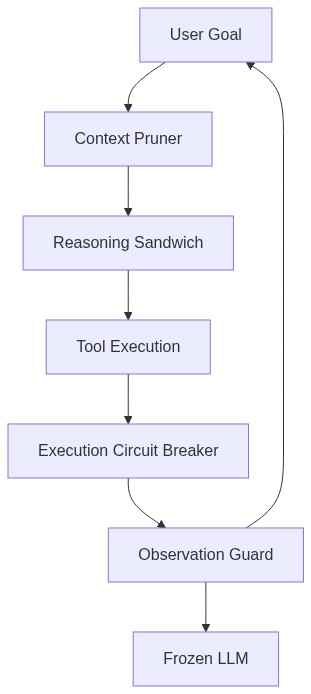
Anatomy of an Autonomous System at Scale
When scaffolding matures from simple scripts into resilient harnesses, developer leverage decouples completely from manual line editing. In an OpenAI Codex internal project, an agent-first development setup ran over five months, generating approximately 1 million lines of code and 1,500 merged pull requests with zero manually written lines of code (Source: Agent Harness Engineering: A Comprehensive Survey | Orchestra).
Notice the constraint: zero manually written lines does not mean zero oversight. The harness enforces continuous verification loops, linting, and automated unit testing before any pull request is assembled. It transforms the human role from a syntax typist into an architecture auditor.
Implementing Your Harness: From Script to Production
Building your personal harness does not require thousands of lines of boilerplate. Start with these three practical implementation rules:
First, isolate execution state. Never pass the full conversation history to the model on step four if step two was a failed grep call. Summarize failures deterministically.
Second, institute a rigid verification sandwich. Require the model to emit a verification assertion command after each state-changing action. As shown on Terminal-Bench 2.0, adding reasoning and verification layers produces double-digit benchmark leaps without touching model weights (Source: Agent Harness Engineering: A Survey).
Third, add loop-breaker heuristics. If an identical command is executed twice with identical failure codes, kill the sub-agent and inject an explicit rollback prompt.
Engineering the Interface for Autonomous Leverage
The future of engineering is not about becoming a better prompt writer; it is about becoming an elite harness architect. When you stop treating foundation models as chat buddies and start treating them as probabilistic computation cores inside deterministic engines, your output scales exponentially.
Every boundary, linter, and validation gate you construct amplifies machine reasoning into durable, verified work. Stop waiting for next-generation foundation models to solve your workflow friction. Build the harness, control the environment, and command the leverage.
Sources: The State Of AI Harness Engineering 2026 - Marmelab | Agent Architecture & Harnesses | Agent Harness Engineering: A Comprehensive Survey | Orchestra | Agent Harness Engineering: A Survey
No comments:
Post a Comment