Most engineering teams try to build super-prompts that handle an entire enterprise workflow, only to watch context windows implode and reasoning drift. The asymmetric advantage belongs to teams who stop building lone-genius models and start deploying orchestrator-worker architectures that delegate to specialized subagents.
The Illusion of the All-Knowing Model
When a single foundation model tries to research, parse compliance, cross-reference policy, and write a summary in a single pass, it chokes. It is not an intelligence deficit; it is an attention bottleneck. Think of an air traffic controller: their job is not to fly all twenty incoming planes, but to route each aircraft into its designated corridor. A UC Berkeley study evaluating seven open-source multi-agent frameworks revealed failure rates between 41% and 86.7%, uncovering 14 distinct failure modes tied directly to flawed delegation, coordination, and interaction (Source: Agentic AI Statistics 2026: 150 Sourced Data Points). Monolithic architectures collapse under multi-step tasks because error propagation is immediate and uncontained. If step two hallucinates, steps three through ten compound the failure. Delegated agent design isolates failure domains, ensuring that bad outputs are caught at the boundary before infecting your entire production pipeline.
The 90% Performance Chasm in Production
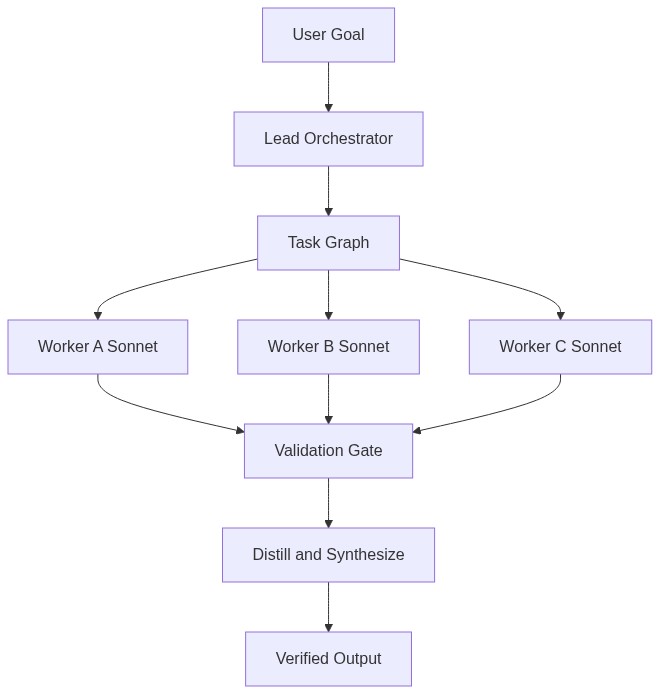
Delegation is not a code optimization trick; it changes system topology entirely. In an internal research evaluation, Anthropic found that a lead Claude Opus 4 orchestrator delegating parallel research tasks to Claude Sonnet 4 subagents outperformed a single-agent baseline by 90.2% (Source: Multi-agent orchestration in 2026: supervisor, swarm ...). Splitting tasks allows cheap, fast worker instances to execute focused operational workloads while a flagship model maintains high-level context. Dynamic runtime routing yields immediate operational dividends across enterprise workflows. Consider HCLTech, which achieved 40% faster case resolution by implementing dynamic handoffs between specialized AI agents based on runtime context (Source: 6 Multi-Agent Orchestration Patterns for Production (2026)). Rather than bloating prompts with every possible tool definition, the orchestrator routes tasks conditionally. Each worker receives clean inputs, narrow tool sets, and precise output boundaries, eliminating context-window bloat and prompt interference.
The Triple-D Orchestration Framework
To build resilient multi-agent systems without falling into the 14 known failure modes, implement the Deconstruct-Dispatch-Distill (DDD) protocol. 1. Deconstruct: The orchestrator accepts the macro goal, reviews the current state, and breaks execution into an acyclic task graph. It assigns no execution work to itself. 2. Dispatch: Tasks are routed to isolated subagents provisioned strictly with task-specific toolsets, strict system schemas, and time budgets. Subagents run concurrently whenever dependencies allow. 3. Distill: The orchestrator validates worker outputs against deterministic schemas. If a subagent fails validation, the orchestrator triggers a retry with targeted critique or routes to an alternate worker before synthesizing the final output into a coherent payload.
Automating Subagent Genesis at Scale
Hardcoding every subagent creates rigid maintenance debt. Modern orchestrators dynamically spawn ephemeral workers tailored to unexpected subtasks. On 165 GAIA benchmark tasks, the dynamic subagent creation system AOrchestra achieved an 80.0% overall success rate, demonstrating 88.7% success on Level 1, 80.2% on Level 2, and 61.5% on Level 3 tasks (Source: AOrchestra: Automating Sub-Agent Creation for ...). When an orchestrator encounters an unknown dependency, it synthesizes a custom worker definition, provisions limited tools, tests the output against assertions, and tears down the environment once complete. This eliminates brittle manual configuration while maintaining strict boundaries around system privileges and tool access.
From 10 Minutes to 30 Seconds in Enterprise Operations
Enterprise adoption is accelerating because orchestration delivers measurable operational velocity. The share of U.S. enterprises with over $1 billion in revenue orchestrating multiple AI agents rose from 9% to 18% in one quarter (Source: Agentic AI Statistics 2026: 150 Sourced Data Points). At Wells Fargo, deploying an orchestrated agent system allowed 35,000 bankers to query 1,700 internal procedures in approximately 30 seconds, down from roughly 10 minutes previously (Source: 6 Multi-Agent Orchestration Patterns for Production (2026)). When customer-facing bankers need exact procedural guidance, a single-agent architecture struggles to navigate thousands of conflicting policy manuals without lag or drift. An orchestrator queries domain indices in parallel, delegates legal checks to compliance subagents, and synthesizes answers instantly.
The Leverage of Delegated Cognition
The real frontier of artificial intelligence is not larger parameter counts; it is organizational architecture. Building systems that delegate tasks cleanly transforms AI from a fickle autocomplete toy into a fault-tolerant software engine. When you decompose complex challenges into observable, isolated, and coordinated subagents, you construct resilient organizational knowledge that scales reliably. Stop asking what a larger model can remember. Start building the orchestration networks that enable specialized intelligence to execute.
Sources: Multi-agent orchestration in 2026: supervisor, swarm ... | AOrchestra: Automating Sub-Agent Creation for ... | 6 Multi-Agent Orchestration Patterns for Production (2026) | Agentic AI Statistics 2026: 150 Sourced Data Points
No comments:
Post a Comment