
Most engineers waste thousands upgrading raw GPU compute because their local LLM crawls, assuming the core processor is slow. The contrarian truth is that your silicon cores are starved: local LLM inference is strictly memory-bandwidth bound, meaning an optimized setup can outperform high-end enterprise rigs at a fraction of the cost.
Your Bottleneck Is Bandwidth, Not Raw Teraflops
When developers hit poor generation speeds, they instinctively look at compute capacity. That diagnosis is wrong. Autoregressive inference generates one token per pass, requiring the entire parameter weight set to be loaded from memory into cache for every token generated. Think of your GPU not as a manufacturing plant that lacks tools, but as an ultra-fast assembly line constantly waiting on a single cargo elevator. If the elevator cannot deliver the blueprint fast enough, the workers sit idle. On a modern AVX2 desktop CPU, this memory-transfer constraint drags output down to just 5–15 tokens/second (Source: Running local LLM: Best use cases and tools - Geniusee). Moving those weights onto a midrange GPU uncaps the pipeline, immediately hitting 40–80+ tokens/second for comparable small-model inference (Source: Running local LLM: Best use cases and tools - Geniusee). The game is won entirely in memory transfer speed.
The 140 GB Trap That Crashes Production
The single most common operational failure occurs during model sizing. Teams attempt to serve uncompressed weights without calculating working memory. For example, running Llama 3.1 70B in raw FP16 demands approximately 140 GB of VRAM for model weights alone before accounting for the KV cache or runtime overhead. When teams load a massive checkpoint without accounting for the dynamic context window, the operating system abruptly falls back to system paging or terminates the process with an out-of-memory error. To build a robust pipeline, engineering teams must maintain an absolute buffer: always retain about 20% VRAM headroom reserved strictly for context expansion and execution scratch space during production serving.
The P.A.C.E. Framework for Squeezing Hardware Dry
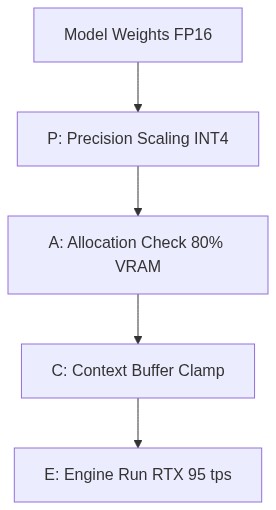
To extract true maximum performance without crashes, implement the P.A.C.E. framework across every local engine: Precision scaling, Allocation reserve, Context budgeting, and Engine execution. First, apply 4-bit precision to slash transfer volume. Second, ensure that static weight allocation never exceeds eighty percent of total memory. Third, clamp dynamic context memory buffers using PagedAttention to prevent unbounded cache growth. Fourth, bind execution to specialized native engines. While an Apple Silicon M4 Pro with 24 GB unified memory yields 42 tokens/second on Llama 3.2 7B Q4, executing that same compressed build across a dedicated consumer card like an RTX 4090 reaches 95 tokens/second (Source: Utilization of local large language models for business ...).
Quantization Arithmetic: The 3% Quality Delta
The lingering fear among engineers is that aggressive compression destroys model intelligence. The empirical metrics contradict this. Applying AWQ INT4 quantization to Llama 3.1 70B drops standard MMLU and HellaSwag benchmark scores by only 1–3% compared to uncompressed FP16, while drastically slashing physical hardware requirements. In a production fine-tuning case study involving an enterprise Daily Drilling Report dataset, quantizing a LoRA-adapted Llama 3.2 1B checkpoint resulted in a 77.08 BERTScore compared to 79.59 for the non-quantized baseline—a modest 3.2% relative reduction in exchange for massive hardware agility (Source: Run LLMs Locally: Hardware Tiers, Tools Compared & Setup Guide). You trade imperceptible linguistic edge cases for quadrupled memory efficiency and real-time generation speed.
Local Sovereignty Over Cloud Rental
Squeezing maximum performance out of local silicon is not merely an exercise in benchmark optimization; it is an architectural declaration of technical independence. Running 8B to 14B parameter models locally easily delivers more than 20 tokens/second on consumer-grade hardware using accessible runtimes. When your inference engine operates natively, you decouple your product's unit economics from token billing, eliminate data governance compliance overhead, and insulate your infrastructure from third-party API outages. Mastering memory-efficient local deployment transforms silicon from a costly bottleneck into a perpetual, private asset.
Sources: Running local LLM: Best use cases and tools - Geniusee | Utilization of local large language models for business ... | Run LLMs Locally: Hardware Tiers, Tools Compared & Setup Guide
No comments:
Post a Comment