
Most brands believe winning attention requires pouring more capital into paid acquisition loops, but the math has broken: ad auction costs continue to climb while click-through yields shrink. The asymmetric opportunity belongs to operators who stop buying ephemeral clicks and start building retrieval-augmented generation (RAG) pipelines that intercept, persuade, and convert user intent natively.
The Attention Trap: Paying Rent on Borrowed Audiences
Traditional digital advertising operates like a tax on lack of customer understanding. You bid on coarse keywords, serve static banners, and pray users tolerate the friction. However, user intent has migrated into conversational interfaces where interruptive ads fail. Recent research on LLM-enhanced RAG for ad auctions shows that traditional embedding-only baselines struggle to interpret nuanced, multi-turn conversational intent (Source: Cleo Research, 2025). The root problem is not low ad budget; it is context blindness. When an advertising pipeline relies solely on static user profiles, it acts like a billboard on an empty highway. In contrast, RAG systems dynamically pull authoritative enterprise assets into context, delivering bespoke recommendations in direct response to real-time queries without triggering banner blindness.
The Context Engine: Why Grounded Retrieval Destroys Cold Ads
Think of a traditional ad network as a megaphone, while a RAG pipeline acts as a master librarian who has memorized every transaction and product nuance in your vault. When a user asks a complex commercial question, standard ads offer generic links. A retrieval engine, however, queries a vector index of your catalog, policies, and historical wins to synthesize an exact solution. Target proved this shift by rebuilding campaign similarity matching with semantic retrieval and RAG to rank historically similar campaigns and dramatically optimize spend (Source: Target Case Study). By shifting dollars from speculative auction bidding to grounded enterprise retrieval, brands solve the user's specific barrier instantly instead of paying repeat fees to re-target them across the web.
The R-A-G-S Architecture for Paid Media Replacement
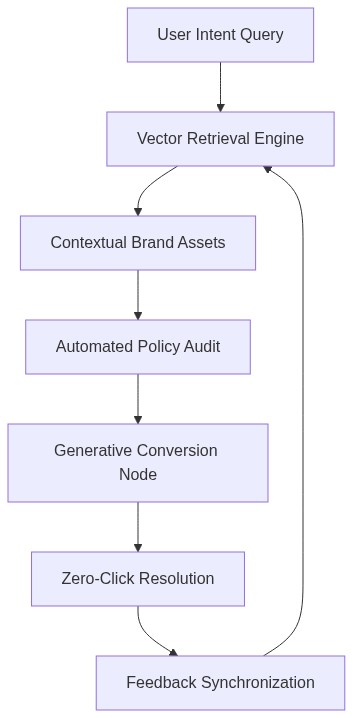
To successfully bypass the paid media treadmill, engineering teams must implement the R-A-G-S framework: Retrieve high-intent context, Audit brand boundaries, Generate personalized solutions, and Synchronize downstream feedback. Instead of manually creating dozens of ad variants, VidMob implemented a RAG-style Creative Data Distillery via an Adobe plugin, boosting ad-creation efficiency by 25% and expanding variation generation by more than 10x (Source: VidMob). Furthermore, their LLM recommendations improved newsletter click-through rate by 50% over traditional collaborative filtering (Source: VidMob). The framework replaces speculative creative testing with a programmatic loop that generates contextually perfect answers, bypassing the waste inherent to traditional display and search campaigns.
The 6-Week Squeeze: Turning Research Cycles into Real-Time Conversions
Speed of execution defines who wins market share. In classic performance marketing, planning, creative production, and compliance review take weeks—causing campaigns to miss cultural windows. CLICKFORCE in Taiwan tackled this friction directly by deploying an AI marketing analysis platform on Amazon Bedrock Knowledge Bases with RAG. They compressed marketing industry analysis time from 2–6 weeks to under 1 hour while slashing operational costs by 47% (Source: CLICKFORCE). When your pipeline can analyze consumer shifts and generate grounded collateral in sixty minutes instead of a month, competitor ad campaigns appear frozen in time. The bottleneck in paid acquisition was never media buying skill; it was the latency of processing market data into deployable customer value.
The Compliance Moat: Scaling Content Without Institutional Risk
The primary failure mode of scaling marketing content using generative AI is hallucination and regulatory breach. One unvetted claim can trigger severe platform penalties or legal exposure. This is why Syntora built a dedicated compliance RAG architecture that checks outputs against exact brand guidelines. Their system eliminated manual compliance reviews while reducing brand violations by 85% (Source: Syntora). By restricting LLM answers to strictly retrieved internal policies, you build a self-policing content generation engine. Human review teams stop acting as bureaucratic bottlenecks and become strategic orchestrators, allowing enterprises to output hyper-targeted collateral at a frequency that outpaces conventional agency retainers.
The Zero-Ad Conversion Engine: Autonomous Revenue at Scale
The ultimate payoff of the RAG transition is turning customer acquisition into a continuous conversion loop. Consider an enterprise e-commerce platform that integrated a RAG chatbot for customer automation across 250,000+ customer records: it autonomously resolved 87% of inquiries without human intervention (Source: Enterprise E-commerce Case Study). Rather than spending millions driving re-engagement traffic to generic landing pages, the company allowed conversational retrieval to satisfy high-intent queries immediately. When prospective buyers receive immediate, grounded, and accurate answers, traditional conversion funnels compress into single-session transactions. You no longer need to buy the user's attention three times over if your pipeline satisfies their query the first time.
The Shift from Renting Real Estate to Owning the Answer
Every dollar poured into the digital ad duopoly is operational expenditure that evaporates the second your campaign ends. Building enterprise RAG infrastructure transforms marketing from a recurring auction tax into a proprietary, compounding capital asset. The battle for modern commerce will not be won by the brand that buys the most impressions, but by the brand that provides the most reliable, context-aware answer in the microsecond a buyer seeks clarity. When you control the retrieval engine, you stop playing the ad network's rigged game—and start defining the digital interface on your own terms.
Sources: CLICKFORCE AWS Case Study (Amazon Bedrock Knowledge Bases) | VidMob Creative Data Distillery Report | Syntora Brand Compliance Study | Target Campaign Forecasting Semantic Retrieval Case Study | Enterprise E-Commerce RAG Automation Study | Cleo Research Paper on LLM-enhanced RAG for Ad Auction (2025)

No comments:
Post a Comment