
Most ecommerce teams are spending six figures optimizing product copy for Google keywords that AI answer engines bypass entirely. While your competitors obsess over legacy meta tags, generative engines like ChatGPT and Perplexity are directly brokering checkout intent—and choosing stores built to be machine-ingested.
The Zero-Click Bleed Is Real
Traditional search queries are collapsing into conversational synthesis. When a buyer asks an AI engine for personalized recommendations, the engine does not surface a list of links; it evaluates, selects, and presents specific SKUs. If your catalog relies on keyword-stuffed marketing prose, you are invisible. This is not a drop in rank; it is total catalog omission. For instance, data from VisibilidadOn across representative ecommerce accounts reveals a median +38% lift in brand visibility on top 30 commercial prompts and a 2.3x ChatGPT Shopping inclusion rate simply by engineering feeds for AI discovery (Source: VisibilidadOn). The problem is not your product quality; your product content is fundamentally unreadable to the large language models currently acting as personal concierges.
Your Catalog Is Speaking the Wrong Language
Generative Engine Optimization (GEO) is the systematic architecture of ecommerce content, schema, and inventory signals so large language models can extract, verify, and recommend your products. Think of legacy SEO as painting a billboard beside a highway, while GEO is encoding your inventory directly into the autonomous vehicle's navigation system. In legacy setups, search engines scanned for string matches. Generative engines run on semantic retrieval and entity extraction. When an organic skincare brand reworked its product pages with detailed ingredient specifications, deep structured data, and verified customer reviews, it transformed from an invisible vendor into a primary recommendation for targeted queries like organic skincare solutions for dry skin (Source: Organic Skincare Brand Case Study). The engine demands certainty, not clever taglines.
The 4-Step SIFT Protocol for Generative Dominance
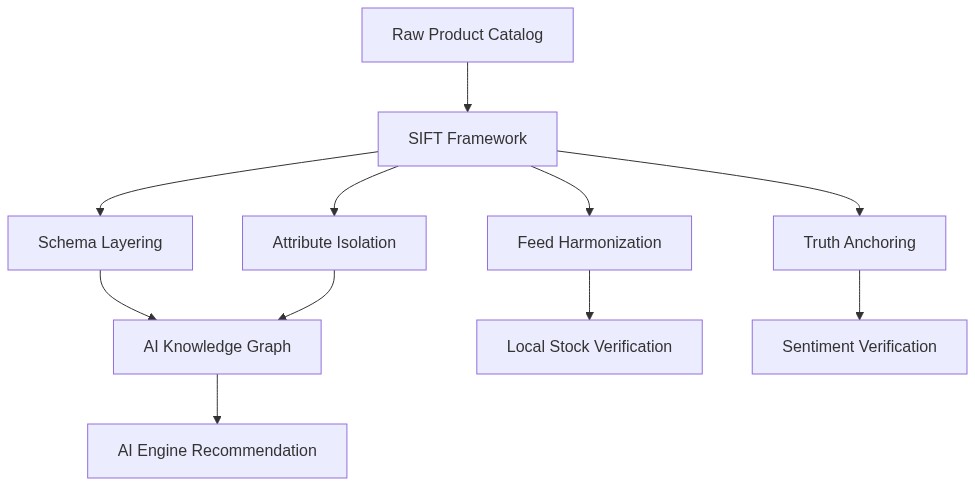
To transition your storefront from legacy keyword bait to high-confidence model ingestion, you must discard narrative fluff. Use the SIFT Framework: 1. Schema Layering: Inject granular Product, MerchantReturnPolicy, and Offer schema to eliminate model hallucination. 2. Ingredient and Attribute Isolation: Convert narrative paragraphs into hard attribute tables defining dimensions, materials, and constraints. 3. Feed Harmonization: Synchronize real-time pricing and stock signals across external feeds. 4. Truth Anchoring: Expose authentic, verified reviews with structured sentiment tokens so engines validate your real-world claims. Cetaphil demonstrated this transformation by shifting product content to benefit-led phrasing, scannable layouts, and strict bulleted specs specifically designed for conversational engines (Source: Cetaphil / Ad Age).
The 100k SKU Turning Point
The failure mode for large catalogs is treating GEO as an editorial rewrite rather than an infrastructure overhaul. A massive catalog cannot manually hand-craft prose. In a benchmark study of an ecommerce store running 100,000+ product pages, engineers restructured product descriptions and implemented comprehensive structured data across the entire site. The intervention drove a brand exposure shift from 15% to +420% brand exposure in generative engines (Source: E-commerce Store GEO Case Study). Concurrently, this technical pivot achieved an AI search traffic +300% surge, conversion rate +180%, and average dwell time +250% (Source: E-commerce Store GEO Case Study). Generative engines favor deterministic accuracy over generic brand storytelling.
The Omnichannel Ground Game
AI agents are risk-averse; they recommend stores that offer concrete logistics proof. A sporting goods store operating physical locations unlocked visibility for competitive phrases like best soccer gear near me only after integrating localized structured data feeds displaying real-time in-store pickup availability and local pricing (Source: Sporting Goods Store Case Study). Digital richness must mirror physical utility. Even interactive experiences compound this: retailer Kappahl secured a 136% increase in live video sales by embedding its Miniplayer directly onto product pages, offering dynamic product validation that AI-era shoppers crave (Source: Kappahl Case Study). When machine engines see verifiable stock, local context, and dynamic proof, recommendation confidence skyrockets.
Winning the Autonomous Shopping Economy
GEO is not an ephemeral growth hack; it is the foundational interface for autonomous commerce. The future of retail belongs to brands that treat product listings as structured machine APIs rather than digital magazine pages. When you structure your catalog for machine legibility—pairing unambiguous specifications with bulletproof provenance—you ensure your products are recommended when consumer decisions are delegated to AI. Stop optimizing for obsolete crawler algorithms. Build the infrastructure that feeds the next generation of autonomous commerce, turning algorithmic uncertainty into sustained digital market leadership.
Sources: E-commerce Store GEO Optimization Case Study | VisibilidadOn ecommerce accounts report | Cetaphil product-content shift (Ad Age) | Kappahl live video sales case study | Organic Skincare Brand Case Study | Sporting Goods Store Localized GEO Case Study

No comments:
Post a Comment