
Most engineering teams pursuing self-improving AI make a fatal assumption: they let autonomous agents directly rewrite their own prompt instructions and operational logic. What sounds like compounding intelligence almost immediately turns into unchecked drift, silent regressions, and unrepeatable workflows.
The Illusion of the Self-Rewriting Agent
Engineering leaders are obsessed with closing the self-improvement loop. The holy grail seems simple: deploy an agent, let it identify failures across terminal executions, and allow it to continuously rewrite its system prompts. But when an agent acts as both the student and the grading professor, it optimizes for path-of-least-resistance solutions rather than true system capability.
The mechanism failure is subtle: an agent modifies an edge-case prompt to clear an immediate error, inadvertently breaking three upstream assumptions. Without a rigid external boundary, continuous runtime self-modification destabilizes your baseline. Your bottleneck is not the model's raw reasoning capacity; it is the absence of an immutable, empirical harness governing how modifications are selected, tested, and shipped.
The PURE Framework for Stable Capability Growth
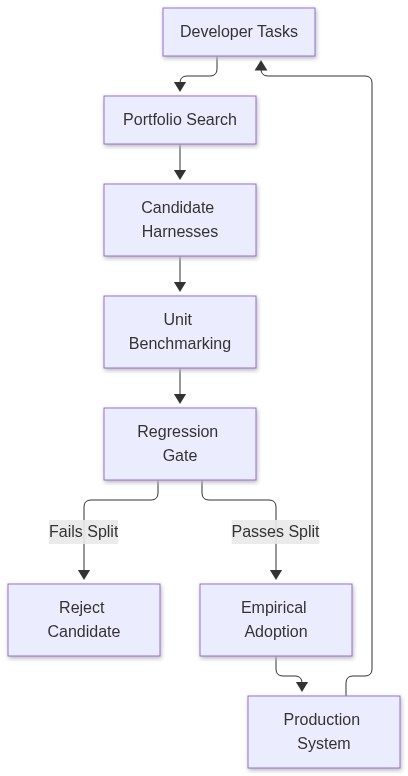
To build an engineering environment that compounds without degrading, replace open-ended self-mutation with the PURE Framework: a deterministic, four-stage feedback engine.
- Portfolio Search (P): Never mutate a single linear path. Generate divergent candidates across harnesses and prompt variants simultaneously.
- Unit Benchmarking (U): Run all candidates against standardized, immutable terminal tests rather than arbitrary live-environment trials.
- Regression Gating (R): Enforce a strict hold-out split where harness modifications are kept only if test performance clears a fixed baseline.
- Empirical Adoption (E): Promote validated changes to daily workflows, monitoring real-world developer throughput metrics.
Instead of continuous self-editing, treat your developer platform like an aircraft turbine: you do not modify the engine blades while in mid-flight; you test experimental configurations against an immutable wind tunnel.
Gated Regression Outperforms Run-Time Mutation
The definitive breakthrough in recursive agent optimization is separating harness modification from model inference. In evaluation-gated architectures, the operational environment changes, but updates are retained exclusively when held-out performance proves superior.
Consider the empirical data: the Self-Harness architecture implemented a rigorous two-split regression gate on Terminal-Bench 2.0. Rather than allowing wild runtime prompt rewrites, it systematically modified the execution harness and kept candidates only when they passed the gate. The result was a whole-system gain of 14.2–21.4 percentage points across three distinct foundation models.
Similarly, post-hoc portfolio architectures confirm that linear mutation is inferior to candidate exploration. HELIX's 65-candidate portfolio experiment achieved 4.0% greater coverage than Pi for its single best fixed harness, and surged up to 58.0% greater coverage when utilizing the complete post-hoc portfolio. Exploring multiple configurations against static gates consistently defeats recursive single-thread prompts.
Slashing Infrastructure Cost by 75% via Factory Benchmarking
What does this look like in production code generation? The industry's best alternative to recursive self-editing is task-specific factory benchmarking.
Take the WarpBench architecture. Instead of letting agents autonomously tweak their own parameters in production, the factory system benchmarked varying combinations of underlying models and task harnesses against explicit scorers for cost, quality, and correctness. By isolating these scorers, the engineering team systematically discovered combinations that reduced cost per pull request by approximately 75% without a quality regression (Source: What Are the Best Software Factory Platforms in 2026? - Warp).
When you decouple the benchmark from the executor, you transform optimization from an unpredictable black box into a predictable engineering equation. You gain the freedom to swap out expensive inference routes for lean, high-velocity harnesses without sacrificing technical correctness.
Why Human Observability Beats Autonomous Feedback Loops
Algorithmic benchmarks only solve half the challenge; the rest relies on developer adoption loops. Autonomous agents cannot measure cognitive fatigue, developer trust, or workflow friction.
Anthropic demonstrated the power of metric-driven human feedback loops in an internal study of 132 engineers and researchers published on December 2, 2025. By building feedback loops rooted in usage analytics, developer surveys, and production outcomes rather than autonomous self-editing, Claude usage expanded from 28% to 59% of daily work (Source: How AI is transforming work at Anthropic). Over that period, self-reported productivity gains increased from 20% to 50%, while merged pull requests per engineer per day surged by 67% (Source: How AI is transforming work at Anthropic).
Crucially, this system preserves engineer agency. The study noted that engineers intentionally practice without AI on selected tasks to preserve their fundamental problem-solving abilities (Source: How AI is transforming work at Anthropic). Keeping the developer in the evaluation loop prevents skill atrophy while accelerating velocity.
Engineering the Disciplined Software Engine
The pursuit of autonomous self-improvement often seduces teams into building brittle feedback loops that trade long-term architectural stability for short-term novelty. Real leverage comes from structural discipline.
When you replace autonomous self-editing with portfolio evaluation, rigid regression gates, and clear human telemetry, your software delivery pipeline transforms. You stop fighting hallucinated edge cases and start shipping compound gains. The objective is not to build an agent that endlessly rewrites itself in the dark; it is to construct an enduring platform that amplifies human clarity and guarantees technical integrity at scale.
Sources: How AI is transforming work at Anthropic | What Are the Best Software Factory Platforms in 2026? - Warp
No comments:
Post a Comment