
The industry's big lie is that putting a chat interface next to your IDE solves the software development lifecycle. It doesn't. Standard artificial intelligence code assistants actually increase copy-pasted code and duplicated blocks while decreasing necessary refactoring (Source: GitClear 2025). The true bottleneck isn't the model's raw generation speed; it is the chaotic loss of context between your ticketing systems, codebases, and runtimes. By shifting from reactive prompt engineering to an agentic system built on protocols, skills, and model context hooks, you can eliminate this friction and automate up to 87 percent of manual development effort.
The Illusion of Speed and the Hidden Quality Tax
Most engineering leaders believe they have modernized their software development lifecycle (SDLC) by handing developers a standard AI autocomplete tool. While developers using these tools can complete tasks 55 percent faster (Source: GitHub), this localized speed boost hides a systemic quality tax. Without formal boundaries, agents generate isolated code blocks, creating a maintenance nightmare. Research shows a stark rise in duplicated code blocks and a sharp decline in refactored code when developers rely on ungrounded AI assistance (Source: GitClear 2025). The root cause of this regression is simple: Context Loss. Your AI lacks deep, stateful integration with your company's actual engineering practices. When an agent cannot access historical ticket decisions, system architecture patterns, or internal security standards, it defaults to generic web-trained patterns that break on contact with your specific production environment.
The Blueprint of an Agentic Architecture: Skills, Hooks, and MCP
To build a robust agentic SDLC (ASDLC), we must move away from long, fragile prompts and adopt a structured, protocol-driven architecture. Think of this approach like a classic operating system: the core AI model is the CPU, but it needs standard buses, device drivers, and system hooks to interact with the outside world. This architecture relies on three key pillars: Skills, Hooks, and the Model Context Protocol (MCP).
- Skills are packaged, version-controlled execution playbooks (such as a 'Skills.md' file inside the repository) that define exact domain rules, testing checklists, and runtimes for the agent.
- Hooks are automated event listeners within your CI/CD pipelines and issue trackers that trigger agents dynamically.
- MCP acts as the universal adapter, allowing agents to securely consume trusted, real-time technical knowledge directly inside their execution context. This system ensures that every automated action is structured, predictable, and fully aligned with your existing development workflows.
The CAPS Framework: Orchestrating the Protocol-Driven Loop
To consistently execute this architecture, we use the CAPS (Context, Action, Protocol, Synthesis) Framework. This four-step loop guarantees deterministic execution from a raw bug report to a verified pull request.
- First, Context pulls real-time, trusted organization data utilizing an MCP server, avoiding generic web assumptions.
- Second, Action executes isolated work using specific tool chains triggered by repository hooks.
- Third, Protocol evaluates the generated work against your repository's local 'Skills.md' file.
- Finally, Synthesis records all telemetry, decisions, and code changes back to your central ticketing system, ensuring complete traceability. By formalizing this pipeline, you stop treating AI as an unpredictable chat partner and start treating it as a reliable, automated software engineering pipeline.
How HP and Atlan Saved Thousands of Manual Engineering Hours
This protocol-driven approach is not speculative science fiction; it is already delivering massive returns at scale. For example, HP modernized its SDLC by integrating Stack Overflow’s MCP Server directly into its agentic workflows (Source: HP Case Study). Instead of relying on raw training data, HP's coding agents query a verified internal knowledge base at code-generation time, eliminating hallucinated library calls and dramatically improving output quality. Similarly, data platform Atlan deployed context agents to automate metadata documentation across 50 enterprise customers (Source: Atlan Case Study). These agents generated more than 690,000 asset descriptions, with 87 percent rated as equal to or better than human writing. For just one enterprise client, this automated pipeline saved 1,279 hours of manual context curation—reclaiming approximately $128,000 in engineering labor (Source: Atlan Case Study).
Step-by-Step: Implementing the Automated Defect-to-Fix Loop
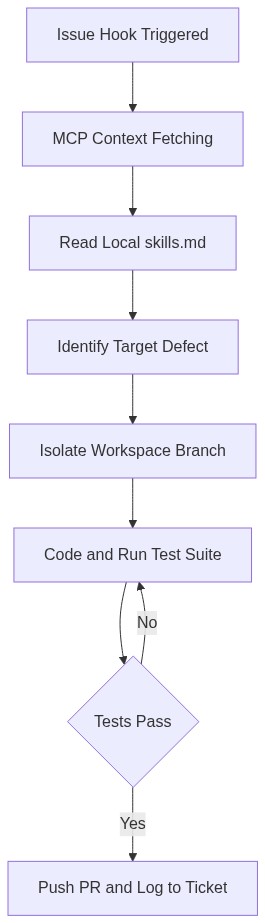
Ready to build? Let's implement an automated bug-fixing loop using the CAPS framework.
- Step 1: Set up the Hook. Configure a GitHub webhook to trigger on a new issue labeled 'Bug'.
- Step 2: Initialize MCP Context. The webhook spins up an agent container. The agent connects to your internal development MCP servers (like Stack Overflow Enterprise) to gather context.
- Step 3: Consult the Local Skill. The agent reads
skills.mdfrom the root of the targeted repository. This markdown file specifies the environment setup commands, testing suites, and pull request guidelines. - Step 4: Execute and Test. The agent creates a branch, modifies the code, runs the test suite locally as dictated by the skill, and resolves any failures.
- Step 5: Synthesize and Commit. The agent pushes the branch, opens a pull request, and posts a bidirectional validation report containing the root-cause analysis directly back to the original issue thread (Source: Skills.md Case Study).
The Enterprise Impact of Autonomous Secure SDLCs
Applying this structured automation to complex security environments yields even greater returns. In a payments-industry implementation, an enterprise deployed an autonomous Secure SDLC (SSDLC) powered by MCP (Source: Secure SDLC Case Study). This pipeline automatically analyzes JIRA tickets, writes patches, runs security vulnerability scans, and manages deployments for more than 150 enterprise microservices. The results are clear: the automated pipeline achieved an 87 percent reduction in manual development effort, a 94 percent security vulnerability detection rate, and a 65 percent faster time-to-deployment. Furthermore, organizations utilizing AI-enhanced vulnerability tools achieved a 96 percent correlation between prioritized vulnerabilities and actual, real-world exploits, reducing their overall exposure window by 46 percent (Source: Secure SDLC Case Study).
Elevating the Engineering Guild Beyond the Terminal
As PwC predicts that more than half of all engineering teams will run a fully agentic SDLC by 2027 (Source: PwC 2026), the role of the software developer is undergoing a fundamental shift. We are moving away from the era of manual line-by-line typing and entering the era of system architecture and protocol curation. Your value as an engineer is no longer measured by how quickly you can write boilerplate code, but by how effectively you design the skills, boundaries, and protocols that direct your agents. By automating repetitive tasks, we free up engineering teams to focus on solved problems, system design, and genuine innovation. The future of software engineering does not belong to those who write code fastest, but to those who construct the most resilient systems for agents to operate within.
Sources: HP + Stack Overflow MCP: Agentic SDLC with Model Context Protocol Case Study | Skills.md Agentic SDLC Pipeline (Rahul Roy, production case study) | AI Agents for Secure SDLC in Payments (Enterprise MCP architecture) | Context Agents in Enterprise SDLC (Atlan case study) | Agentic SDLC Adoption & Outcomes (PwC 2026 report)
No comments:
Post a Comment