Most companies treat Retrieval-Augmented Generation as a simple database search problem, but the 'Naïve RAG' era is dead. While beginners are still wrestling with basic vector indices, industry leaders have shifted to multi-modal, agentic architectures that transform stagnant data into active operational leverage.
The evolution of RAG (Retrieval-Augmented Generation) has transitioned from simple 'document-to-prompt' pipelines to complex, cognitive architectures. Modern RAG no longer relies on a single vector database. It has matured into a sophisticated orchestration of knowledge graphs, multi-source ingestion, and automated evaluation layers. We are moving from 'Retrieve and Generate' to 'Reason, Verify, and Synthesize.' This involves integrating structured data, real-time backend updates, and 'LLM-as-a-Judge' guardrails to ensure that the output isn't just relevant, but factually bulletproof. It represents a paradigm shift from a technical experiment to a mission-critical business infrastructure that bridges the gap between static LLM training sets and dynamic, proprietary enterprise realities.
The primitive approach to RAG fails at scale because it ignores the 'Seven Failure Points' of engineering, including retrieval mismatch and hallucination (Source: arXiv preprint 2401.05856, 2024). Businesses are evolving their implementations because raw similarity search is precision-poor; it lacks the context of relationships and business logic. By evolving to more robust systems, companies are no longer just 'finding documents'—they are compressing the time-to-competence for employees. For instance, moving beyond static libraries allows new staff to act with the authority of veterans, as seen when organizations compress 6-12 months of ramp-up time into immediate, day-one productivity (Source: Dust blog, 2024). This evolution is the only way to move AI from a novelty chatbot to a reliable analytical copilot.
To master the modern RAG landscape, implement the S.T.A.C.K. Framework:
- Synthesis of Sources: Integrate Slack, Notion, and real-time backend data rather than isolated PDFs.
- Triple-Layer Validation: Deploy a RAG pipeline, an LLM Guardrail for policy, and an LLM Judge for quality (Source: Evidently AI, 2024).
- Augmented Graphing: Move beyond vectors to Knowledge Graphs to map complex relationships.
- Contextual Chunking: Optimize how data is broken down to prevent retrieval failure points.
- Knowledge Looping: Use RAG-powered agents to draft responses for human review, reducing research time to under three minutes (Source: Dust blog, 2024).
This systemic approach moves the needle from 'it usually works' to 'it never fails.'
Architecture
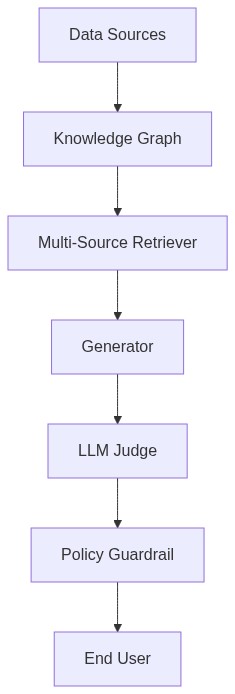
The architecture has evolved from a linear path to a recursive loop. Instead of User -> Search -> Generate, the modern pattern uses a 'Judge-Lead Orchestration' model. Data is pulled from heterogeneous sources (Notion, Slack, SQL), passed through a Knowledge Graph to establish context, and then audited by internal guardrails before the human-in-the-loop stage. This ensures compliance in regulated sectors like banking while maintaining speed.
The core problem isn't the LLM's intelligence; it is the 'Context Gap.' It is like asking a brilliant researcher to write a report while they are locked in a room with only outdated textbooks. Naïve RAG gives them more books, but Advanced RAG gives them a telephone, a filing cabinet, and a fact-checker. We are moving from retrieval as a 'lookup' to retrieval as 'contextual grounding.' This shift diagnoses the root cause of AI failure: the lack of structured, relational understanding. By integrating Knowledge Graphs and heterogeneous data, we replace simple keyword matching with true semantic comprehension, effectively creating an external 'working memory' for the model that mirrors human organizational logic.
Case Studies & Metrics
The shift to advanced RAG patterns is validated by significant enterprise gains. LinkedIn evolved to Graph-Augmented RAG for customer service, resulting in a 28.6% reduction in median per-issue resolution time (Source: Evidently AI, 2024). DoorDash moved beyond simple retrieval by implementing a three-component stack of RAG, LLM Guardrails, and an LLM Judge to ensure delivery support reliability (Source: Evidently AI, 2024). In the financial sector, Royal Bank of Canada (RBC) deployed 'Arcane' for internal policy retrieval, enabling specialists to navigate complex web platforms and compliance docs with higher efficiency (Source: Evidently AI, 2024). Finally, Malt's 'MaltyAI' agent demonstrated the human impact; where new agents previously required 6-12 months to gain confidence, the RAG agent allows them to answer accurately in seconds from day one (Source: Dust blog, 2024).
Conclusion
The evolution of RAG is a journey from uncertainty to utility. We are no longer in the era of 'experimental' AI; we are in the era of engineered reliability. By moving from simple similarity searches to structured, multi-source, and judged architectures, we don't just solve technical problems—we unlock the collective intelligence of an entire organization. The ultimate goal of RAG isn't better chatbots; it is the democratization of expertise, ensuring that every employee has the best information the company owns, exactly when they need it. This architectural shift is what will separate the leaders from the laggards in the AI-driven economy.
Sources
Evidently AI blog: 10 RAG examples and use cases from real companies, 2024 Dust blog: RAG use cases: 9 ways retrieval augmented generation solves real business problems, 2024 arXiv:2401.05856 Seven Failure Points When Engineering a Retrieval Augmented Generation System, 2024

No comments:
Post a Comment