
Most enterprises treat AI agents as linear chatbots, hoping for outputs that actually require a factory. The friction you feel in AI scaling isn't a 'poor model' problem; it is a structural failure of loop design. By shifting from prompting to Loop Engineering, organizations like GitHub have achieved a 62% reduction in token costs while maintaining production-grade quality (Source: GitHub talk on Loop Engineering).
What
Loop Engineering is the transition from 'One Prompt, One Answer' to an iterative, self-correcting system of agents. It is the practice of designing Plan-Execute-Verify cycles where models are chained in feedback loops to handle complexity. Instead of asking one expensive model to do everything, Loop Engineering uses 'Model Right-Sizing' to route specific sub-tasks—like classification or error detection—to smaller, faster models. This creates a 'Dark Factory' for software and data (Source: StrongDM/GitHub), where autonomous loops discover work, execute changes, and perform automated verification without constant human oversight.
Why
The primitive approach to AI hits a ceiling because LLMs lack inherent self-correction. Loop Engineering solves this by embedding 'Compound Leverage.' This is critical because AI-assisted developers can suffer a 17% drop in code comprehension when using static tools (Source: Anthropic Study). You need loops to include explicit verification and reviewer agents that force system clarity. Furthermore, the economic shift is massive: moving from manual prompting to loop-driven automation allows teams to manage systems where an AI agent budget of $10,000–$18,000 per month can replace significant portions of manual labor, producing $1,000 per day in output (Source: StrongDM / GitHub talk).
How
To implement Loop Engineering, apply the R.V.P. Framework:
- Route: Send high-complexity reasoning to large models and low-complexity classification to models like Claude Haiku to save up to 3x in costs (Source: GitHub).
- Verify: Ensure every output is greeted by a 'Reviewer Agent' rather than passing directly to production.
- Polling: Optimize loops through scheduling and polling changes rather than keeping agents in an active, compute-heavy state. Success requires defining clear termination conditions and error-handling paths that automatically surface recurring mistakes, much like the 'Entity Context Rules' used in logistics to fix carrier-specific data edge cases (Source: Loop Logistics).
Approach Architecture
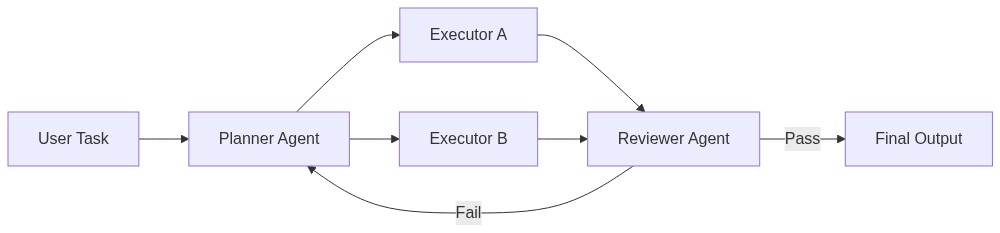
The loop architecture decentralizes the 'God Model' and replaces it with a modular assembly line. A Planning Agent decomposes the task, which is then fed into Parallel Executor Agents. A final Reviewer Agent acts as the gatekeeper, either approving the work or routing it back through a Feedback Loop. This prevents 'hallucination leakage' into the final output.
Reasoning for the Approach
The core problem isn't that current AI isn't smart enough; it's that it isn't 'reliable' enough for production. Think of Loop Engineering like a Japanese 'Andon Cord' on an assembly line. In linear prompting, if the AI makes a mistake at Step 1, the failure cascades. In a loop, the system is designed to catch its own tail. It is not a conversation; it is a circuit. This reframe moves the focus from 'better prompts' to 'better infrastructure,' treating AI as a mechanical component that requires a governor and a feedback sensor to operate at scale.
Case Studies & Metrics
GitHub demonstrated that loop-level optimizations—specifically model right-sizing and classification separation—resulted in a 62% token cost saving across 109 production runs while maintaining quality (Source: GitHub talk). StrongDM's 'Dark Factory' model estimates that loop-engineered workflows can generate approximately $1,000 per day in AI coding output (Source: StrongDM). Meanwhile, Loop (logistics) utilizes an 'Atomic Task System' to handle edge-case-heavy supply chain documents, using failure analysis loops to propose fixes for recurring AI errors before humans even detect them (Source: Loop Logistics). Across these cases, the recurring theme is that quality is a function of the loop, not the model.
Conclusion
Loop Engineering is the bridge between AI as a novelty and AI as a utility. By building systems that can verify, iterate, and self-correct, we move closer to the 'Dark Factory' vision of autonomous productivity. This isn't just about saving 62% on your token bill; it's about building a digital infrastructure that works while you sleep, ensuring that as our tools become more complex, our systems remain robust, transparent, and economically viable. The future of engineering doesn't belong to those who can prompt the best, but to those who can build the best loops.
Sources: GitHub talk on Loop Engineering & the Real Cost of Agentic AI | StrongDM Dark Factory Case Study | Anthropic AI Developer Comprehension Study | MindStudio Engineering Patterns | Loop Logistics Atomic Task System
No comments:
Post a Comment