
Most teams build monolithic AI systems that try to answer every question, only to end up with unpredictable outputs, high API costs, and zero ROI. The real wins come from single-purpose AI agents that master exactly one business workflow—converting chaotic tasks into deterministic results.
The $300M Case for Shrinking Your Agent's Scope
Engineering teams routinely fail with generative AI because they attempt to build universal assistants. When an agent is expected to draft emails, calculate quotes, and diagnose database errors, its prompt space explodes, causing hallucinations and unfixable edge cases. The real breakthrough comes when you limit the agent to a single operational boundary. Consider UPS ORION: rather than building a multi-purpose logistics manager, UPS built an agent focused solely on route optimization. That single focus saves approximately 100 million miles and $300 million annually, while cutting carbon emissions by 100,000 metric tons (Source: UPS ORION Case Study). The lesson is simple: narrow the agent's mandate until failure becomes mathematically improbable.
The Root Cause: Unbounded Context Breaches Reliability
Why do broad agents fail in production? It isn't model intelligence; it's context dilution. Think of a single-purpose AI agent like a specialized surgical tool. If a surgeon's scalpel kept changing its shape to become a hammer or a wrench, every procedure would fail. Broad agents try to hold dozens of system prompts, schemas, and user permissions simultaneously. In contrast, JPMorgan Chase built COiN (Contract Intelligence) to execute one specific job: extract and classify clauses in credit agreements. By constraining the scope, COiN parses 12,000 commercial credit agreements in seconds, replacing roughly 360,000 lawyer-hours of manual review annually while reducing human error rates by 80% (Source: JPMorgan Chase COiN Study). Constrained task boundaries create deterministic outcomes.
The SCOPE Architecture for Hyper-Focused Agents
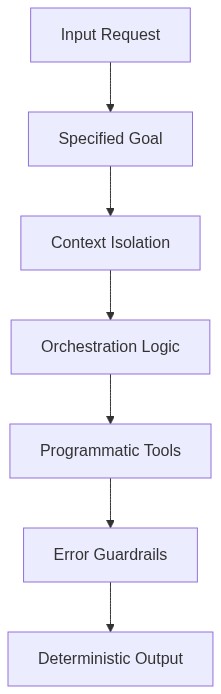
To build an agent that actually survives production, apply the SCOPE framework:
- Specified Goal: Define a single input-to-output signature.
- Context Isolation: Feed only the immediate schema and task data needed.
- Orchestration Logic: Hardcode step-by-step decision trees rather than relying on pure LLM autonomy.
- Programmatic Tools: Limit execution to explicit API calls with strict parameters.
- Error Guardrails: Enforce automated fallback logic when confidence scores dip.
Signetic applied this exact design pattern with their prior-authorization healthcare agent. By targeting one bottlenecked administrative task, they replaced a grueling two-hour manual workflow with an automated sequence (Source: Signetic Report). Every component of your architecture must serve this exact structural sequence.
The Minute-Scale Resolution: Turning Logic Into Action
Once task boundaries and frameworks are set, focus on tool execution and deterministic guardrails. A single-purpose agent must not 'guess' an output; it must query authoritative APIs and perform targeted interventions. For example, Signetic's billing agent handles rejected pharmacy claims. Instead of asking a general model to figure out medical billing, the agent follows precise logic to re-verify codes, check coverage rules, and resubmit claims. The result? Resolution happens in minutes instead of 30–45 minutes per case (Source: Signetic Report). When customer volume scales, this focus prevents degradation: Bank of America's Erica assistant has executed over 1 billion+ interactions by adhering strictly to standardized banking operations (Source: Bank of America).
The Metric Shift: Engineering for Compounding Margins
Deploying single-purpose agents is not just a technical fix—it transforms unit economics. According to BCG, a global industrial goods firm integrated targeted agentic workflows into daily operations, generating a 2 percentage-point EBITDA boost in two years (Source: BCG). Similarly, a consumer packaged goods brand deployed specialized content agents, cutting blog production costs by 95% and speeding up publishing time by 50x (Source: BCG). When you systematically replace manual operational bottlenecks with single-purpose agents, you move software from a cost center to a high-leverage compound engine.
Sources: UPS ORION Case Study | JPMorgan Chase COiN Study | Bank of America Erica Report | Signetic Healthcare Agents Report | BCG Industrial Goods & CPG Agentic AI Deployment Study
No comments:
Post a Comment