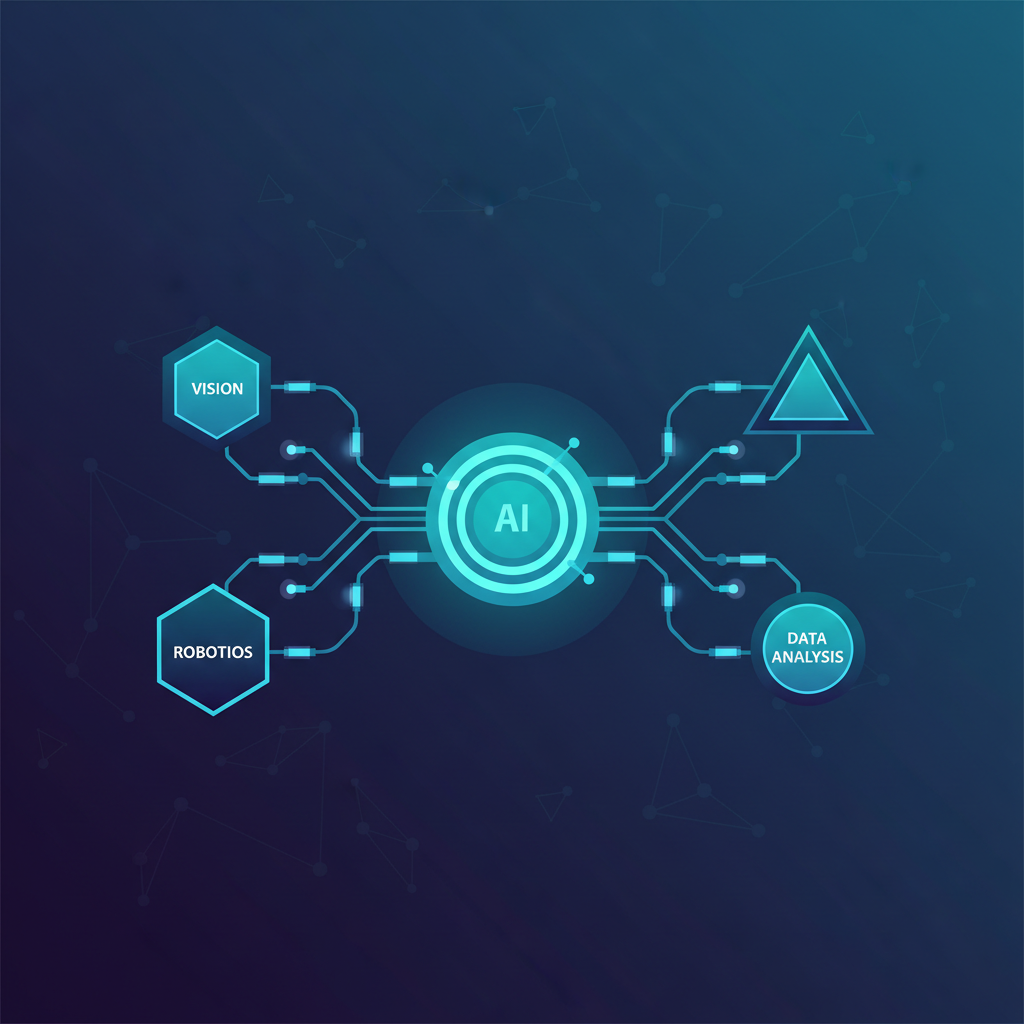
Most engineering teams build rigid, single-purpose AI pipelines for every new task, accumulating massive maintenance debt. The future belongs to generalist base agents that differentiate dynamically into hyper-specialized execution paths on demand.
The $40k Custom Architecture Trap
In 2023, software engineering swallowed a dangerous myth: that every distinct problem requires a bespoke, hardcoded AI pipeline. Teams built isolated models for data parsing, separate fine-tunes for execution, and custom rule engines for quality control. The result? Fragile software monoliths that break the moment a protocol shifts. Consider the parallel in stem cell biology. If a multi-cellular organism required a completely distinct genetic code for every single organ, evolution would stall under the weight of its own complexity. Yet, tech stacks are currently designed with this exact point-solution anti-pattern. When you lock an AI model into a single narrow function, you inherit compounding technical debt, zero cross-task transfer, and exponential operational costs. The solution isn't building more micro-models; it's deploying a single, uncommitted base agent that adapts dynamically to whatever operational lineage you demand.
Your Bottleneck Is Model Isolation, Not Capability
The core operational bottleneck in modern automation is not a lack of intelligence; it is structural isolation. Biological systems solved this millions of years ago through pluripotency—the capacity of a single embryonic stem cell to differentiate into hundreds of functional, highly specialized cell types such as neurons, cardiomyocytes, or pancreatic beta cells, all guided by micro-environmental signals. A base AI agent operates under the exact same blueprint. Instead of retraining specialized models from scratch, you deploy an undifferentiated, high-reasoning base agent into an environment rich with context, tools, and feedback loops. By applying specific operational inputs, the base agent undergoes a functional transition into a specialized execution engine. The root cause of standard AI failure is trying to forge hardcoded specialized tools before establishing an adaptable base architecture.
The PROPEL Framework for Agent Differentiation
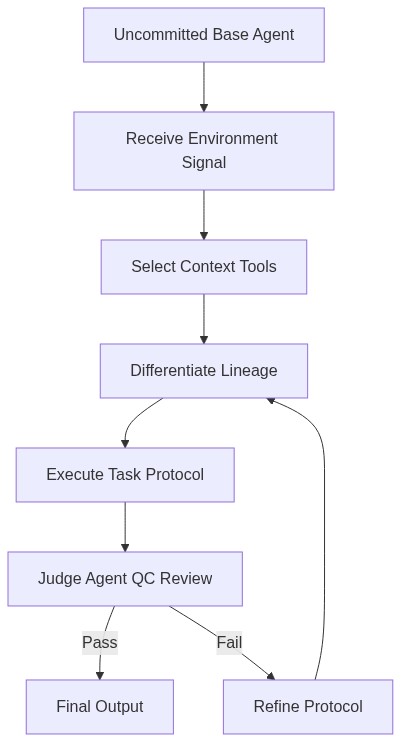
To transition from static pipelines to dynamic agents, implement the PROPEL System: 1. Primary Uncommitted State: Maintain a highly capable, zero-shot base agent equipped with core logic and tool interfaces. 2. Signal Reception: Expose the agent to task-specific environment triggers and initial constraints. 3. Phenotypic Specialization: Allow the agent to select specialized sub-agents or toolkits based on runtime requirements. 4. Execution & Monitoring: Execute the task while a secondary sub-agent evaluates state changes. 5. Loop Refinement: Self-correct protocol flaws in real-time without manual code interventions. A real-world example of this system in action is Agentic Lab (Source: Multi-agent system for stem-cell protocols). Rather than using static software for every protocol, Agentic Lab deployed a unified agentic architecture to generate, critique, and optimize multi-week differentiation protocols for human pluripotent stem cells into pancreatic organoids, autonomously adjusting parameters based on morphology.
When a Single Engine Runs the Entire Lab
The true test of a pluripotent agent framework is multi-domain adaptation without structural changes. Consider the DeepNEU platform (Source: DeepNEU aiPSC platform). DeepNEU operates as a unified simulation engine for artificially induced pluripotent stem cells (aiPSCs). Instead of rewriting code for every targeted disease, the platform relies on one core architecture to simulate diverse tissue types and pathological states. When applied to infantile-onset Pompe disease (IOPD), DeepNEU reproduced complex gene and protein expression profiles with high precision relative to real iPSC cells. When shift came to neurological conditions, the exact same platform modeled Rett syndrome—a disorder caused by MeCP2 deficiency in roughly 80% of clinical cases (Source: DeepNEU aiPSC platform). During the 2020 pandemic, researchers repurposed this exact same base pipeline to simulate SARS-CoV-2 lung infections and identify therapeutic targets, proving that a unified base agent outpaces fragmented point solutions every time.
Closed-Loop Feedback: The Agent as Judge and Executor
Static software fails because it lacks internal validation mechanisms. A pluripotent agent architecture overcomes this by pairing primary execution agents with autonomous judge sub-agents within a continuous feedback loop. In the Agentic Lab framework, a specialized vision-language sub-agent was tasked with monitoring iPSC culture quality by evaluating cell morphology and confluency at levels comparable to human expert biologists (Source: Multi-agent system for stem-cell protocols). In a complex neuron–astrocyte co-culture protocol, the system's judge agent autonomously identified a critical design flaw: simultaneous cell seeding caused aggressive astrocytes to monopolize the substrate. Without human intervention or model retraining, the judge proposed a sequential seeding protocol that resolved the issue (Source: Multi-agent system for stem-cell protocols). Similarly, StemCell-GPT demonstrates this multi-objective specialization by executing CRISPR gRNA design, SNV-aware patient targeting, and ssODN template generation within a single multi-functional agent (Source: StemCell-GPT OpenReview).
Rewriting the Code of Life with Generative Engines
When generalist AI capabilities intersect with generative protein design, the rate of discovery compounds. In a project between OpenAI and Retro Biosciences, researchers leveraged a generalist model architecture (GPT-4b-micro) to redesign core biological reprogramming factors including SOX2 and KLF4 (Source: OpenAI + Retro Biosciences). The resulting synthetic factors, RetroSOX and RetroKLF, demonstrated a >50-fold increase in pluripotency marker expression compared to native proteins (Source: OpenAI + Retro Biosciences). Furthermore, over 30% of RetroSOX variants and nearly 50% of RetroKLF variants outperformed native versions—with some active variants differing by more than 100 amino acids from natural sequences (Source: OpenAI + Retro Biosciences). In donor mesenchymal stromal cells, over 85% activated endogenous pluripotency genes within just 12 days (Source: OpenAI + Retro Biosciences), demonstrating that an adaptive agent can engineer solutions far beyond biological defaults.
Architecting the Universal Multi-Agent Stack
To deploy this architecture, construct your stack in three explicit layers: Layer 1 (The Base State): A high-reasoning base agent tasked with orchestration and intent parsing. Layer 2 (Environment Vectors): Dynamic context inputs, domain-specific tools, and runtime constraints that act as differentiation signals. Layer 3 (Feedback Loops): Evaluator sub-agents that judge outputs, run quality checks, and feed real-time errors back into Layer 1 for autonomous course correction. Think of this setup like stem cell differentiation: your base agent is the pluripotent cell, the task context acts as growth factors, and the output is a specialized, functional tissue type. Stop building isolated, fragile scripts for every new requirement. Modern software architecture demands an adaptable, pluripotent agent foundation capable of reorganizing itself to tackle any problem you feed it.
Sources: Agentic Lab – Multi-agent lab co-pilot for pluripotent stem-cell protocols | DeepNEU / aiPSC platform – Universal simulation engine for disease modeling | StemCell-GPT – Specialized AI agent for human stem-cell genome editing | OpenAI + Retro Biosciences – GPT-4b-micro based protein-engineering pipeline

No comments:
Post a Comment