
Most engineering leaders treat Jira as a passive, soul-crushing graveyard of stale tickets and unread comments. The winning minority have turned it into an active orchestration brain for autonomous AI agents, transforming raw business intent into merged code without drowning their teams in administrative overhead.
Your Engineering Bottleneck Is Not Coding Speed
Engineering leaders are obsessed with faster code generation in the IDE, but writing syntax was never your true bottleneck. The real friction lives in the connective tissue: vague requirements, missing acceptance criteria, fragmented context across PRs, and endless quarterly planning churn.
Think of your IDE as a high-performance racecar engine; feeding it ambiguous, low-context Jira tickets is like pumping unrefined sludge into the gas tank. No matter how fast your AI code generator runs, poor issue definition leads to rework, hallucinated dependencies, and stalled reviews.
When you treat Jira as the central context anchor rather than a digital chore, you eliminate the cognitive tax that derails development before the first line of code is ever typed.
The Enterprise Failure Mode of Stateless AI Agents
When enterprise teams spin up ad-hoc AI agents without deep organizational context, they trigger an expensive failure loop: hallucinated business logic, blown token budgets, and broken builds. Isolated coding agents lack historical context, architectural constraints, and team-specific domain rules.
Context-free generation is deeply inefficient. Atlassian internal benchmarking demonstrated that AI agents enriched by its Teamwork Graph delivered 44% more accurate results while consuming 48% fewer tokens than context-blind agents (Source: Atlassian blog / announcement on AI-native software development in Jira, 2026).
Without an authoritative orchestrator acting as the single source of truth, autonomous tooling simply produces technical debt at machine speed.
The T-A-S-K Framework for Agentic Jira Workflows
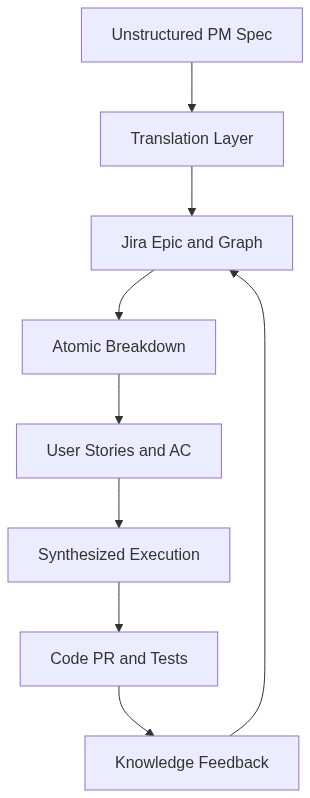
To build an AI-native Software Development Life Cycle (SDLC), you must upgrade Jira from a tracking board to a deterministic execution engine. Implement the T-A-S-K Framework:
- T — Translation Layer: An agent digests unstructured PM conversations into structured, spec-compliant epics with rigorous edge-case definitions.
- A — Atomic Decomposition: Automated agents break epics into granular, estimated user stories with explicit acceptance criteria and branch definitions.
- S — Synthesized Execution: Developer agents pull full context from the Jira graph, write code, run tests, and scaffold services.
- K — Knowledge Feedback: PR outcomes, test results, and deployment states automatically sync back to update the issue status and resolve blocker queries.
How Egnyte and Reddit Turn Intent Into Merged Code
High-performing teams are already deploying this closed-loop architecture. For example, Egnyte’s search team utilized Claude Code to transform raw product manager discussions directly into structured Jira Epics, automatically decompose them into estimated, linked stories, scaffold underlying services, and assist CI/CD deployment (Source: Egnyte case study, “Adopting an AI-Native SDLC: Egnyte Search Team Case Study”, 2026).
Similarly, Reddit established Jira as its centralized enterprise source of truth to coordinate and govern multi-agent AI workflows directly tied to strategic business goals (Source: Atlassian LinkedIn post, “How Reddit is Using Jira for AI SDLC”, 2026).
By anchoring agentic execution in Jira, these teams maintain complete traceability from high-level roadmap goals down to every commit.
The 19% PR Throughput Surge and the Math of Reclaimed Time
The measurable impact of integrating agentic intelligence across your ticketing workflow is stark. In engineering operations adopting Atlassian Rovo Dev, repositories achieved 19% more merged pull requests per month compared to non-adopting repos (Source: Atlassian blog, “The AI-native SDLC is paying off”, 2026).
For low to medium-activity repositories, the uplift surged between 37% and 51% in throughput, while developers reported saving 2 to 4 hours per week on routine coding and review overhead (Source: Atlassian blog, 2026).
Administrative savings extend beyond the IDE: Procore’s Head of Engineering documented a 75% reduction in time spent writing quarterly roadmaps, while Sprout Social utilized Rovo Agents to resolve 80% of tickets from new hires instantly (Source: Atlassian blog, “Beyond the Jira Board…”, 2026).
Elevating Software Teams From Ticket Processors to System Architects
The shift to a Jira-based AI SDLC is not an exercise in shaving minutes off sprint cycles—it is a fundamental reinvention of the software engineering craft. When mechanical planning, ticket drafting, context retrieval, and boilerplate generation run autonomously, your human engineers graduate from ticket processors to system architects.
Your engineers can finally focus their energy on system resiliency, domain innovation, customer experience, and high-leverage architectural trade-offs.
Software development is moving from human-pushed tickets to machine-orchestrated delivery. Anchoring your AI agents inside a rich context graph is how your organization leads that transition instead of getting swept away by it.
Sources: Atlassian blog, 'The AI-native SDLC is paying off: 19% more PRs and 2–3 hours …' (2026) | Atlassian blog / announcement on AI-native software development in Jira (2026) | Atlassian blog, 'Beyond the Jira Board…' (2026) | Atlassian LinkedIn post, 'How Reddit is Using Jira for AI SDLC' (2026) | Egnyte case study, 'Adopting an AI-Native SDLC: Egnyte Search Team Case Study' (2026)
No comments:
Post a Comment