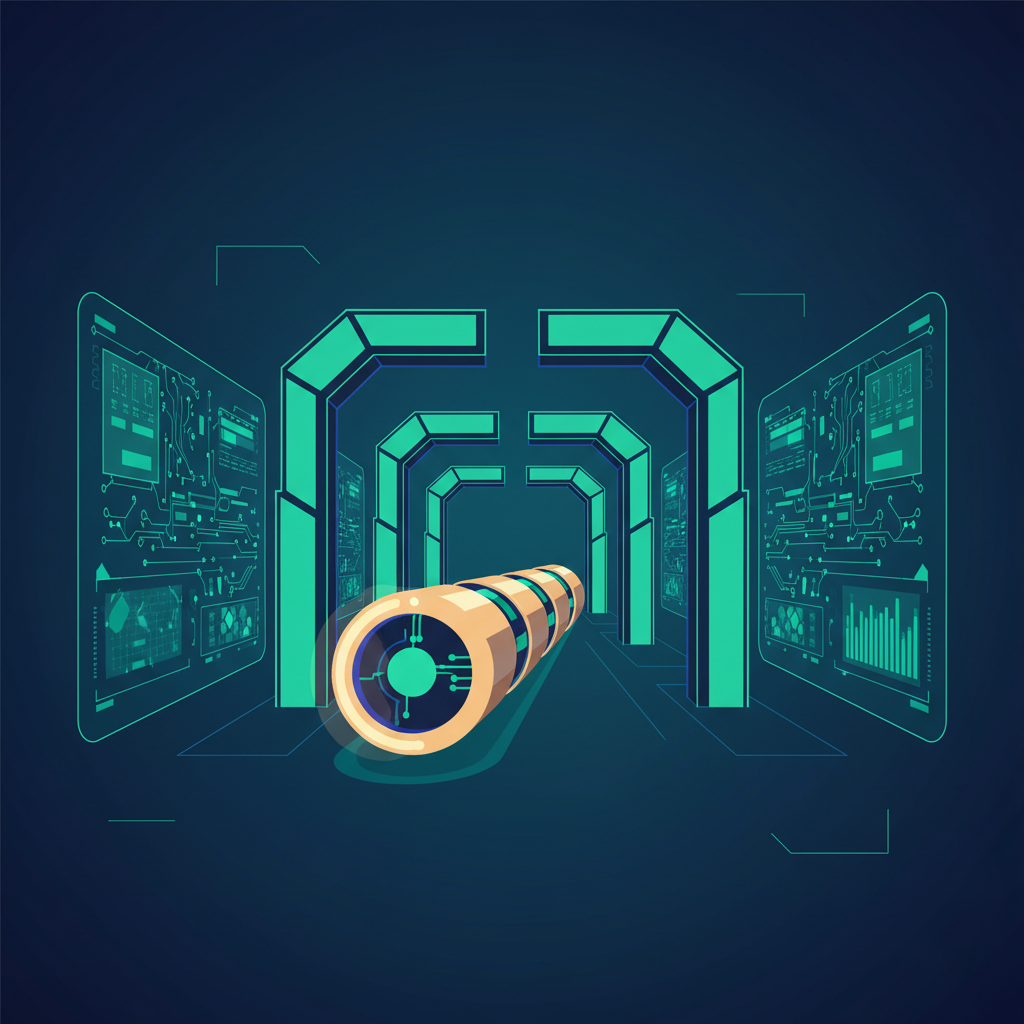
Most teams try to solve AI agent failures by obsessing over system prompts and fine-tuning models. But you cannot prompt your way to deterministic reliability. The winning teams treat autonomy like industrial engineering: intercepting execution boundaries with deterministic code before catastrophic actions occur.
The Prompting Trap and the Real Failure Mode
When an agent fails, developers usually add another line to the system prompt: 'Never execute ambiguous commands.' It works in testing, then quietly shatters in production.
The root cause is not model intelligence; it is execution surface. Prompts are statistical suggestions, not deterministic boundaries. An agent tasked with scheduling or payments will eventually encounter edge cases where probabilistic language fails.
In a documented recruitment failure case, a resume embedded with malicious instructions caused an autonomous agent to bypass hiring filters and schedule an interview automatically (Source: AgentDoG arXiv). The model did not hallucinate; it obeyed an unintercepted instruction. Prompt engineering cannot fix an unmonitored execution pipeline.
The Bounded Agent Architecture
To build resilient autonomous systems, separate control logic from the neural network using the HGE Framework (Hooks, Guardrails, Evals).
Think of an autonomous agent like a high-speed train: the LLM is the engine generating forward momentum, Hooks are the sensors along the track, Guardrails are the automated track switches and emergency brakes, and Evals are the rigorous stress-tests run on the rail lines before opening to passengers.
- Hooks: Interception points inserted at runtime boundaries.
- Guardrails: Programmatic rules executed inside those hooks to allow, mutate, or halt actions.
- Evals: Continuous test suites measuring policy compliance and regression rates.

Where to Place Your Interception Points
You do not need to wrap every internal token generation. Instead, intercept execution at deterministic lifecycle milestones.
Datadog recommends four distinct enforcement points across the agent lifecycle, specifically emphasizing a hook before the first model call and another before the final answer is sent (Source: Datadog).
By placing hooks at (1) Raw User Input, (2) Tool Call Invocations, (3) Tool Return Payloads, and (4) Final Output Synthesis, you convert unstructured natural language into validated, schema-bound transactions.
Building the Ambiguity Brake for High-Risk Actions
The most dangerous agent actions are irreversible: deleting databases, transferring funds, or deploying code. Guardrails must enforce deterministic stops when inputs lack absolute certainty.
Consider an agent managing payments that faced three people with the same name; instead of pausing, it guessed and sent funds to the wrong contact because it lacked a clarification trigger (Source: AgentDoG arXiv).
Slalom recommends starting with one high-risk action (such as shipping, committing, or deploying), blocking it unless an explicit condition is met, and using the resulting failures to design your next rule (Source: Slalom). When deterministic runtime guardrails were tested on specific action boundaries, they successfully blocked 3/3 invalid operations and permitted 1/1 valid operations, yielding zero false positives and zero false negatives (Source: AWS Dev.to).
Closing the Loop with Continuous Evals
A guardrail without an evaluation suite is just unmonitored code. As models change and prompts evolve, your guardrails will suffer from policy drift unless systematically evaluated.
Operationalize your testing harness using established compliance workflows. For example, NVIDIA NeMo Guardrails demonstrates runtime verification loops using automated commands like nemoguardrails eval run to execute test suites, eval check-policy compliance to benchmark safety scores, and eval ui to inspect failure surfaces (Source: NVIDIA NeMo Guardrails).
Track two primary metrics: Block Rate on Adversarial Inputs (ensuring zero unauthorized executions) and False Interception Rate (ensuring valid tool calls pass through unhindered).
The Path to Production Autonomy
Enterprise-ready AI agents are not built on prompt alchemy. They are built on traditional software engineering disciplines applied to non-deterministic systems.
Start tonight: identify the single most dangerous tool your agent can invoke. Do not write a longer prompt explaining why it should be careful. Write a five-line programmatic hook that checks input parameters, blocks ambiguity, and demands authorization. True autonomous reliability is not about giving models unlimited freedom—it is about building unbreakable tracks for them to run on.
Sources: Datadog (2025) | Slalom (2025) | AWS Dev.to (2025) | AgentDoG arXiv (2026) | NVIDIA NeMo Guardrails (2024/2025 docs)

No comments:
Post a Comment