
Most engineering teams celebrate when their AI agent automatically recovers from a runtime crash, unaware they have built an expensive digital hamster wheel. Repairing state is not the same as advancing architecture—and mistaking self-healing for self-evolution is why enterprise agent fleets plateau at high operational cost.
The Elastic Band Trap in Modern Agentic Systems
When an agent fails, the standard industry reflex is to build a self-healing loop. If an API returns a 500 error or a schema deviates, an inspector agent retries the call, patches the payload, and restores baseline health. This is maintenance, not intelligence.
Think of a self-healing loop like a human immune system fighting off a recurring fever: it returns the body to status quo, but it does not teach the organism how to avoid the pathogen next time. In production, teams discover that a customer support agent's escalation rate can drift dangerously—climbing from 5% to 25% as input drift compounds without programmatic guardrails (Source: The Self-Healing Agent Pattern, 2025). Patching symptoms keeps your system alive, but it traps your architecture in an infinite loop of repairing the exact same failure modes.
Self-Healing Restores State; Self-Evolution Rewires Policy
The architectural distinction is absolute. Self-healing is reactive error correction: detect anomaly, roll back, swap tool, or retry until the predefined success metric is satisfied. Self-evolving loops operate on the meta-layer: they treat runtime telemetry, edge cases, and healing events as training signals to permanently update prompts, routing topology, and tool definitions.
Consider heavy industrial manufacturing. In an autonomous welding cell, a pure healing mechanism detects a flawed joint, isolates tip wear as the root cause, and executes an on-the-fly tool swap and re-weld to eliminate downtime (Source: JISEM, 2025). That is world-class healing. But a self-evolving system goes one layer deeper: it updates the predictive maintenance policy so the tip is swapped at cycle 450 instead of failing at cycle 482. Healing fixes the defect; evolution rewires the threshold.
The ADAPT Loop: Engineering Autonomous Policy Mutation
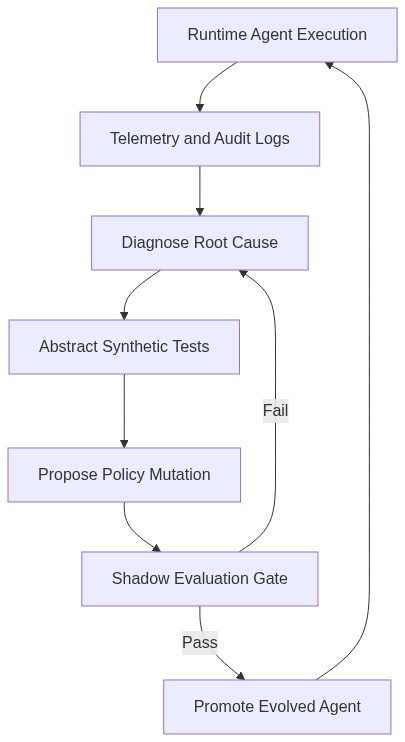
To transition from fragile patch routines to autonomous evolution, implement the ADAPT Framework: a closed-loop engineering harness separating runtime execution from policy optimization.
- Audit: Log execution traces, state divergence, and recovery interventions across your fleet.
- Diagnose: Run offline meta-agents over failure clusters to isolate root-cause patterns rather than point errors.
- Abstract: Convert concrete failures into generalized synthetic assertions and regression tests.
- Propose: Generate mutated system instructions, dynamic few-shot exemplars, or modified graph edges.
- Test: Run parallel shadow evaluations against golden datasets before promoting the evolved agent version to production.
By decoupling execution from mutation, you prevent unstable prompt drift while systematically converting runtime exceptions into permanent capability upgrades.
Quantifying the Industrial Payoff of Layered Loops
When engineered correctly, layered healing and evolutionary architectures yield massive efficiency dividends across complex topologies.
In data operations, Dragonfly and Union.ai deployed self-healing agents to maintain a living knowledge graph indexing 250,000 software products. Operating at 2,000+ concurrent runs, the architecture slashed failure recovery time by 50% while simultaneously increasing team development velocity by 30% (Source: Union.ai, 2025).
Similarly, automated production lines using agentic root-cause correction reduced mean downtime per fault from ~30 minutes to <5 minutes while driving down scrap rates by >70% (Source: JISEM, 2025). The compounding advantage emerges when these operational savings are funneled into continuous policy refinement rather than manual fire-fighting.
Building the Autonomous Software Factory
What does this look like in day-to-day software engineering? In a benchmark study by ZenML, an agentic software factory scaled to 14 automations (with 11 running regularly) and completed 2,000+ agent operations within five days. Crucially, 98% were fully automated, requiring human intervention on only 2% of operations for initial setup and steering (Source: ZenML, 2025).
When support systems add self-healing controls to monitor confidence thresholds, escalation rates drop from 25% back to 6%, false escalations drop from 20% to 2%, and the system independently resolves 15% of problematic queries (Source: The Self-Healing Agent Pattern, 2025). In infrastructure grids, this compounding reliability drives 40% fewer outages and 20% lower maintenance costs (Source: SuperAGI, 2025).
Beyond Stability: The Imperative for Compounding Agency
Fixating on system uptime is the modern equivalent of polishing a steam engine during the advent of electrification. Stability is no longer the competitive frontier; the rate of autonomous adaptation is.
When your agentic architecture heals itself, you eliminate operational drag. But when your agentic architecture evolves itself, you transform daily runtime entropy into an expanding moat. Every failed tool call, ambiguous user input, and latency spike becomes raw fuel for architectural optimization. Stop building systems that merely survive production. Build loops that emerge from every failure smarter than they entered it.
Sources: Union.ai, How to Build Self-Healing Agents (2025) | ZenML, Building a Self-Healing Software Factory with AI Agents (2025) | Agentic AI for Self-Healing Production Lines: Autonomous Root Cause Analysis (JISEM, 2025) | The Self-Healing Agent Pattern (2025) | SuperAGI Industry Overview (2025)

No comments:
Post a Comment