
Most engineering teams assume agent latency and ballooning API bills are caused by reasoning models. They are wrong. The real bottleneck is running repetitive safety guardrails, schema evaluations, and policy judges synchronously across every single multi-turn step.
The Synchronous Guardrail Tax Crushing Your Unit Economics
Every production agent setup runs an invisible gauntlet: PII checks, prompt-injection filters, semantic verifiers, and LLM-as-a-judge scorers. Running these evaluations dynamically on every single token step burns massive budget. Anthropic reported that prompt caching can unlock up to a 90% cost reduction and an 85% latency reduction on long context windows (Source: Anthropic prompt-caching announcement). Think of synchronous agent validation like an airport security checkpoint where the same trusted passenger is completely unpack-searched at every domestic gate transfer. When you validate static system state repeatedly, you are paying full computational price for zero new information. The fix is not disabling safety checks—it is decoupling evaluation state from model generation via deterministic and semantic caching layers.
When Naive Semantic Matching Breaks Agent Safety
Teams attempting semantic caching often face silent failures by using raw cosine similarity. An agent checking user permissions or temporal data cannot treat 'transfer $50 yesterday' and 'transfer $50 tomorrow' as identical just because vector embeddings match. In parameter-rich agent queries, pure semantic similarity hit a ceiling with hit-decision F1 near 0.67; on a combined temporal pipeline, precision reached 0.75, recall was 0.5625, F1 was 0.6429, and specificity hit 0.7188 (Source: Temporal semantic caching evaluation). Blind caching returns stale, unsafe guardrail passes. A reliable cache requires composite keys that bind intent, entity variables, security scopes, and temporal boundaries together before bypassing a safety judge.
The TIER Framework for Production Guardrail Caching
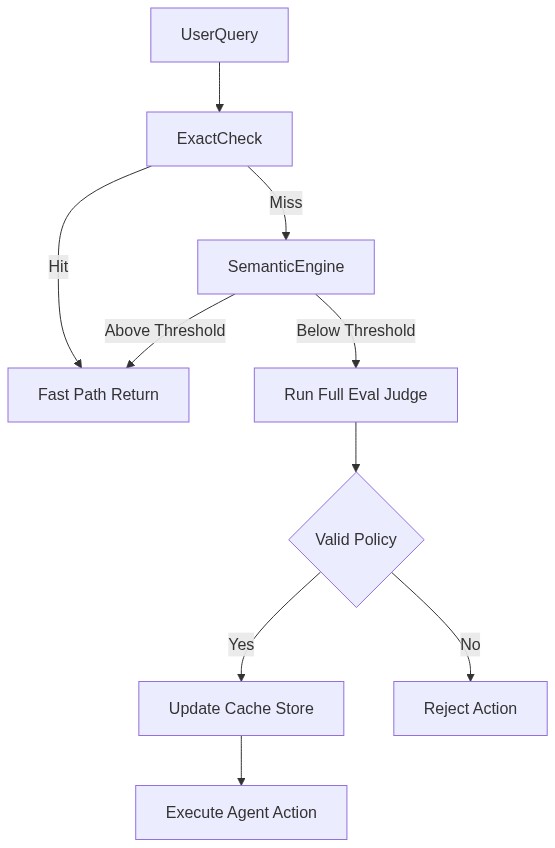
To safely cache agent evaluations without leaking edge-case failures, implement the TIER architecture:
- T - Template Hashing: Exact-match hash verification for static tool schemas and system guardrails.
- I - Intent Indexing: Vector-based semantic classification bounded by strict entity extraction.
- E - Execution Replay: Deterministic validation lookup for known-safe trajectory subgraphs.
- R - Realtime Invalidation: Dynamic cache eviction triggered whenever environment state or policy rules change.
By splitting evaluations into structured layers, you only invoke heavy LLM-based judges when an agent trajectory enters uncharted territory, preserving safety without stalling runtime execution.
Deterministic Plan Reuse Cuts 50% of Runtime Overhead
Once evaluation boundaries are cached, entire agentic sub-plans can be stored safely. On multiple real-world agent applications, agentic plan caching reduced costs by 50.31% and latency by 27.28% on average while fully maintaining task performance (Source: Agentic Plan Caching paper). Similarly, across 500+ agent sessions with 10,000-token system prompts, prompt caching cut API costs by 41–80% and improved time to first token by 13–31% across model providers (Source: DeepResearch Bench prompt-caching study). When safety validations and execution graphs are verified once, downstream agent routing skips redundant reasoning loops entirely.
Building Replay-Based Offline Evaluation Pipelines
Caching is not just for production runtime—it is transformative for testing. The Adaptive Decentralized Multi-LLM Orchestration benchmark demonstrated a replay-based evaluation protocol that cached task-agent executions—including responses, latencies, token usage, costs, and judge scores—to compare routing policies under identical conditions (Source: Adaptive Decentralized Multi-LLM Orchestration benchmark). In embodied agent planning, cache-driven approaches sustained success rates of 84–100% with top models and 68–100% with smaller models across diverse environments (Source: Cache-Driven Asynchronous Planning for Embodied AI Agents). Cached traces let you iterate on your evaluation judges without spending a single dollar re-running unchanged agent steps.
Architecting Autonomous Systems for Real-World Speed
Real-time AI autonomy requires responsiveness. Your users do not care how many safety policies you evaluate; they care whether the agent resolves their problem quickly and reliably. By caching evaluations, safety boundaries, and plans, you transform security from a high-latency tax into an instant, deterministic utility. True engineering maturity is not about running the largest model on every check—it is about making safety computationally frictionless.
Sources: DeepResearch Bench prompt-caching study | Anthropic prompt-caching announcement | Agentic Plan Caching paper | Temporal semantic caching evaluation | Adaptive Decentralized Multi-LLM Orchestration benchmark | Cache-Driven Asynchronous Planning for Embodied AI Agents

No comments:
Post a Comment