
Most teams believe agent latency is an inference compute bottleneck, so they aggressively slap semantic caches across every user turn. The contrarian reality: unverified caching turns robust guardrails into security blindspots and degrades answer validity, while leaving 80% of cost savings on the table.
The Illusion of the Static Guardrail
When engineering agentic workflows, you face a compounding tax. Every dynamic reasoning step requires passing system prompts, tool definitions, and historical evaluations. Most architectures rerun every safety eval and policy check on every single loop, creating crippling operational drag.
Anthropic's prompt caching economics demonstrate that caching long prompts can achieve up to 90% cost reduction and 85% latency reduction (Source: Atlan Context Caching: Make AI Agents Faster and Cheaper, 2026). Yet engineering teams hesitate to cache security layers, fearing stale policy state. The real bottleneck is not the evaluation model itself; it is treating every deterministic check as an isolated real-time computation.
The 0.67 F1 Failure Mode
The naive instinct is to implement raw semantic caching: if query B is mathematically close to query A in vector space, reuse query A's validation decision. This approach fails catastrophically under production parameters.
Benchmarking temporal semantic caching reveals that pure semantic similarity is not a sound proxy for answer validity. Hit-decision F1 scores capped near 0.67, while a combined pipeline reached precision 0.75, recall 0.5625, F1 0.6429, and specificity 0.7188 (Source: Evaluating Temporal Semantic Caching and Workflow Optimization..., arXiv, 2026).
Think of naive semantic caching like an airport security line that lets a passenger skip inspection simply because they look like the person who passed through ten minutes ago. Semantic proximity does not guarantee safety invariance.
The T-P-E Guardrail Framework
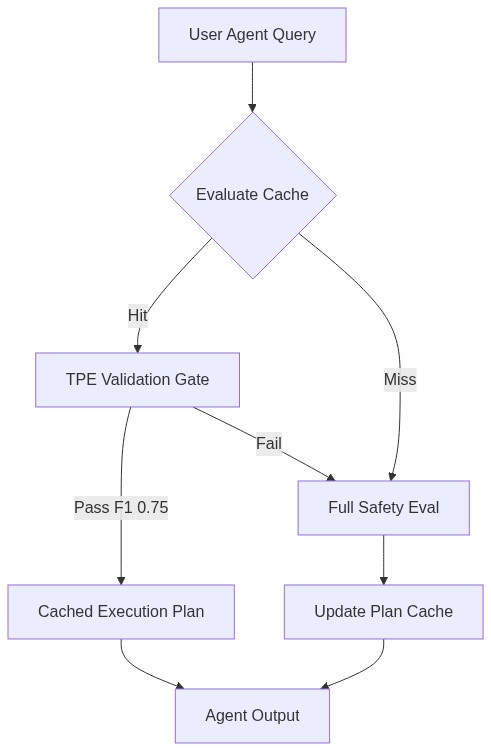
To safely cache agent evaluations without compromising safety boundaries, you must decouple transient context from deterministic policies. The T-P-E Framework establishes a three-tier validation architecture:
- Temporal Context Layer (T): Pin state variables, timestamps, and transient credentials outside the cache key.
- Policy Invariant Layer (P): Cache static system instructions, evaluation prompts, and regulatory rule trees across execution runs.
- Execution Plan Layer (E): Cache verified trajectory sub-plans rather than full raw model outputs.
By splitting verification along these boundaries, you preserve deterministic safety guarantees while drastically cutting inference cycles.
Proof in Production: Halving the Execution Bill
When structured caching is implemented across agent trajectories, efficiency gains scale exponentially with task complexity.
In evaluations across 500+ agent sessions featuring 10,000-token system prompts, prompt caching cut API costs by 41–80% and improved time to first token by 13–31% (Source: An Evaluation of Prompt Caching for Long-Horizon Agentic..., arXiv, 2026).
Furthermore, across multiple real-world agent applications, agentic plan caching reduced costs by 50.31% and cut latency by 27.28% on average while fully maintaining downstream task performance (Source: Agentic Plan Caching: Test-Time Memory for Fast and Cost..., arXiv, 2025). Cache-driven asynchronous planning even maintained 84–100% performance across environments with GPT-5 / GPT-5-mini, and 68–100% with GPT-5-nano (Source: Cache-Driven Asynchronous Planning for Embodied AI Agents, arXiv, 2026).
The 4-Stage Progressive Implementation
Never deploy cache-driven routing directly to production enforcement. Mitigate operational risk by following a disciplined phased rollout (Source: AI Agent Architecture Design Strategies for Cost Optimization, Towards AI, 2026):
- Phase 1: Passive Data Collection: Log raw cache hit/miss candidates without bypassing any active evaluation pipelines.
- Phase 2: Quota Tracking: Monitor token consumption deltas, cache staleness, and hit precision thresholds.
- Phase 3: Quota Enforcement: Enforce deterministic rate and cost limits against high-confidence policy nodes.
- Phase 4: Automatic Routing Decisions: Dynamically route agent trajectories through validated cached sub-plans and bypass redundant eval steps.
Engineering the Autonomous Edge
Scaling production AI agents is not an exercise in brute-forcing larger context windows or buying higher API throughput tiers. The competitive moat belongs to systems that minimize redundant cognition.
By treating evaluation caches and guardrails as stateful, structured memory rather than brute-force filters, you create agents capable of long-horizon autonomy. You eliminate computational waste, lock down reliability, and transition from fragile prototypes to resilient, enterprise-grade production architectures.
Sources: An Evaluation of Prompt Caching for Long-Horizon Agentic... (arXiv, 2026) | Agentic Plan Caching: Test-Time Memory for Fast and Cost... (arXiv, 2025) | Evaluating Temporal Semantic Caching and Workflow Optimization... (arXiv, 2026) | Cache-Driven Asynchronous Planning for Embodied AI Agents (arXiv, 2026) | Atlan: Context Caching: Make AI Agents Faster and Cheaper (2026) | AI Agent Architecture Design Strategies for Cost Optimization (Towards AI, 2026)

No comments:
Post a Comment