Most engineering leaders believe their bottleneck is code generation speed, so they hand developers Copilot and wonder why sprint velocity barely budges. The real friction point is not writing syntax; it is the administrative black hole of project coordination, ticket context thrashing, and manual triage inside Jira.
The Context Tax Bleeding Your Sprints
Engineering teams spend hundreds of hours translating product briefs into Jira issues, triaging incoming bugs, and reconciling tickets with pull requests. The bottleneck in modern software delivery is not typing code; it is cognitive overhead. When developers lack structured context, velocity stalls. For instance, an experiment integrating Claude AI with Jira showed that converting a 15 pages of requirements document into structured execution artifacts manually takes days, but an AI pipeline converted it into 70+ Jira tickets in 30 minutes, spanning 11 epics, 20+ user stories, and 50+ technical tasks (Source: Medium, 'From Vision to Velocity: How Claude AI + JIRA Integration Accelerated Our SDLC', Jul 2025). Without automated issue decomposition, engineers remain expensive administrative clerks.
The Real Problem: It Is Not Code, It Is Workflow Debt
Software delivery fails when ticketing systems act as passive record-keepers rather than active coordination engines. Think of standard Jira like an unindexed warehouse: when a worker asks for a part, they must wander down 25 aisles to check dependencies. Integrating agentic AI turns that warehouse into an automated retrieval system. A global engineering provider integrating AWS Bedrock with Jira collapsed manual workflow stages from over 25 steps to fewer than 5, slashing overall SDLC effort by approximately 60% (Source: Nous Infosystems case study, 'Agentic AI Cuts SDLC Effort 60% with AWS Bedrock'). When context flows automatically between Jira, codebases, and CI/CD, developers stop managing status and start shipping value.
The TRACE Architecture for AI-Powered Jira Workflows
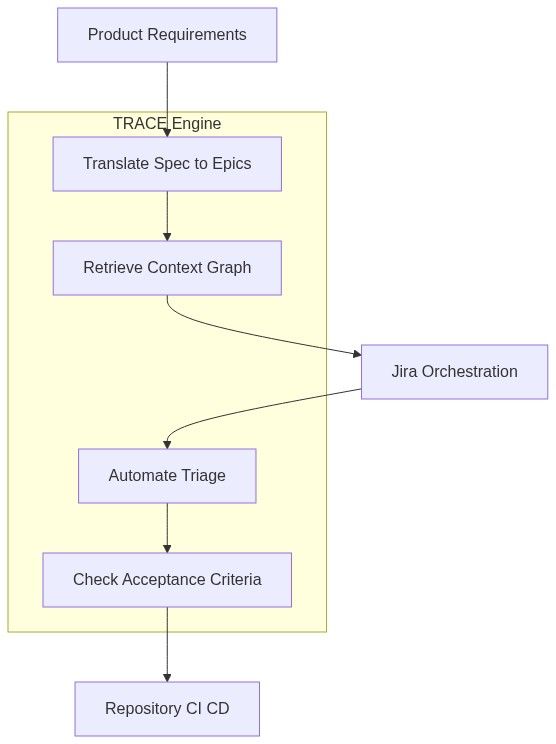
To build an AI-native SDLC around Jira, deploy the TRACE Framework: 1. Translate: Convert raw specs and PRDs into epics and subtasks programmatically. 2. Retrieve: Enrich tickets with organizational graph data rather than raw prompts. Atlassian benchmarked that agents powered by Teamwork Graph delivered 44% more accurate results using 48% fewer tokens (Source: Atlassian blog, 'How we are evolving Jira for AI-native software development', 2026). 3. Automate: Trigger AI triage on ticket creation to assign severity, components, and regression risks. 4. Check: Enforce automated test generation and acceptance criteria validation. 5. Execute: Close feedback loops between GitHub and Jira seamlessly.
Triage Velocity and the Compounding Quality Loop
Manual bug triage creates massive downstream drag. Tickets sit idle, descriptions lack reproduction steps, and unvetted bugs pollute sprints. AI-driven triage fundamentally shifts these economics. In a real-world implementation, DevPlaza deployed an AI triage system that delivered 50% faster bug triage, 35% higher unit test coverage, 2x fewer CI/CD failures, 40% better PR quality, and a 5x higher developer productivity multiplier (Source: GOML.io case study, 'How DevPlaza improved software reliability across the SDLC with AI'). When issues enter Jira pre-analyzed with reproduction steps and component tags, cycle times collapse across the entire release pipeline.
Governance in Regulated Pipelines Without Velocity Hits
A common fear is that automating SDLC workflows invites chaotic code and audit failures. In practice, governing the SDLC with AI guardrails produces higher compliance than manual checklists. A regulated legal tech organization executed an AI-governed SDLC across 8 repositories, delivering approximately 1 month of sprint output in just 4 days, while producing 600 Playwright tests and completing 6 of 6 SOW deliverables (Source: Eliza case study, 'Legal Tech Company Builds Governed AI-SDLC'). Similarly, HeartFlow achieved comprehensive end-to-end traceability and automated documentation across Jira and GitHub in 10 weeks (Source: Ketryx case study, 'Heartflow'). AI does not bypass process; it hardens it.
Step-by-Step: Implementing Agentic Jira Workflows
Begin by operationalizing your intake stage. Connect an LLM pipeline to process product requirements documents into decomposed user stories with standardized Gherkin acceptance criteria. Next, configure automated webhooks on ticket creation to run context retrieval against past resolved issues and system architecture docs. Then, embed automated verification before closing the loop: link pull request checks to auto-update Jira issue custom fields with test results. Rather than attempting a whole-system overhaul overnight, activate one workflow slice at a time—starting with automated spec-to-ticket breakdown—to establish reliable baseline metrics before orchestrating multi-agent systems.
Software Engineering Beyond the Ticket Queue
The ultimate transformation of AI in the SDLC is not about generating code faster—it is about liberating engineering teams from bureaucratic drag. When Jira transforms from a chore tracking system into an intelligent orchestration fabric, the role of the engineer elevates. Developers transition from task executors to systems architects, focusing on complex domain problems, architecture resilience, and true customer value. By unifying context, orchestration, and automated governance, your team stops managing ticket queues and returns to building extraordinary software.
Sources: GOML.io case study, 'How DevPlaza improved software reliability across the SDLC with AI' | Medium, 'From Vision to Velocity: How Claude AI + JIRA Integration Accelerated Our SDLC', Jul 2025 | Atlassian blog, 'How we’re evolving Jira for AI-native software development', 2026 | Eliza case study, 'Legal Tech Company Builds Governed AI-SDLC' | Nous Infosystems case study, 'Agentic AI Cuts SDLC Effort 60% with AWS Bedrock' | Ketryx case study, 'Heartflow'

No comments:
Post a Comment