
Most teams building multi-agent harnesses burn 80% of their latency budget asking a monolithic reasoning model to orchestrate specialized workers. The contrarian reality is that frontier LLMs make terrible switchboards; your harness does not need another generation step to route intent, it needs deterministic, bounded evaluation.
The Illusion of Orchestration Intelligence
When multi-agent workflows stall, engineering leads instinctively upgrade their orchestrator prompt or deploy a heavier reasoning model. But your bottleneck is not model intelligence; it is orchestration bloat. Using an unrestricted generative LLM to choose between specialized subagents forces high-variance token generation over an operational space that is entirely finite. In practice, generic LLMs suffer from hallucinated agent delegations, state bleed, and unpredictable selection drift. Instead of treating delegation as an open-ended conversation, production harnesses treat it as a bounded classification problem over an explicit registry of specialized workers.
The Switchboard Analogy: Why Generators Fail at Routing
Think of an old-fashioned telephone exchange. You do not hire a creative novelist to listen to an incoming caller, write an internal essay about conversational intent, and then plug the wire into a terminal. You hire a switchboard operator who matches incoming signals against an exact map of active lines. Generative models act like the novelist: they hallucinate context, introduce hundred-millisecond jitter, and invent new departments when uncertain. Dedicated routing infrastructure acts like the switchboard: incoming state is resolved against defined agent capabilities deterministically, decoupling selection logic from generative execution.
The P-E-R-C System: Bounded Agent Dispatch
Production-grade agent selection follows the PERC Framework:
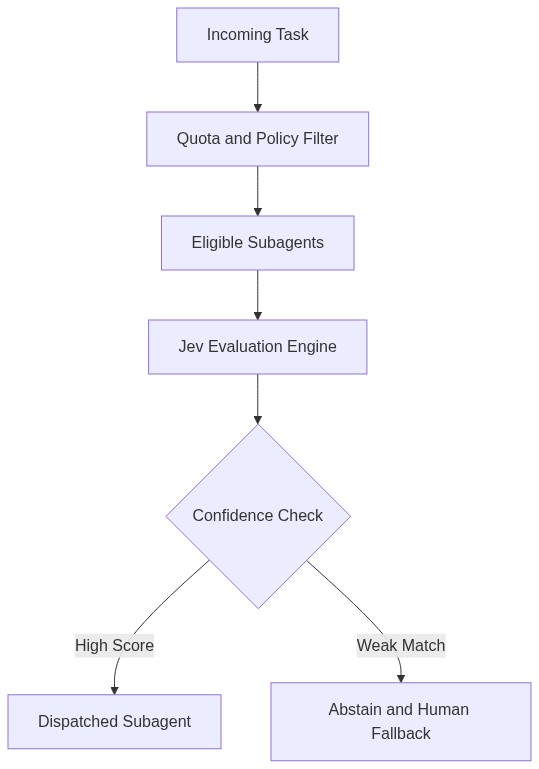
- Policy Pruning: Strip ineligible subagents based on hard quota, auth scopes, or policy constraints before running inference.
- Evaluation: Score the residual agent pool using Jev's fast, typed selection over known capabilities.
- Rejection Threshold: Enforce an abstention floor where low-confidence matches trigger human-in-the-loop escalation rather than a hallucinated handoff.
- Context Injection: Pass only the distilled payload to the chosen subagent, eliminating state contamination.
Dissecting the Sub-Millisecond Routing Flow
Implementing the PERC framework requires a hard architectural boundary between your orchestrator harness and your execution workers. Instead of passing prompt history down a recursive chain of LLM calls, incoming tasks hit an upfront filter layer. System constraints prune candidate workers before Jev evaluates the prompt against the registered capabilities. Because routing executes via specialized classification rather than autoregressive token output, decisions resolve with high confidence or abstain immediately.
Real-World Mechanics: Benchmarks and Failure Modes
The costs of generative tool and agent selection compound aggressively at scale. Consider the 100-tool benchmark on jev-agent.com: when choosing search_flights across 100 mocked tools, Jev resolved the target with 99% confidence, clocking 506.9 ms median latency (approximately 308 ms after isolating the network floor), consuming only 403 input tokens, and costing just $0.00001693 (Source: jev-agent.com). Contrast this with common multi-agent failure modes, where an unrestricted orchestrator guesses a downstream tool when uncertain. Implementations like jev-agent-skill-router prevent state pollution by explicitly declining weak matches rather than guessing (Source: jev-agent-skill-router), while platforms like the OpenAgents terminal agent (450 GitHub stars) enforce bounded command-loop judgments (Source: AwesomeJev).
Pre-Filtering and Independent Validation
Routing accuracy spikes when combined with programmatic pre-filters. In the agent-router / Herdr integration (55 GitHub stars), the harness prunes eligible coding models by policy and quotas before passing candidate options to Jev for ranking (Source: AwesomeJev). Rather than blindly trusting routing benchmarks, teams validate decisions against standardized suites. Projects like jev-decision-benchmarks (1 GitHub star) measure abstention and tool selection across MetaTool, When2Call, and BFCL V4 benchmarks (Source: AwesomeJev). Similarly, implementations like jev-router (prismhq) route each request dynamically to the most cost-effective viable model instead of locking the pipeline into a fixed, expensive endpoint (Source: prismhq).
The Sovereign Agent Harness
The long-term objective of multi-agent engineering is not to build bigger, monolithic orchestrators that attempt to hold the entire system state in a single context window. The objective is to build modular, self-healing networks of micro-agents governed by strict, predictable dispatch rules. When you pull selection logic out of the black box of generative completions and assign it to high-precision evaluators like Jev, your architecture transforms from an unpredictable demo into deterministic software. Speed, cost reduction, and low error rates are merely the operational symptoms of an architecture that finally respects system boundaries.
Sources: jev-router (prismhq) | jev-agent-skill-router | jev-agent.com | AwesomeJev curated directory (OpenAgents terminal agent, agent-router / Herdr integration, jev-decision-benchmarks)
No comments:
Post a Comment