Most engineering teams downgrade to Sonnet to protect their run-rate, assuming flagship reasoning models carry a 5x premium. That assumption is burning weeks of developer velocity: on standardized runs, Sonnet 5 costs $0.51 per task while Opus 5.5 sits at $0.55 per task (Source: Artificial Analysis). Paying four cents less per run to sacrifice reasoning fidelity is an asymmetric mistake.
The Illusion of Cost Optimization
Engineering teams routinely confuse token price with system-level efficiency. When deploying production agents, you do not pay for tokens in a vacuum; you pay for the downstream cost of failure. According to Artificial Analysis, Sonnet 5 runs at $0.51 per task, while Opus 5.5 executes at $0.55 per task (Source: Artificial Analysis). That 4-cent margin creates a false sense of frugality while crippling system throughput.
The 17-Point Deficit in Autonomous Code
Consider an autonomous script patch that fails silently in staging. On the Vibe Code Bench 1-100, Opus 5.5 hits 30.361% accuracy, whereas Sonnet 5 falls to 13.822%—a staggering 16.539 percentage point deficit (Source: Vibe Code Bench). Sonnet 5 misses multi-step dependency trees that Opus 5.5 resolves on the first pass, forcing costly human-in-the-loop interventions.
Your Bottleneck Is Not Speed, It Is State Drift
The real problem is state drift in multi-turn environments. Think of your agent as a cargo ship: a half-degree navigational error at launch lands you on another continent after twenty nautical miles. On Terminal-Bench 4.0, Opus 5.5 achieves 31% completion compared to Sonnet 5 at just 14% (Source: Artificial Analysis). Sonnet loses environmental context mid-execution, turning complex workflows into terminal loops.
The R-E-A-P Protocol for Tiered Routing
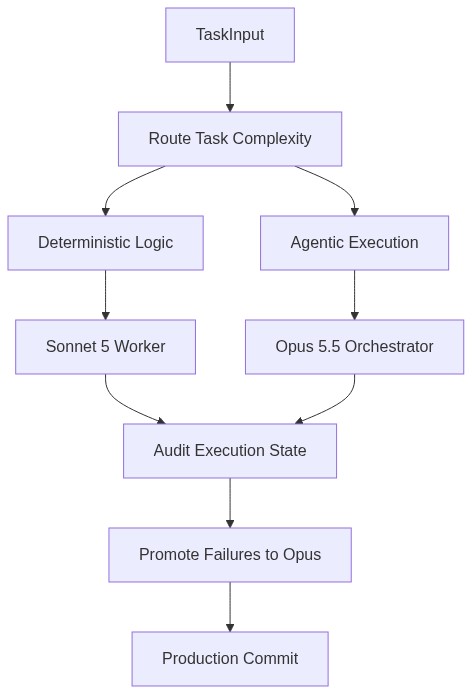
To capture maximum capability without budget bloat, implement the R-E-A-P Framework: Route, Evaluate, Audit, and Promote. Stop running monolithic model assignments. Route deterministic extraction to lightweight workers, evaluate branching difficulty dynamically, audit execution traces, and promote high-complexity tasks directly to Opus 5.5 before an unrecoverable failure cascades down your pipeline.
Bridging the Professional Output Threshold
On complex professional workflows, the performance gap compounds exponentially. The Artificial Analysis Intelligence Index rates Opus 5.5 at 58 versus Sonnet 5 at 38 (Source: Artificial Analysis). Furthermore, in professional task evaluations via GDPval-AA v2.1, Opus 5.5 logs 1,846 Elo against Sonnet 5 at 1,449 Elo—a massive 397-point margin (Source: Artificial Analysis). Across broader tests, the Vals Index overall confirms this with Opus 5.5 scoring 69.689% versus Sonnet 5 at 59.61% (Source: Vals Index).
Engineering for Compound Reliability
Architecting AI systems is not about minimizing raw API spend; it is about building reliable, unassisted systems. When your agent commands a 20-point composite intelligence advantage, human developers stop babysitting CI/CD outputs and return to core product architecture. Choose your models based on compound system success, not marginal token discounts.
Sources: Artificial Analysis | Vibe Code Bench | Vals Index
No comments:
Post a Comment