
Most teams build AI agents by piping every single button-click and decision branch through a massive reasoning model, running up massive latency and ballooning compute bills. The asymmetric advantage belongs to teams decoupling deliberation from reflex: routing fast, structured choices through a dedicated decision engine while reserving generative models exclusively for prose.
The $0.05 Flaw Paralyzing Modern Autonomous Agents
When an agent navigates a web portal or triages a triage queue, 90% of its runtime actions are not creative. They are discrete routing decisions: click button A, classify event B, or escalate ticket C. Routing these split-second micro-decisions to a multi-billion-parameter model causes chronic latency traps and massive token waste.
Your system does not have a reasoning problem; it has a reflex allocation problem. Humans do not activate the prefrontal cortex to pull a hand away from a hot stove. In autonomous pipelines, forcing a heavyweight model to parse a structured decision-tree creates compounding delays. In benchmark internal workflow evaluations, conventional model chains buckle under latency, whereas a decision-only design delivers response times of 70–500 ms with reported 194x speed gains and 445x lower costs (Source: TypeSafe, cited in [15][18]). Eliminating text generation from the execution loop restores agent throughput.
The Human Brain Split You Are Ignoring in Software
Cognitive psychologist Daniel Kahneman mapped human thought into two engines: System 1 (instinctive, rapid, unconscious) and System 2 (deliberate, analytical, slow). Modern software architectures repeatedly force System 2 models to handle basic System 1 reflexes.
Think of a seasoned racecar driver. The driver does not run a mathematical physics simulation to tap the brakes into a sharp turn; muscle memory executes the turn in milliseconds. Deep cognitive analysis only fires when unexpected engine smoke appears. Jev System One design embodies this principle. It strips away prose generation, temperature sampling, and token-by-token decoding. Instead, it emits structured state transitions. By deploying Jev strictly as a fast reflex engine, teams eliminate the conversational overhead that cripples interactive browser agents and real-time classification pipes.
The FAST Framework for Decoupled Agent Execution
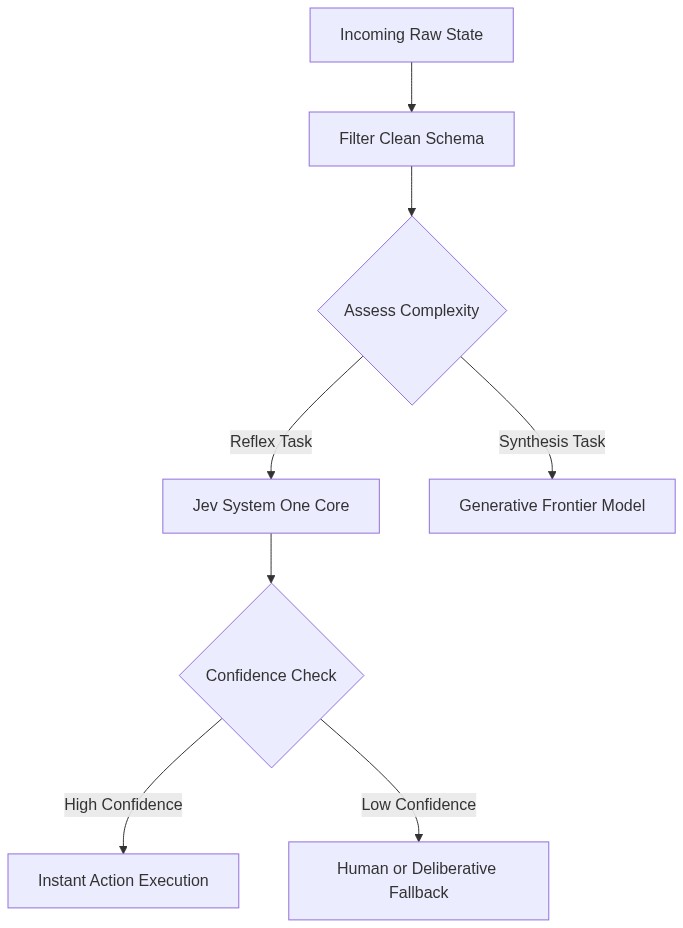
To build resilient pipelines, implement the FAST Framework: Filter, Assess, Split, and Trigger.
First, Filter the incoming state into pure schema, stripping unstructured prose. Second, Assess path complexity: does this state require creative reasoning, or is it a selection among fixed valid options? Third, Split execution: funnel reflex tasks to a System 1 engine like Jev, while routing creative synthesis to a text generator. Fourth, Trigger programmatic fallbacks whenever decision confidence dips below predetermined safety thresholds.
In TypeSafe's public benchmark across 4 workflow tasks—security alerts, support-agent traces, vendor invoices, and customer-service response selection—this decision-only pattern formed the foundation for evaluating deterministic operational accuracy without generative bloat (Source: TypeSafe [17]).
Anatomy of an Automation Failure: The Zurich Flight Experiment
Consider what happens when you pit raw LLM reasoning against dynamic web pages. Traditional agents fail because rendering latency and token output bottlenecks desynchronize the agent from DOM updates, timing out checkout forms and flight search portals.
In an end-to-end browser execution test, an agent was tasked with executing a multi-step flight booking flow. By decoupling actions, Jev completed the Zurich-to-London search in about 7 seconds at a total execution cost of $0.0039, utilizing Jev exclusively for deterministic navigational choices while calling an auxiliary small model solely for text field insertion (Source: Google Flights browser task [1]). Across general internal workflow tests, Jev demonstrated an average 67.8% agreement with reference answers at 0.4 seconds per case and $0.0004 per case (Source: TypeSafe [4][7]). Speed enables live recovery.
High-Frequency Telemetry: Doom Loops and Support Triage
When state transitions exceed standard operational frequencies, monolithic architectures crash entirely. In real-time stress testing, engineers deployed a reactive bot powered by Jev across a Doom-style simulation environment at 10 queries per second, maintaining continuous system stability at an operating cost of roughly $7 per hour (Source: Industry report [11]).
This exact high-frequency throughput maps directly to enterprise operations. In production support operations, Kanerika implemented a member-support agent powered by Jev that resolves 65% of member queries instantly, routing low-confidence edge cases to live human executives (Source: Kanerika [6]). The reflex engine acts as a tireless first-line gatekeeper, shielding human teams and expensive compute pools from high-volume, low-ambiguity friction.
Building the Autonomous Reflex Core of Next-Gen Infrastructure
Building production-grade AI systems requires acknowledging an uncomfortable truth: raw parameter count is a clumsy substitute for architectural discipline. Treating every API call as an essay-writing contest yields bloated unit economics, fragile latencies, and frustrated users.
When you introduce a specialized reflex layer like Jev System One, you free your analytical models to handle genuine, high-context ambiguity. You transform erratic agents into predictable, high-speed micro-engines capable of operating at the speed of the web. The future of autonomous automation will not be won by models that think endlessly about trivial actions, but by modular systems that react instantly, accurately, and at near-zero marginal cost.
Sources: Google Flights browser task [1] | TypeSafe workflow evaluations [4][7] | Kanerika member-support report [6] | Industry report on Doom-style stress testing [11] | TypeSafe benchmark and early-access reports [15][17][18]

No comments:
Post a Comment