Most engineering teams pour millions into automated alerts, yet they remain tethered to pagers because their software is functionally brittle. The real competitive moat is not building systems that never break, but engineering autonomous architectures that diagnose, rewrite, and heal themselves mid-flight.
The Pager Duty Delusion
Engineering leaders mistake alert volume for system observability. You wire up dashboards and call it reliability, yet human triage remains the ultimate bottleneck. When a distributed pipeline fails at 3 AM, a human engineer must wake up, parse logs, reproduce context, formulate a hotfix, and deploy. This manual feedback loop is not resilience; it is a structural tax on engineering velocity. True resilience requires shifting from passive monitoring to closed-loop autonomy. If your infrastructure relies on manual intervention to survive network partitioning or dependency corruption, you do not have a modern distributed system—you have a fragile monolith wrapped in expensive telemetry.
The 5-Engine Anatomy of Autonomous Systems
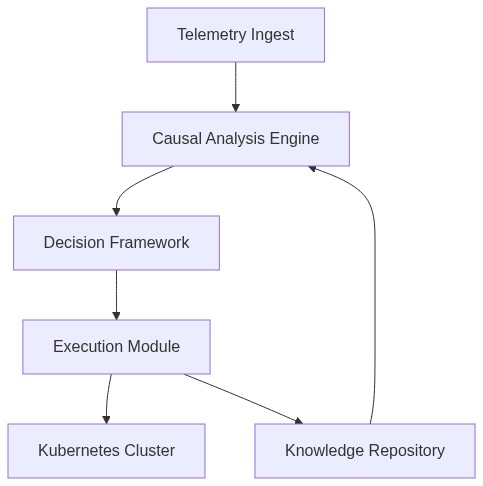
Production self-healing is not magic; it operates like the human immune system. White blood cells do not consult a human manual to attack a pathogen—they detect anomalies, generate targeted responses, execute neutralizations, and catalog memory for the future. Enterprise systems mimic this biology through five decoupled modules: monitoring layers, analysis engines, decision frameworks, execution modules, and knowledge repositories (Source: Self-healing enterprise applications review). The monitoring layer senses drift, the analysis engine models causality, the decision framework synthesizes remediation steps, the execution engine enforces changes, and the knowledge repository updates state records. Without these five engines running in lockstep, closed-loop autonomy collapses into brittle, rule-based scripting.
The M.E.N.D. Framework for Runtime Recovery
To build an autonomous self-evolving stack, apply the M.E.N.D. Framework: Measure, Evaluate, Neutralize, Document. Standard implementations rely on Kubernetes, Istio, Linkerd, and Keptn to orchestrate traffic management, cluster control, and SLO-based remediation (Source: Autonomous Stack study). First, Measure state via telemetry sidecars. Second, Evaluate failure root causes through causal graphs. Third, Neutralize anomalies dynamically using automated canary routing or localized micro-patches. Fourth, Document state mutations to continuously train future models. This discipline allows environments to survive cascade failures without human oversight.
When Root Cause Analysis Scales Beyond Human Limits
The primary roadblock in distributed networks is not remediation speed, but root cause isolation. A cascaded failure can trigger 10,000 downstream error alerts within seconds, masking the original point of failure. In large-scale carrier backbones, simple heuristic parsing fails completely. Real-world validation from Vodafone demonstrated that deploying a hybrid causal and graph-based AI framework achieved an F1 score of 0.86, an AUC of 0.92, and an accuracy of 0.94 on complex backbone-network fault diagnosis (Source: Vodafone backbone network case study). By mathematically tracing graph topologies rather than parsing linear log streams, systems isolate the exact failing node within seconds.
Self-Evolving Code and the 17-Second Horizon
Beyond infrastructure, self-evolving code represents the cutting edge of runtime repair. In a 30-day Apache Kafka study, an autonomous AI code generation engine detected and fixed 23 critical bugs, 67 performance bottlenecks, and 156 code-quality problems, clocking 91.3% accuracy with 89.1% of fixes accepted as production-ready, saving 340 hours of developer time (Source: Apache Kafka self-healing AI study). When combined with cloud orchestrators, recovery speed drops dramatically: empirical benchmarks reveal systems reducing MTTD to 17 seconds and MTTR to 22 seconds (Source: AI-enhanced self-healing cloud infrastructure study), leaving rule-based automation far behind.
Surviving Nine Chained Catastrophes
Theory breaks down under harsh production chaos. Consider the Zeltrex Night Shift autonomous development platform, built on a 6-layer self-healing framework. Over 17 days, the agent executed 323 tasks across 8 model providers. During this window, it encountered 9 chained infrastructure faults causing 3 days of downtime, yet automatically recovered in all but one case (Source: Zeltrex Night Shift platform). The single failure revealed that even adaptive agents need deterministic fallback protocols. When autonomous code synthesis, causal graph diagnosis, and decoupled orchestration converge, your systems cease being static artifacts and become durable, living digital organisms.
Sources: Zeltrex Night Shift platform study | Apache Kafka self-healing AI code generation study | Vodafone backbone network case study | AI-enhanced self-healing cloud infrastructure study | Autonomous Stack / Kubernetes + Istio + Keptn implementations | Self-healing enterprise applications review

No comments:
Post a Comment