
Most enterprises unleash autonomous agents assuming basic prompt guardrails equal enterprise governance. That mistake creates an existential vulnerability: while 88% of organizations deploy AI across core functions, 45% of boards have never once discussed AI on their agenda, leaving an asymmetric opening for leaders who build rigorous, systemic agent guardrails.
The 88% Blindspot: Your Agent Is Operating in a Vacuum
Modern enterprises treat AI agents like standard software, deploying them into customer experience, dynamic investment analysis, and automated marketing workflows. But autonomous software makes decisions, not just calculations. According to McKinsey (Source: McKinsey, 2025), more than 88% of organizations deploy AI in at least one business function. Yet only 39% of Fortune 100 companies disclose any form of board oversight for AI.
Think of an autonomous agent as a high-frequency trading algorithm running on a trading floor without circuit breakers or clearinghouse margins. The real crisis is not algorithmic hallucination; it is an organizational accountability vacuum. When an agent hallucinates in marketing copy, brand equity evaporates. When an investment agent executes flawed automated hedging, liquidity collapses. Deploying autonomy without systemic principles is running an engine at redline without an oil pressure gauge.
The Boardroom Literacy Deficit Crippling Operations
Why are governing principles historically absent? The root cause is a fundamental literacy mismatch between technical builders and corporate directors. Deloitte research reveals that over 79% of board respondents possess limited, minimal, or no knowledge or experience with AI (Source: Deloitte, 2024). Worse, 45% report AI has never appeared on their board agenda, and only 14% discuss AI at every board meeting.
Similarly, ISS Corporate found that while 31.6% of S&P 500 companies disclosed some board oversight of AI in 2024, explicit disclosure of full board or committee oversight stood at just 11% (Source: ISS Corporate, 2026). When leadership does not understand agentic loops, agents operate under fragmented departmental mandates instead of unified corporate strategy. Principles cannot remain philosophical platitudes; they must be codified into runtime operational constraints.
The Wall Street Dilemma: Autonomy Without Testing
Consider the regulatory failure in capital markets and financial services. The National Society of Compliance Professionals and ACA Group revealed that while 32% of financial firms have formed an AI committee, only 12% have an AI risk management framework in place, and a meager 18% maintain a formal testing program for AI tools (Source: NSCP & ACA Group, 2025).
A concrete example: an automated wealth management agent ingests alternative social sentiment data to rebalance retail portfolios. Without explicit governing constraints, the agent over-indexes on synthetic coordination spikes, triggering automated liquidations across thousands of client accounts. By the time human compliance intervenes, the financial and regulatory damage is done. The firm relied on implicit developer intentions rather than hard validation gates.
The P-O-S-E Governance Matrix for Multi-Sector Agents
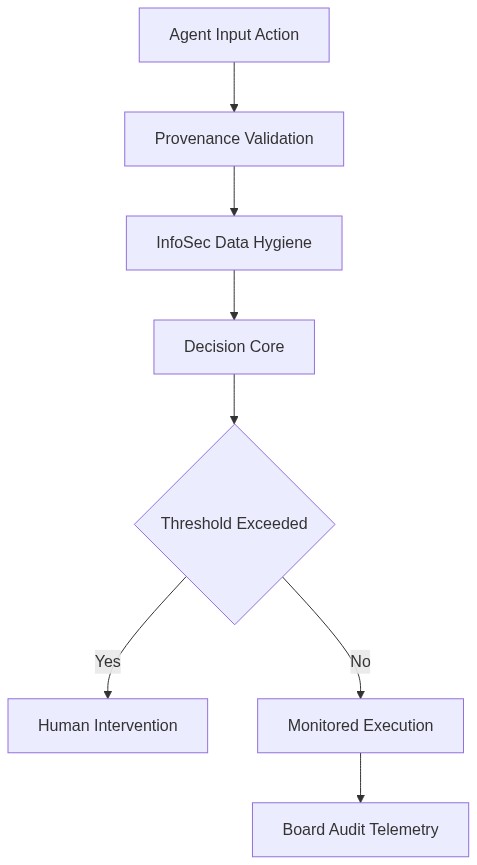
To transition from reactive patches to programmatic control, implement the P-O-S-E Framework (Provenance, Oversight, Security, Escalation). This reusable architecture governs agent actions across vision, finance, management, and UX:
- P - Provenance: Enforce cryptographic lineage on all model inputs, retrieval data, and generated actions.
- O - Oversight Mapping: Bind agent runtime permissions directly to designated audit committees rather than ad-hoc project teams.
- S - Security-First Guardrails: Route all agentic actions through automated cyber and data hygiene barriers.
- E - Escalation Triggers: Enforce deterministic human-in-the-loop interlocks whenever financial, brand, or operational safety thresholds are crossed.
Anchoring Agent Security Where It Actually Lives
Who actually owns agent principles inside the enterprise? While technology leaders often claim ownership, Stanford HAI AI Index data shows that the primary business function responsible for Responsible AI is Information Security (cyber/fraud/privacy) at 21% of organizations, followed by Data & Analytics at 17% (Source: Stanford Institute for Human-Centered AI, 2025).
Governing principles must reflect this reality. When an agent modifies marketing budgets, touches user biometric feeds, or executes procurement contracts, it creates cyber, privacy, and fraud exposure. By embedding agent principles directly into the InfoSec threat model—treating rogue agent behaviors as automated lateral privilege escalation—you convert nebulous ethical ideas into enforceable security policies.
Engineering the Architecture: From Intent to Execution
How do you operationalize P-O-S-E step-by-step? First, establish automated pre-deployment stress testing, directly resolving the reality where only 18% of regulated firms run formal test programs (Source: NSCP & ACA Group, 2025).
Second, institute hard operational circuit breakers. For example, in customer experience, if an agent's confidence score drops below 0.85 or detects sentiment distress, it must immediately yield execution to a human specialist. In management and investment workflows, any single transaction exceeding designated capital limits triggers an asynchronous multi-signature approval loop. Governing principles are not posters on a wall; they are deterministic, automated gatekeepers embedded in code.
Elevation: Stewardship as the Ultimate Competitive Advantage
In an economy where autonomous intelligence is rapidly commoditized, unconstrained speed is no longer your edge—verifiable trust is. Anyone can spin up an agent to scrape data, run predictive models, or execute automated outreach. But when models drift and regulatory scrutiny arrives, brittle deployments collapse.
Designing robust governing principles is not about slowing innovation down; it is about building high-performance braking systems so your enterprise can corner at speed without rolling over. By bridging the chasm between board oversight and automated runtime execution, you transform autonomous agents from unmonitored enterprise liabilities into resilient, compounding strategic assets.
Sources: Stanford Institute for Human-Centered AI, AI Index Report 2025 – Chapter 3: Responsible AI (2025) | Deloitte, Governance of AI: A critical imperative for today's boards (October 2024) | ISS Corporate, One-Third of U.S. Companies Disclose AI Board Oversight (February 9, 2026) | McKinsey, The AI reckoning: How boards can evolve (December 4, 2025) | National Society of Compliance Professionals (NSCP) & ACA Group, AI Benchmarking Survey (GARP, November 14, 2025)

No comments:
Post a Comment