Most engineering teams assume Claude Code Routines are the holy grail for replacing flaky end-to-end beta runs, but deploying them into your quality pipeline right now guarantees silent test failures and broken feedback loops.
The Illusion of Drop-In Agentic Quality Assurance
Engineering leads love the promise of autonomous agentic validation: point an LLM at an open pull request, let it explore like an unpredictable human beta tester, and receive actionable defect reports. But treating Claude Code Routines as a test runner fundamentally misunderstands what Anthropic built. Routines are designed for scheduled background housekeeping, not high-volume deterministic verification. When teams swap traditional CI/CD beta harnesses for routines, they quickly discover that agent autonomy without testing infrastructure yields chaos rather than coverage.
The Five-Run Ceiling That Stalls Continuous Delivery
The real bottleneck in autonomous testing is not model intelligence; it is execution mechanics. Official Anthropic documentation states that routines are capped at just 5 runs/day for Pro, 15 for Max, and 25 for Team/Enterprise users (Source: Anthropic Docs). Even under API execution, single routines cap out at 30 fires/hour with an account ceiling of 100 API fires/hour (Source: Anthropic Platform Docs). A standard beta testing pipeline must process dozens of commits, staging pushes, and matrix configurations every single morning. Hitting an execution ceiling by 10 AM completely paralyzes delivery.
Silent Discards and the Ephemeral Beta Interface
Imagine a factory assembly line where every tenth car simply vanishes off the conveyor belt into thin air without ringing an alarm. That is the current reality of webhook-triggered routines. Official documentation warns that excess GitHub webhook events beyond hourly thresholds are silently dropped until the window resets (Source: Anthropic Docs). Furthermore, the underlying /fire endpoint relies on the experimental-cc-routine-2026-04-01 beta header, with Anthropic explicitly flagging that behavior, limits, and the API surface may change (Source: Anthropic Docs). Building automated quality gates on shifting API foundations creates unstable infrastructure.
The P-A-T-H Framework for Routing Operational Automation
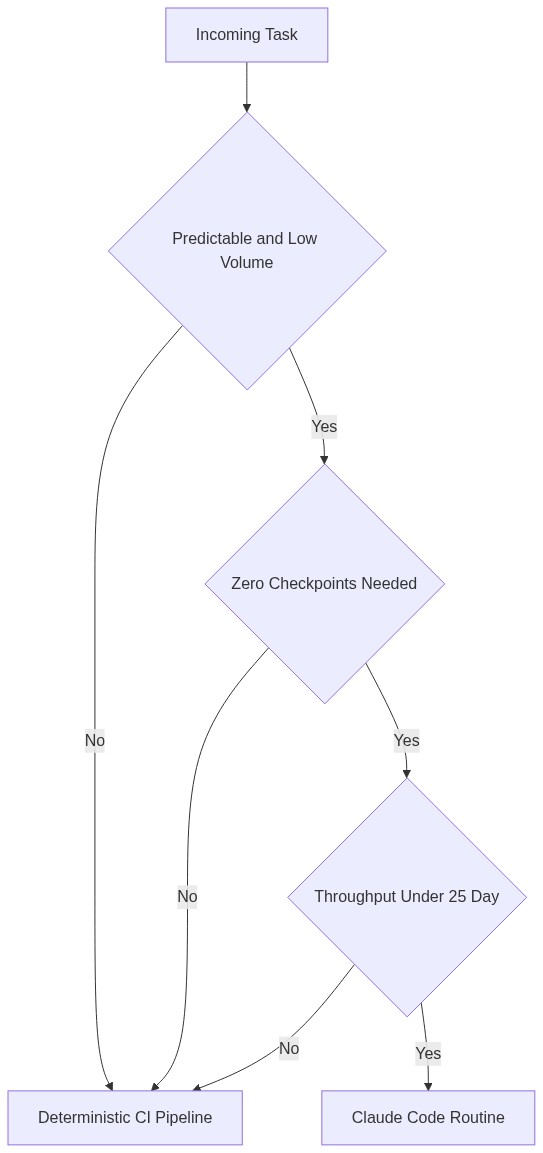
To prevent infrastructure outages, evaluate every candidate workflow through the PATH Framework: Predictability (does the task tolerate non-deterministic timelines?), Approval (can the action safely run without a human checkpoint?), Throughput (does the daily volume comfortably fit within 25 runs?), and Heuristics (are failure states observable via standard diffs?). Automated beta testing fails all four criteria: it requires instant execution, multi-stage approval checkpoints, hundreds of hourly runs, and deterministic assertions. If a workflow fails any criteria in PATH, it belongs in standard CI, not routines.
Where Routines Actually Excel: The Drift Detection Pattern
Real-world engineering case studies reveal where routines actually deliver asymmetric upside: low-frequency, high-context operational hygiene. In a documented practitioner deployment, teams successfully used routines for weekly documentation drift detection rather than beta execution (Source: Practitioner Case Study). Because routines feature no approval checkpoints and run fully autonomously, practitioners explicitly warned that the feature is too early for production-critical paths (Source: Practitioner Case Study). Running autonomous agents where mistakes commit straight to codebases is catastrophic for beta tests, but invaluable for asynchronously catching stale markdown.
Architecting Resilience Beyond the Research Preview
Great automation is not about throwing experimental models at brittle pipelines; it is about respecting the architectural boundaries of your toolchain. Claude Routines represent a genuine breakthrough for autonomous, low-frequency workspace maintenance. Keep your continuous testing deterministic inside battle-tested orchestration harnesses, and isolate research-preview agents to asynchronous audit layers. By designing around hard platform limits today, you position your infrastructure to adopt true autonomous test runners the exact moment the underlying platform matures.
Sources: Anthropic Docs | Anthropic Platform Docs | Practitioner Case Study
No comments:
Post a Comment