
Most engineering teams obsess over chunking strategies and embedding models, assuming generation errors stem from weak semantic search. They don't. Your retrieval-augmented generation pipeline is silently hallucinating because your vector index acts as an append-only swamp of conflicting historical truths—giving your LLM authoritative access to yesterday's obsolete facts.
The Silent Decay of Vector Stores
When enterprise systems ingest updates, engineers usually append new vector embeddings alongside the old ones. The embedding space doesn't know time; it only measures semantic proximity. A prompt asking for standard operating procedures will match both a 2021 draft and a 2024 revision with near-identical cosine similarity.
Consider a real failure documented by Earley Information Science: a medical device company's RAG system repeatedly retrieved outdated cleaning procedures during audits (Source: Earley Information Science). The issue wasn't retrieval math; it was temporal blindness. Think of unversioned RAG like a library where librarians shelve every revised draft right next to the current edition without changing the cover date. The AI simply grabs the closest book on the shelf.
Your Bottleneck Is Not Semantic Search
The root cause of enterprise RAG failure is not vector distance—it is the absence of temporal provenance. In regulated environments managing 50,000+ documents, such as pharmaceutical enterprises (Source: DZone), treating your index as a monolithic entity creates catastrophic compliance risks.
Without explicit state tracking, you cannot reproduce an answer generated three weeks ago. When a clinical operations system changes prompts, schemas, or embedding models, it alters retrieval behavior unpredictably (Source: Clinical RAG Governance Paper). If your AI recommends an outdated dosage or deprecated API parameter, you cannot diagnose the failure without knowing the exact state of three moving targets: your underlying data index, your embedding pipeline, and your system prompts.
The P.A.V.E. Governance Architecture
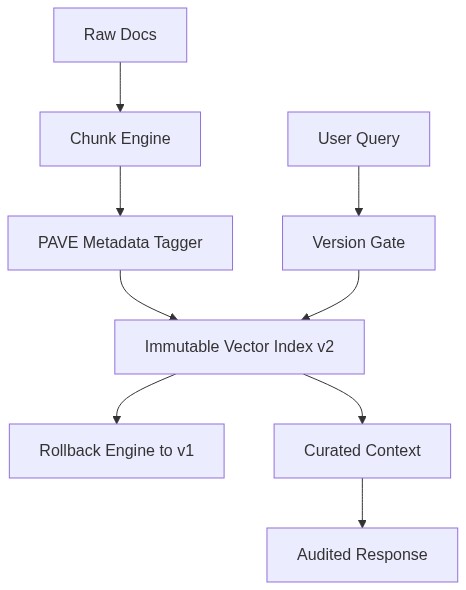
To build deterministic retrieval, implement the P.A.V.E. Framework (Provenance, Attributes, Versioning, Expiry). This operational model shifts your architecture from an append-only dump to an immutable, reproducible pipeline.
First, pin your Provenance by creating frozen retrieval bundles combining prompt templates, schema definitions, and model checkpoints. Second, enforce rich chunk-level Attributes. Earley Information Science demonstrated that tagging chunks with document status, product model, configuration, region, version, and safety relevance dramatically improved retrieval precision for validated procedures (Source: Earley Information Science).
Third, bind Versioning directly to retrieval indices, replicating the pattern used in Splunk's BridgeIT RAG-as-a-Service, which deploys explicit version control and instant rollback capabilities across indices (Source: Splunk BridgeIT). Fourth, configure Expiry using time-based decay curves to deprioritize stale documentation, a critical requirement identified by Danswer enterprise deployments (Source: ZenML).
Engineering the Deterministic Retrieval Loop
Implementing versioned RAG requires shifting from raw similarity queries to metadata-filtered candidate generation. When a user queries your system, your orchestrator must inject deterministic guardrails before vector calculation occurs.
``python # Metadata filtering prevents temporal leakage retriever.search( query="sterilization protocol", filters={ "document_status": "approved", "version": "2.4", "region": "US-FDA", "is_active": True } ) `` Splunk implemented strict version control and rollback mechanisms across retrieval indices and model checkpoints precisely to guarantee auditability over time (Source: Splunk BridgeIT). If an index update introduces corrupted embeddings or poisoned contexts, automated rollback mechanisms instantly repoint your retrieval endpoint to the prior pinned snapshot.
The Audit Trail: Replay, Rollback, and Release
Version control unlocks dynamic state reconstruction. In regulated clinical operations, standard guidance mandates a frozen, auditable retrieval bundle that logs model, prompt, schema, and RAG index versions together (Source: Clinical RAG Governance Paper).
This guarantees exact replayability: if a compliance auditor flags an answer generated on March 14th, the engineering team can spin up an isolated runtime matching that exact snapshot and observe the deterministic input context. Furthermore, ZenML notes that enterprise Danswer users explicitly require automated time-based decay algorithms, ensuring documents untouched for extended periods naturally lose ranking authority (Source: ZenML). By treating retrieval state as compiled software artifacts, version control transforms unstable AI outputs into verifiable enterprise assets.
From Stochastic Demos to Immutable Systems
The real divide between fragile generative AI proofs-of-concept and mission-critical enterprise infrastructure is reproducible discipline. Managing RAG without version control is equivalent to deploying raw database edits directly into production without Git.
When you enforce strict version control, metadata validation, and immutable index snapshots, your AI ceases to be a probabilistic toy guessing against stale data. It becomes an auditable, governed intelligence engine capable of defending every answer it provides.
Sources: Splunk BridgeIT RAG-as-a-Service | Earley Information Science | DZone Enterprise RAG | ZenML Danswer Analysis | Clinical RAG Governance Paper
No comments:
Post a Comment