
Most teams believe that winning with enterprise AI is an algorithmic sprint: deploy the strongest foundation model, claim the top spot, and watch dominance compound. In reality, modern models possess just enough static context to capture leadership today, but lack the continuous operational context required to discover shifting ground and stay number one tomorrow.
The Illusion of Static Dominance
Reaching first place with AI creates false security. You wire an advanced model to raw data, run a pilot, and celebrate early wins. Yet enterprise data shows a severe disconnect: in a survey of 1,002 U.S. knowledge workers, only 12% reported that their AI understood the company as well as a senior employee, while 45% compared its capability to an unonboarded new hire (Source: Want more confidence in AI? Give it more context. - Atlassian). Worse, while 77% recognized institutional knowledge as vital, only 21% believed their AI actually retained it (Source: Want more confidence in AI? Give it more context. - Atlassian). Your model might synthesize a baseline playbook to take the lead, but without continuous institutional context, it behaves like a temporary contractor who cannot spot emerging competitive threats or systemic shifts.
The Real Bottleneck Is Not Your Model
When enterprise AI stumbles after initial rollout, executives typically blame prompt quality or model choice. The root cause is fundamentally different: it is not algorithmic intelligence, but context architecture. Think of an enterprise LLM as a world-class Formula 1 driver. If you drop that driver onto an unmapped track with a cracked windshield and disconnected telemetry, raw driving skill guarantees a crash. When surveyed across 250 IT and data leaders, 87% cited data readiness as their primary roadblock to production, 61% frequently delayed AI deployments due to distrusted data, and 66% suffered biased or misleading outputs stemming directly from immature infrastructure (Source: What Is Context Management? Your 2026 Guide - DataHub). Without structured lineage and living business rules, high-speed execution simply accelerates failure.
The Anatomy of Context Starvation
Consider what happens when enterprise agents rely solely on raw data tables. Miro observed this failure mode firsthand: their analytics agent initially queried raw Snowflake metadata alone and correctly answered only about 50% of benchmark queries (Source: What Is Context Management? Your 2026 Guide - DataHub). Half the time, the agent produced incorrect conclusions because schema definitions lacked operational meaning. Only after Miro integrated query history, cross-system signals, and real-world business definitions did benchmark accuracy jump to roughly 90% (Source: What Is Context Management? Your 2026 Guide - DataHub). Without ambient operational signals, an agent cannot discern whether a sudden metric drop signifies a supply disruption or merely a tracking change. The lesson is clear: models cannot defend market leadership using isolated database columns.
The ARC Engine for Sustained Primacy
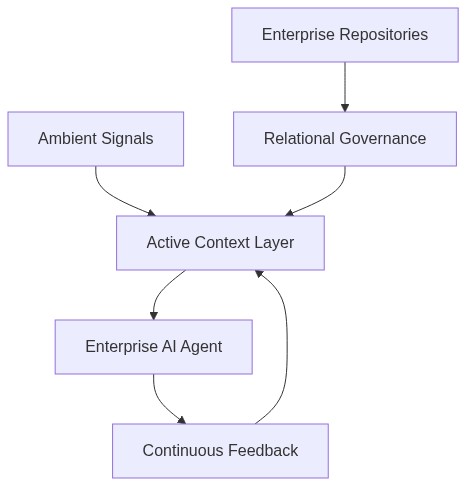
To transition from a temporary peak to sustained dominance, enterprises must replace static retrieval with the ARC Framework (Ambient signals, Relational governance, Continuous feedback). Instead of querying disconnected repositories, ARC builds an active nervous system: Ambient signals capture live operational traffic and query logs; Relational governance establishes canonical business terms across legacy borders; and Continuous feedback loops real-time agent discoveries back into enterprise memory. When Pinterest implemented this dedicated context layer, their analytics agent quickly achieved 10x the adoption of the next-most-used internal agent within two months and accelerated answer generation by 60x (Source: What Is Context Management? Your 2026 Guide - DataHub). Structured context turns a novelty tool into an indispensable competitive moat.
Escaping the Seven Percent Trap
Despite the clear rewards of context infrastructure, most enterprises remain paralyzed. Across industry benchmarks, only 7% of organizations have successfully operationalized agentic AI, while 40% remain bogged down in prolonged development cycles (Source: Which industries are ahead in agentic AI, and the common ...). In manufacturing environments, a meager 8% have brought agentic AI into active production, with 54% stalled directly by disconnected legacy systems (Source: Which industries are ahead in agentic AI, and the common ...). Teams fail to stay ahead because they attempt to build autonomous agents on top of siloed, blind repositories. Reaching operational status requires treating your corporate context pipeline not as an IT maintenance task, but as primary production infrastructure.
Owning the Horizon of Ambient Discovery
Sustained market leadership belongs to organizations that continuously feed external and internal discovery engines. In modern AI-search ecosystems across Google AI Mode, ChatGPT, Perplexity, and Gemini, Home Depot secured first position with an average 28.9% share of voice (Source: LLM visibility case study: How Home Depot is ...). They achieved this dominance not by training custom foundation models, but by broadcasting structured, authoritative context that multi-engine systems consistently trust. Winning the top spot is merely an initial transaction. Remaining there requires building a system where institutional knowledge, ambient telemetry, and governance evolve faster than your competitors can query them.
Sources: What Is Context Management? Your 2026 Guide - DataHub | Want more confidence in AI? Give it more context. - Atlassian | Which industries are ahead in agentic AI, and the common ... | LLM visibility case study: How Home Depot is ...
No comments:
Post a Comment