
Most teams believe feeding vast corporate archives or academic literature into an LLM will automatically surface break-through discoveries, but this confuses statistical fluency with genuine invention. Instead of creating new paradigms, language models excel at exotic recombination, leaving you with plausible hallucinations that waste research capital unless governed by strict empirical constraints.
The Surface Distance Trap
Language models create a seductive illusion of novelty. When prompted to generate breakthrough concepts, they produce syntax that looks radically unfamiliar, yet fundamentally circles the training perimeter. A comprehensive benchmark evaluating 8 models generating 524,308 hypotheses across 6 natural-science fields revealed this exact gap: while the generated hypotheses were up to 16% farther from existing work in lexical space, their median 'out-of-known-space' novelty was actually 15–23% lower than published human research (Source: Large Language Models Extend Known Research But Do Not Create New Research Directions).
Think of an LLM as a master mosaic artist working with an enormous crate of pre-existing colored glass tiles. It can assemble a pattern no human has ever laid down before, but it cannot manufacture a new mineral. The model reorganizes existing human tokens rather than generating unobserved truths about physical reality.
The Real Bottleneck Is Verifiability, Not Vocabulary
The failure to discover is not a failure of linguistic creativity; it is an architectural limitation of verification. LLMs struggle catastrophically when applied to domains characterized by low verifiability or very expensive checking costs (Source: PDF Open Problems Solved by LLMs? A Survey of Verifiable ...).
In pure mathematics or drug discovery, proposing a million plausible theorems is trivial. Verifying which ones are true without breaking physical or computational laws is the actual bottleneck. When an LLM asserts that a specific protein folding path or mathematical conjecture works, it cannot test its own assertion against empirical ground truth. If you cannot automate cheap, deterministic verification, an LLM simply multiplies unverified hypotheses, flooding researchers with noisy leads that take months to disprove manually.
When Specialized Data Collapses the Illusion
Discovery fundamentally requires operating at the sparse boundary of domain knowledge, which is precisely where standard auto-regressive models decay. Consider the breakdown that occurs when applying models to dense, proprietary environments. Experiments on enterprise tables show that model performance actively declines as table size and sparsity increase, causing models to produce the wrong number of labels and collapse basic table structure (Source: Unveiling Challenges for LLMs in Enterprise Data ...).
Furthermore, deep-seated public-source knowledge biases within base models consistently override specialized, rare internal data (Source: Unveiling Challenges for LLMs in Enterprise Data ...). If a genuine scientific or market anomaly appears in your internal data as a sparse signal, the model's Bayesian prior—trained on billions of common web tokens—smooths that anomaly away, mistaking a genuine discovery for statistical noise.
The Blindspot in Modern Validation
Why do so many organizations convince themselves their models are making discoveries? Because almost nobody actually checks. An analysis of 68 industry papers revealed that fewer than 15% conducted rigorous human evaluations of model outputs (Source: LLMs with Industrial Lens: Deciphering the Challenges and Prospects).
This lack of scrutiny trickles down from systemic organizational neglect. McKinsey survey findings indicate that only 21% of organizations maintain formal generative-AI policies, and a mere 32% actively address output inaccuracy through validation and monitoring frameworks (Source: Generative AI and LLMs in industry: a text-mining analysis and critical evaluation of guidelines and policy st). When organizations skip rigorous oversight, superficial fluency is mislabeled as strategic breakthrough, quietly polluting proprietary knowledge bases with ungrounded speculation.
The P-V-G Protocol for Grounded Insight
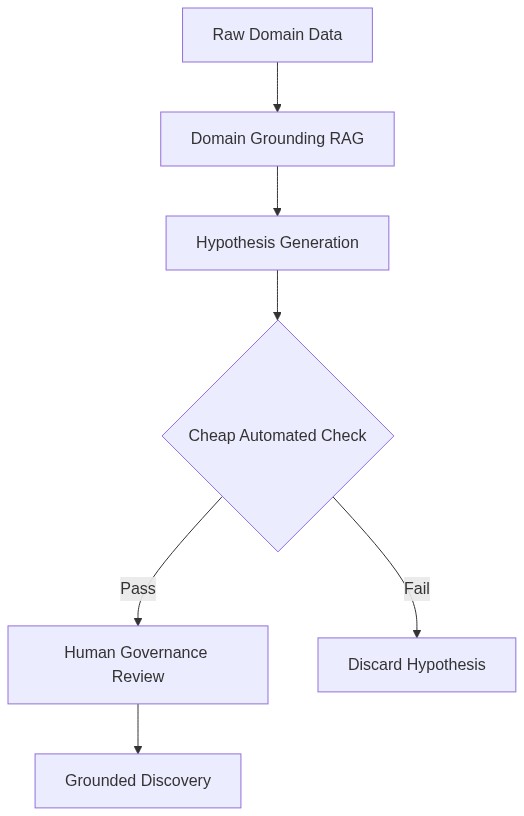
To turn generative systems from hallucinations into dependable discovery engines, you must invert the typical workflow through the P-V-G Framework: Prior Grounding, Verifiable Boundaries, and Governance Loops.
First, eliminate base-model priors by strictly isolating the context window with domain-retrieval mechanisms. For example, a news-aggregation company attempting to surface real business opportunities implemented retrieval-augmented generation on Llama 2, reaching 89% precision, 84.5% recall, and 85% accuracy only after rigorous domain grounding was enforced (Source: Business insights using RAG–LLMs: a review and case study).
Second, route outputs exclusively through automated verification pipelines. Third, require explicit human-in-the-loop checkpoints before any synthesized hypothesis enters the research pipeline.
Elevating the Machine from Oracle to Scout
The path forward requires abandoning the fantasy of the AI oracle. LLMs do not possess scientific intuition, nor do they understand the stubborn, physical resistance of an unsolved problem. What they offer is rapid, structured exploration of the combinatorial space we have already mapped.
When you stop asking models to be primary inventors and instead deploy them as constrained scouts governed by empirical verification, you protect your research teams from pursuing phantom breakthroughs. True discovery remains an arduous, human encounter with reality—AI simply sharpens the questions you bring to the frontier.
Sources: LLMs with Industrial Lens: Deciphering the Challenges and Prospects | Large Language Models Extend Known Research But Do Not Create New Research Directions | Unveiling Challenges for LLMs in Enterprise Data ... | PDF Open Problems Solved by LLMs? A Survey of Verifiable ... | Generative AI and LLMs in industry: a text-mining analysis and critical evaluation of guidelines and policy st | Business insights using RAG–LLMs: a review and case study
No comments:
Post a Comment