
Most engineering teams assume their coding agents fail because LLMs lack reasoning power, so they spend thousands upgrading models. The contrarian truth is that your model is fine; your context retrieval is broken. Shoveling raw GitHub repositories into context windows creates fatal hallucination loops, but building a specialized Retrieval-Augmented Generation pipeline gives your agent production-grade codebase comprehension.
The Illusion of Infinite Context Windows
Teams treat million-token context windows as a silver bullet, dumping entire folders into a prompt. When an agent attempts a refactor, it blindly breaks downstream dependencies or hallucinates deprecated library signatures. Consider the contrast: Nuvepro demonstrated that an agent equipped with verified context and automated tests cut engineer review time from 2 hours to 2 minutes (Source: Nuvepro). When context is precision-targeted, review overhead collapses. When context is an unindexed monolith, the agent gets lost in the noise. Dumping your entire directory tree into a prompt is like handing a software engineer 10,000 pages of unsorted paper printouts and demanding an instant architectural patch within five seconds. Humans rely on indexed symbols, semantic navigation, and dependency graphs. Your autonomous coding agent requires the exact same structural discipline to succeed.
The Real Bottleneck Is Syntax Ignorance
The root cause of broken agentic generation is not weak model reasoning; it is syntax-blind retrieval. Traditional RAG systems slice documents into arbitrary 500-token chunks with fixed character overlaps. If you slice a Python class or a Rust implementation mid-function, you sever the semantic scope, strip parameter definitions, and orphan local variables. To solve this, your ingestion pipeline must execute structure-aware chunking based on Abstract Syntax Trees rather than naive character counts. Industry leaders recognize this imperative: JetBrains Air Context specifically engineered its semantic code-search pipeline to parse 9 major languages using structure-aware chunking: Kotlin, Java, Python, JavaScript, TypeScript, C#, PHP, Go, and Rust (Source: JetBrains). When your vector index preserves semantic scope, your downstream agent inherits complete functional blocks instead of fractured, uncompilable tokens.
The PURE Framework for Autonomous Code Retrieval
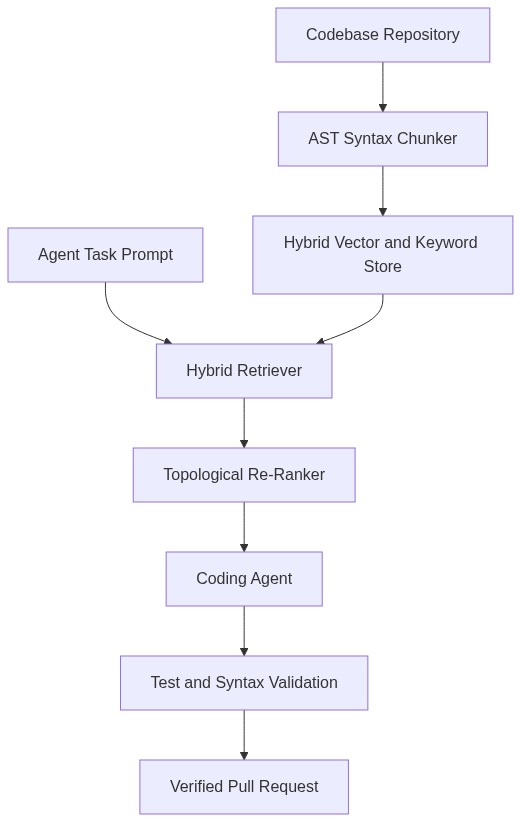
To build an enterprise-ready coding RAG pipeline, implement the PURE Framework: Parse AST nodes to capture classes, interfaces, and function boundaries intact; Unify sparse lexical matching with dense semantic embeddings using hybrid search; Re-rank retrieved chunks based on topological dependency and architectural graph proximity; Enforce validation loops where the agent compiles and tests the code before presenting it. Google Cloud deployed this multi-stage philosophy using a SequentialAgent pipeline with specialized nodes and an asynchronous crawler, indexing internal engineering knowledge into Google Cloud Vector Search with hybrid search (Source: Google Cloud). ActiveWizards applied a similar architecture, running autonomous agents that ingest an entire codebase via structural analysis and a RAG pipeline with FAISS to answer complex developer queries accurately (Source: ActiveWizards).
Tying Internal Documentation to Live Code
Code does not live in a vacuum; it is surrounded by architectural decisions, API documentation, and changelogs. If your agent only retrieves syntax chunks, it misses critical organizational rules, private SDK contracts, and compliance constraints. ZenML reported that eBay solved this gap by deploying an internal knowledge-base GPT built with RAG alongside Copilot and a custom code model, which drastically improved code acceptance rates, accelerated maintenance, and streamlined developer access to internal documentation (Source: ZenML). By pairing structured codebase retrieval with institutional knowledge bases, your agent ceases to write syntactically valid nonsense that violates internal design tokens or security standards. It grounds every single diff in documented, real-world team conventions.
Engineering for Enterprise Scale and Staleness
The silent killer of coding RAG systems is cache staleness. Codebases evolve across hundreds of pull requests daily. A vector store containing yesterday's API signature causes silent merge collisions. Consider the enterprise benchmark documented by Engineers of AI, which scaled a retrieval system across 5,000 employees and 200,000 internal documents (Source: Engineers of AI). At this scale, fresh indexing is not optional—it is critical infrastructure. Your pipeline must incorporate Git webhook triggers that invalidate outdated vector chunks on merge events and recalculate AST references asynchronously. Without continuous incremental re-indexing, an agent's confidence becomes its most dangerous attribute, generating code against phantom methods that your core team deleted three sprints ago.
From Fragmented Code Snippets to Autonomous Engineering
Elevating your development loop is not about outsourcing critical thought; it is about eliminating developer toil. When you provide an autonomous coding agent with a high-fidelity, structure-aware RAG pipeline, you transform software development from an error-prone scavenger hunt into rapid, verified execution. The future belongs to software engineers who architect resilient knowledge systems rather than manual patch-writers. By grounding your agents in real architectural context, you create self-healing development pipelines that amplify human ingenuity, turning complex technical debt into clear, automated iteration.
Sources: Google Cloud | JetBrains | ActiveWizards | Nuvepro | ZenML | Engineers of AI
No comments:
Post a Comment