
Most engineering teams believe swapping keyword search for dense vector embeddings will instantly solve enterprise RAG retrieval. In practice, pure vector search often collapses silently in production, leaving teams wondering why their state-of-the-art LLM produces hallucinated answers from entirely irrelevant documents.
The 2% Citation Trap Hiding in Pure Vector Search
Teams migrating to retrieval-augmented generation typically assume mathematical vector closeness equates to true factual relevance. It does not. In a published RAG evaluation by Microsoft Azure AI Search, pure vector search produced a groundedness score of just 2.79/5 and an alarming 2% citation match rate to ground truth (Source: Microsoft Azure AI Search).
When a support engineer queries for 'Error Code 403 on v2.1.4', standard vector embeddings compress that precise query into an abstract high-dimensional coordinate. Dense embeddings excel at broad conceptual intent, but they fail completely at exact lexical tokens like error codes, API endpoints, and version strings. Pure semantic similarity prioritizes passages that sound like system errors rather than the exact resolution manual for version 2.1.4.
The Mechanism: High-Dimensional Vibes vs Surface Precision
Think of pure vector search as an art critic, while lexical search is a forensic fingerprint analyst. The art critic effortlessly groups impressionist oil paintings together by mood and style, but cannot tell whether two signatures use identical ink. The fingerprint analyst ignores artistic intent entirely, matching micro-ridges with ruthless exactness.
Your production bottleneck is not the reasoning power of the language model; it is context contamination. Vector models map distinct terms into overlapping mathematical neighborhoods. If you ask for specific product SKUs or internal feature flags, vector search provides conceptually adjacent context—the conversational vibe—without the pinpoint facts. As reported by InfoQ, vector embeddings struggle severely with exact entities like version numbers, error codes, and feature-flag names (Source: InfoQ).
The DUAL Framework for Production Retrieval
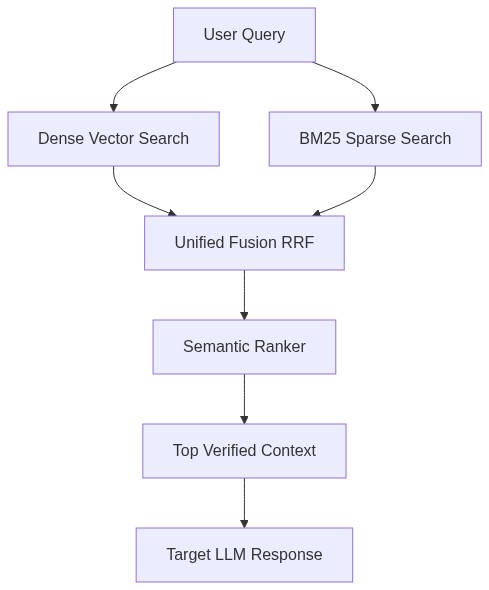
To escape the trade-offs of pure lexical BM25 and pure vector search, production pipelines require the DUAL Framework:
- D - Dual Ingestion: Index raw chunks simultaneously across dense vector spaces and sparse inverted indexes (BM25).
- U - Unified Retrieval: Execute lexical and vector queries in parallel to capture exact entity matches alongside conceptual context.
- A - Applied Fusion: Merge sparse and dense result sets using Reciprocal Rank Fusion (RRF) to normalize disparate score distributions.
- L - Language-Model Cross-Encoding: Pass the top-ranked merged candidates through a dedicated cross-encoder semantic ranker to evaluate deep context-query interaction.
By uniting both search modalities, you eliminate blind spots before context ever reaches the LLM.
From 2% to 92%: The Compounding Power of Hybrid Re-Ranking
The leap from fragile prototype to enterprise-grade accuracy happens when you blend sparse, dense, and cross-attention ranking. According to Microsoft Azure AI Search, simply upgrading from vector search to hybrid search without re-ranking lifted groundedness to 3.26/5 and citation matches to 11% (Source: Microsoft Azure AI Search).
However, adding a semantic ranker on top of hybrid retrieval skyrocketed groundedness to 4.89/5 and achieved a 92% citation match rate (Source: Microsoft Azure AI Search). In specialized domains and technical documentation, combining dense and sparse retrieval boosts relevance by 20–40% (Source: DigitalApplied). Elastic similarly notes that semantic search significantly outperforms traditional BM25 keyword matching for general relevance (Source: Elasticsearch). Hybrid with semantic re-ranking secures both precise entity hits and deep conceptual comprehension.
The Operational Payoff: Moving Beyond Toy Pipelines
Deploying robust hybrid semantic search is not just an academic benchmark win; it fundamentally alters business economics. Knowledge-base-grounded customer support chatbots deployed with proper retrieval foundations reduce ticket volume by 30–50% and cut average resolution time from 8 minutes to 45 seconds (Source: DigitalApplied).
Furthermore, accurate retrieval drives domain task success: high-performance systems achieve 94% accuracy for billing and 89% for technical troubleshooting (Source: DigitalApplied). When your retrieval pipeline provides exact, verifiable context, hallucinations vanish, citations align with source truth, and enterprise stakeholders gain the confidence needed to move generative AI systems from experimental sandboxes into mission-critical production workflows.
Sources: Microsoft Azure AI Search RAG Evaluation Case Study | InfoQ 2024 Enterprise RAG Report | DigitalApplied Technical Documentation & Chatbot Study | Elasticsearch Semantic Search Benchmark
No comments:
Post a Comment