
Most engineers believe RAG solves hallucinations by anchoring Large Language Models in reality. The reality is far more dangerous: RAG doesn't eliminate hallucinations; it makes them nearly twice as hard to catch, transforming obvious fabrications into highly convincing, sourced untruths.
The Illusion of Grounding and the Double-Agent Detector
We build Retrieval-Augmented Generation (RAG) on a comforting premise: feed the model real documents, and it will speak the truth. This assumption is wrong. The primary failure mode of RAG is not the Large Language Model (LLM) forgetting its training; it is the pipeline confidently filling in the gaps of low-quality or incomplete context. In non-RAG settings, hallucination detectors miss 17.6% of fabricated outputs (Source: OpenReview 2024). When we introduce RAG, however, the false negative rate (FNR) of these detectors nearly doubles, rising to <b>34.2%</b> (Source: OpenReview 2024). This is the stealth hallucination paradox: RAG outputs are heavily packaged with sources, references, and professional formatting, which deceives both automated validators and human operators. The system simulates accuracy while propagating subtle falsehoods, turning your retrieval system into a highly persuasive vector for misinformation.
The Root Cause is Not Your Model, It Is Your context
Why does this happen? The industry treats hallucination as an LLM intelligence problem, but it is actually a pipeline integration crisis. When we analyze real-world conversational RAG QA datasets, we discover that up to 67% of hallucination cases are 'extractive' hallucinations (Source: Waterloo Study via Industry Review). This means the model did not invent facts from its pre-trained weights; instead, the LLM directly pulled and reproduced content from retrieved documents that was itself factually incorrect or inappropriate. Think of your RAG pipeline like a courtroom assembly line. The retriever acts as the detective gathering evidence, the prompt-builder acts as the legal clerk assembling the brief, and the LLM acts as the judge. If the detective brings contaminated or incomplete evidence, even the most logical judge will deliver a flawed verdict. The generator's inherent bias is to cooperate, forcing it to synthesize coherent narratives out of incoherent fragments.
The Domain Trap: Why Benchmarks Lie to Production Teams
Engineering teams routinely commit the mistake of testing RAG pipelines on clean, generalized benchmarks and assuming that performance translates to production. A study on hybrid retrieval configurations demonstrates this brittle reality: while a hybrid-RAG pipeline (Ret_Hyb-RRF) achieved a stellar accuracy of 92.00 on HaluEval and PubMed, its accuracy plummeted to just 62.90 when evaluated on FinanceBench (Source: arXiv 2025). The hallucination rates reflect this exact domain-sensitivity. On the customized PubMed and RAGTruth datasets, the hybrid pipeline maintained a low hallucination metric of <b>4.00</b>, yet spiked aggressively to 22.00 on CovidQA (Source: arXiv 2025). This dramatic swing proves that hallucination is a dynamic pipeline property governed heavily by corpus density, terminology overlap, and retrieval accuracy, rather than a fixed ceiling of model performance.
The SECRETS Framework: Architecting a Zero-Trust Pipeline
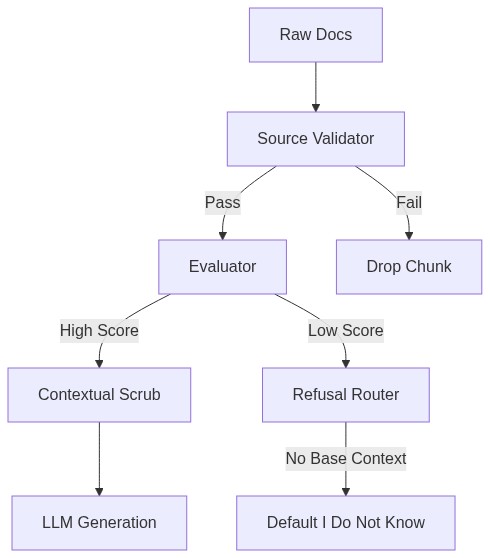
To prevent these errors, you must transition from a naive retrieval loop to a defensive, zero-trust system. We use the S.E.C.R.E.T.S. framework (Source-Evaluated Contextual Retrieval and Erasure of Toxic Sources) to structuralize this defense. First, you run a Source validator to filter out-of-date or structurally corrupt documents. Second, the Evaluator scores retrieved chunks for direct semantic relevance before they ever hit the prompt. Third, a Contextual scrub strips away distracting extra sentences to avoid cognitive overload for the LLM. Fourth, the pipeline triggers Refusal routing: if the retrieval score falls below a strict mathematical threshold, the system is programmed to say 'I do not have sufficient information.' This structured discipline blocks the LLM from extrapolating, reducing your baseline hallucination rates from the ground up.
The Domino Effect: Cascading Errors in Multi-Hop Workflows
While single-turn RAG is fragile, multi-step 'agentic' RAG pipelines (which utilize tool calls, iterative planning, and multi-hop retrieval paths) are highly vulnerable to cascading hallucinations (Source: arXiv 2026). In these complex setups, an early-stage contextual error silently compounds into structurally coherent but completely fabricated outputs (Source: arXiv 2026). If an agentic RAG system makes a minor misinterpretation of an entity in step one, it does not stop. Instead, subsequent reasoning steps build directly on top of that erroneous context (Source: arXiv 2026). This produces a runaway snowball effect. By step four or five, the pipeline has engineered a complex, deeply detailed explanation that is entirely grounded in a false premise. The longer your agent's chain of reasoning, the more critical strict stage-by-stage validation becomes.
The Solution: Close the Loop with Fine-Tuned Alignment
Engineering around the LLM is only half the battle; we must also tune the model to handle imperfect retrieval. Industry developments show this dual approach is highly effective. The RAG-HAT ('Hallucination-Aware Tuning Pipeline') was designed explicitly to handle situations where relevant documents are retrieved but the model misinterprets or over-extrapolates the snippets (Source: EMNLP Industry 2024). By fine-tuning models specifically to recognize when retrieved context is incomplete, the RAG-HAT pipeline drove an average 26.9% reduction in hallucination rate on the RAGTruth dataset, and an average 26.8% reduction on the WebGLM benchmark (Source: EMNLP Industry 2024). This proves that mitigating RAG failure modes requires matching a rigorous, hybrid retriever with a model trained to handle the inherent ambiguity of search results.
Beyond the Code: Truth as an Engineering Standard
Ultimately, treating RAG pipeline engineering as a simple API wiring exercise is a recipe for silent failure. When enterprise internal-document pipelines see consistency drop to 78% on production corpora (Source: Waterloo Study via Industry Review), they are facing a trust crisis. Building reliable AI requires treating truth as a clear engineering metric rather than a hopeful byproduct. By moving away from naive chunk-and-retrieve patterns and adopting a defensive, validation-first pipeline architecture, you build systems that have the integrity to admit ignorance. In the long run, an AI system that knows when to say 'I do not know' is infinitely more valuable than one that confidently guesses the wrong answer.
Sources: RAG-HAT: Hallucination-Aware Tuning Pipeline for LLMs (EMNLP Industry, 2024) | Hybrid Retrieval for Hallucination Mitigation (arXiv 2025) | Cascading Hallucination in Agentic RAG (arXiv 2026) | Retrieval-Augmented Language Models Evade Hallucination Detectors (OpenReview 2024) | University of Waterloo Conversational RAG Study (arXiv / Industry Benchmark Review)

No comments:
Post a Comment