
Most teams believe their AI agents fail because the underlying foundation model is not smart enough, so they churn through model upgrades. The contrarian reality: elite engineering teams do not swap models to hit production grade—they build rigorous feedback loops, turning brittle 60% completion rates into autonomous 86%+ reliability.
The Dangerous Mirage of Autonomous Self-Improvement
Teams often assume a truly modern agent should self-improve automatically on live production data. But throwing raw production traces into runtime prompt mutation without guardrails is like asking an engine to rebuild its own pistons while driving at 80 mph. Unconstrained feedback loops compound subtle bias, leading to silent model drift and catastrophic regressions. In a B2B SaaS support agent deployment, relying on loose runtime assumptions caused recurring billing API misinterpretations. Production failures were only eradicated when the team stopped chasing magical self-evolution and installed an offline annotation-to-eval CI gate (Source: B2B SaaS support agent eval pipeline). The real breakthrough in agentic AI is not skipping human-engineered validation, but knowing precisely when measurement must precede automated iteration.
Diagnosing the Root Cause: Your Model Is Not the Bottleneck
When an agent fails, developers reflexively blame context limits or reasoning power. Yet empirical data shows scaffolding and evaluation design dictate reliability. Consider benchmark results on Terminal Bench 2.0: researchers took deepagents-cli performance from 52.8% to 66.5% without changing the model, which was held strictly fixed at gpt-5.2-codex (Source: Deep agents / Terminal Bench 2.0). All gains came from middleware changes, refined system prompts, and reasoning-budget management. Similarly, in a multi-model sales intelligence study spanning 10 models and 18 metrics, granular dimensional diagnosis revealed that 69% of hallucination failures were merely prompt-induced interpretation errors rather than model limitations (Source: EvalLoop sales intelligence briefing generation). Diagnosing the pipeline consistently beats upgrading the LLM.
Eval Loops vs Self-Evolving Loops: The Core Mechanism
An Eval Loop is an observational diagnostic harness: it intercepts production traces, runs step-level scoring, and flags regressions before code ships. A Self-Evolving Loop is an automated optimization harness: it ingests structured execution signals from previous phases and dynamically adjusts prompts or tool routing without manual intervention. Think of an Eval Loop as a wind tunnel that pinpoints aerodynamic drag across components, while a Self-Evolving Loop is an adaptive wing flap that trims its angle mid-flight based on continuous sensor telemetry. You cannot build a safe adaptive wing until your wind tunnel provides calibrated, step-level metrics. Attempting a self-evolving system without an underlying eval loop guarantees uncontrolled drift.
The 4-Stage PACE Architecture for Agent Reliability
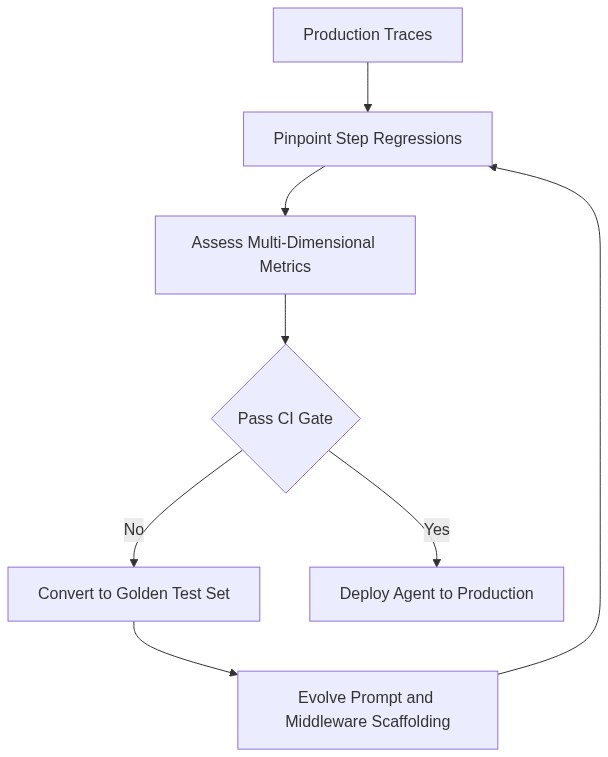
To graduate from brittle prototypes to production agents, apply the PACE framework: Pinpoint, Assess, Convert, and Evolve.
- Pinpoint Step Regressions: Track intermediate steps, not just final outputs. In production pilot cases, step-level monitoring caught a prompt regression where FDRec dropped 12 pp on account lookup and localized an LLM provider degradation strictly to code-generation steps (Source: AgentEval step-level regression detection).
- Assess Multi-Dimensional Scaffolding: Score outputs across distinct axes like synthesis and accuracy. In the EvalLoop benchmark, targeted prompt adjustments guided by dimensional metrics drove overall performance from 82.6% to 94.6%, unlocking a +16.8 pp lift in Content Accuracy and +26.4 pp in Synthesis Power (Source: EvalLoop sales intelligence briefing generation).
- Convert Failure Traces to Golden Sets: Follow LangChain recommendations by manually reviewing an initial batch of 20 to 50 production traces, transforming every failure into a unit test (Source: LangChain production-loop guidance).
- Evolve Scaffolding Safely: Automate iterative feedback once boundaries are hardened.
From 25% to 86%: When Self-Evolving Scaffolding Works
Once granular evaluation is active, you can safely deploy structured self-evolving mechanisms. When OpenAI’s forward-deployed team partnered with Thrive Holdings and Crete to build tax-prep agents across 30+ accounting firms, initial performance was unviable: only 25% of tax returns reached a 75% correct field completion threshold at launch (Source: OpenAI + Thrive Holdings / Crete tax returns). Rather than relying on manual code revisions for every edge case, the team established structured feedback channels from prior execution phases to guide harder tax filings. Within six weeks, correct field completion surged to 86%. Closed-loop telemetry converted multi-firm edge cases into immediate organizational accuracy.
Building the Release Gate: Slashing Critical Failures by 80%
The endgame for engineering leaders is converting raw production telemetry into an ironclad CI/CD pipeline. In the B2B SaaS support agent deployment, routing production annotation data into an automated eval gate reduced critical errors by 80% and boosted end-to-end task completion from 62% to 78% in just 8 weeks (Source: B2B SaaS support agent eval pipeline). Furthermore, support ticket reopens dropped to 14% because breaking changes—such as schema drift and API misinterpretations—were blocked in CI before reaching end users. High-performing engineering teams do not hope their agents behave; they mathematically gate every deployment on reproducible evaluation suites.
The Higher Standard: Engineering Trust in the Agent Era
Moving from experimental AI wrappers to industrial-grade autonomous agents requires a fundamental mindset shift. Models provide raw cognitive horsepower, but your evaluation architecture provides the steering, brakes, and safety cage. When you replace speculative prompt tweaking with systematic trace curation, dimensional analysis, and gated evolutionary cycles, reliability ceases to be an accident. You build software that compounds in intelligence daily, transforming fragile generative experiments into trustworthy, enterprise-grade infrastructure.
Sources: OpenAI + Thrive Holdings / Crete tax returns | B2B SaaS support agent eval pipeline | Deep agents / Terminal Bench 2.0 | EvalLoop sales intelligence briefing generation | AgentEval step-level regression detection | LangChain production-loop guidance

No comments:
Post a Comment